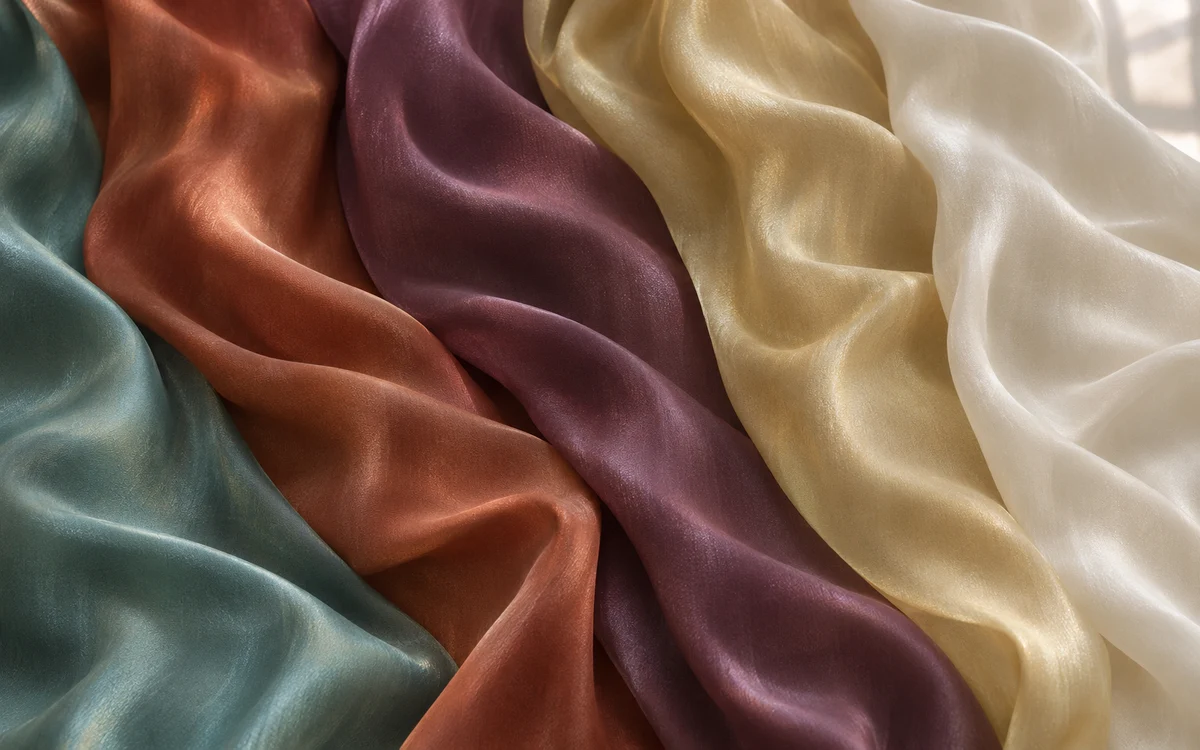
What is acetate fabric?
Acetate fabric contains a manufactured cellulose acetate fiber, commonly made using wood-derived cellulose that is chemically acetylated before spinning. It is often described as semi-synthetic because its feedstock includes cellulose but its fiber-forming material has been chemically modified. It is neither silk nor polyester.
In US textile labeling terminology, acetate is defined by its cellulose acetate composition; triacetate may be used when at least 92% of hydroxyl groups are acetylated. These names identify fibers, not a particular weave. [1]
Acetate can be woven into satin and other constructions, or blended with other fibers. Satin describes a fabric construction, not its composition. A glossy satin could therefore contain acetate, polyester, silk or a blend. Chinese market nicknames and translations such as “Yasha” are not a substitute for a written composition specification.
Acetate and triacetate are not interchangeable
Conventional acetate, often called diacetate in trade discussions, and triacetate differ in their chemical substitution and processing behavior. Do not assume that a care instruction, finishing temperature or performance claim for one applies to the other.
Ask whether a quotation covers acetate, triacetate or a blend, and request the fiber percentages. Brand names also matter only when supported by traceable product information. A named yarn portfolio can have specific tested properties that a generic “acetate-look” offer does not share.
Eastman’s Naia portfolio includes cellulose acetate products promoted for silky hand, color and comfort. Such producer information describes its own products; it does not establish the behavior of every finished acetate fabric. [2]
Properties: fluid drape, smooth hand and variable performance
The appeal of many acetate fabrics is a smooth hand, attractive luster and fluid drape. These qualities can help a dress, blouse or lining move elegantly, but yarn type, weave, weight and finishing all influence the result. A matte acetate blend can look very different from a glossy filament satin.
Avoid blanket promises that acetate is always anti-static, pill-proof, wrinkle-free or cooler than another material. Moisture uptake is a fiber property; breathability, drying behavior and next-to-skin comfort also depend on construction, finish and garment design. A moisture-regain percentage is not a breathability rating.
Evaluate the actual sample for opacity, surface snagging, seam slippage, rubbing marks and wrinkle recovery. For sleepwear, check movement, skin contact and repeated care rather than approving on shine alone.
Care and durability: approve the finished product
Some acetate fabrics need gentle handling, and conventional acetate can be vulnerable to wet handling and excessive heat. This does not justify one washing instruction for the entire category. Triacetate, blends and specially developed products may have different requirements.
Follow the finished garment’s validated care label. Before launch, test the intended washing or dry-cleaning route on the actual fabric, trims and construction. Check dimensional change, color transfer, luster changes, seam appearance and shape after care. Do not advertise “machine washable” because a competing fabric or a yarn brochure uses that phrase.
Likewise, acetate is not automatically easier to care for than every silk fabric. Compare the specific products and their care requirements. Confirm safe pressing conditions through the supplier and a garment trial, rather than applying a universal ironing temperature.
What does “imitation acetate” mean?
In sourcing conversations, “imitation acetate” usually describes an acetate-like appearance or hand rather than actual acetate content. Polyester is one possible base, but the term itself does not prove that the material is 100% polyester. Request the exact fiber percentages.
A polyester satin can be engineered for a softer, more fluid feel through yarn selection and finishing. It remains polyester. It should not be represented to customers as acetate simply because the trade name includes that word. Fiber identification and labeling requirements depend on the destination market. [1]
Neither price nor a warm or cool touch reliably proves composition. If identity matters to the order, use appropriate laboratory fiber analysis and connect the report to the sampled product and bulk specification.
Acetate versus polyester imitation: compare the actual specification
Choose between the two by testing the product against its intended use, not by assuming that one is always luxurious and the other always practical. A well-designed polyester fabric may suit a washable commercial collection; an acetate or acetate blend may suit a different hand, drape and positioning.
The following comparison is a purchasing framework, not a fixed quality ranking.
| Buying question | Acetate / triacetate fabric | Polyester imitation acetate |
|---|---|---|
| Fiber identity | Cellulose acetate; exact type and blend must be stated | Usually a polyester-based offer; confirm percentages |
| Appearance | Can offer fluid drape and refined luster | Can approximate a similar visual effect |
| Comfort | Check construction, finish and garment trial | Check the same factors; appearance does not prove comfort |
| Care | Validate for the actual type and finished garment | Easy care is possible but must be validated |
| Durability | Test snagging, seams and care-related change | Test those properties too; no automatic superiority |
| Price | Compare equivalent written specifications | Cost advantage is quote-specific, not a fixed ratio |
| Environmental claims | Require product-specific evidence and scope | Require product-specific evidence and scope |
How polyester can acquire an acetate-like hand
Possible polyester routes include fine or shaped filaments, desizing and scouring, disperse dyeing, soft finishing and controlled heat-setting. Some constructions also use alkali weight reduction to modify the polyester surface and improve fluidity. Sand-washing, calendering or other surface treatments may be used for a particular look. These are options, not a mandatory recipe for every imitation-acetate fabric.
Alkali treatment can reduce strength if overdone, while finishing can change shade, luster and dimensional behavior. Ask the mill which processes were used and whether the delivered bulk will use the same route as the approved sample.
A universal reduction percentage or heat-setting temperature would be misleading without yarn, construction, equipment and performance targets. Approve the finished result and its test requirements with the mill rather than prescribing a process from a general article.
Uses: dresses, blouses, linings and selected sleepwear
Fluid acetate fabrics can be considered for slip dresses, blouses, skirts, eveningwear and linings. For bias-cut garments, test hanging growth and seam behavior; for light colors, assess opacity under realistic lighting. Wide-leg trousers need adequate strength and seam security as well as drape.
Sleepwear and loungewear are possible applications when the specific fabric and finished garment meet the intended care, comfort and safety requirements. A smooth satin appearance alone does not establish suitability for frequent washing or a particular destination market.
Compare alternatives at the garment level. Cupro may be relevant to a lining brief, modal to soft knit loungewear, and other cellulosic or polyester fabrics to different cost and performance targets. They are not interchangeable simply because all can feel soft.
Buying in Keqiao: compare quotations on equal terms
A broad “acetate price per meter” is not a dependable buying benchmark. Composition, usable width, weight, yarn origin, construction, finishing, color, quantity and stock availability all affect a quote. A low price does not by itself prove imitation, and a high price does not prove acetate content.
Ask suppliers to separate available stock from made-to-order fabric. Record minimums, color-lot availability, sample charges and timing for the specific item. Confirm whether a quotation includes dyeing and finishing, taxes, packing and delivery to the agreed point.
The supplied draft included market price ranges, processing costs and named supplier recommendations without dated quotation records. They are not presented here as verified current offers. Build your comparison from written quotations and physical samples rather than a generic market average.
What to check before buying
1. Get the exact composition and percentages: acetate, triacetate, polyester or a blend.
2. Record construction, finished weight, usable width, stretch and finishing. Keep the article number and color reference.
3. Compare swatches for drape, hand, opacity, snagging and surface change. Make a garment sample when fit and seams matter.
4. Agree on relevant tests and acceptance criteria, including dimensional stability, colorfastness and seam performance where needed.
5. Validate the intended care method on the complete product before printing care labels or making easy-care claims.
6. Confirm price basis, quantity, stock or custom status and whether the approved sample represents the proposed bulk.
7. Request evidence for any environmental claim. A renewable feedstock does not establish a whole garment’s footprint or disposal route. Product-specific fiber certifications should not be extended to untested blends, finishes or garments. Eastman publishes certifications for its own Naia products; that is not blanket certification of the acetate category. [3]
Choose the fabric that meets your specification, intended customer experience and budget. The name on a sample card is only the starting point.
Adapted from a user-supplied English draft and checked against fiber definitions and manufacturer information. Unsupported market prices, processing recipes, supplier recommendations and category-wide performance guarantees were removed or qualified.
General buying guidance, not a laboratory identification, current quotation, universal care instruction or supplier endorsement.
Sources
YOUR NEXT STEP
Put the details to work.
Estimate an order or turn your specifications into a supplier inquiry.