Read Supplier Language as a Fabric Buyer
Your supplier asks you to approve a lab dip. A quotation lists finished GSM and usable width. An inspection report records shade variation and an AQL value. As a fabric buyer, understanding the words is only the first step: the next is knowing which purchasing decision each term affects.
These 40 terms follow the sourcing workflow from development through production, pricing and quality control. Use the buyer confirmation column to ask precise questions rather than approve an ambiguous description.
Source credit: adapted from notes attributed to Knit Export Notes, translated and edited by ClothingStartups Editorial for a fabric procurement audience.
1. Sampling and Development
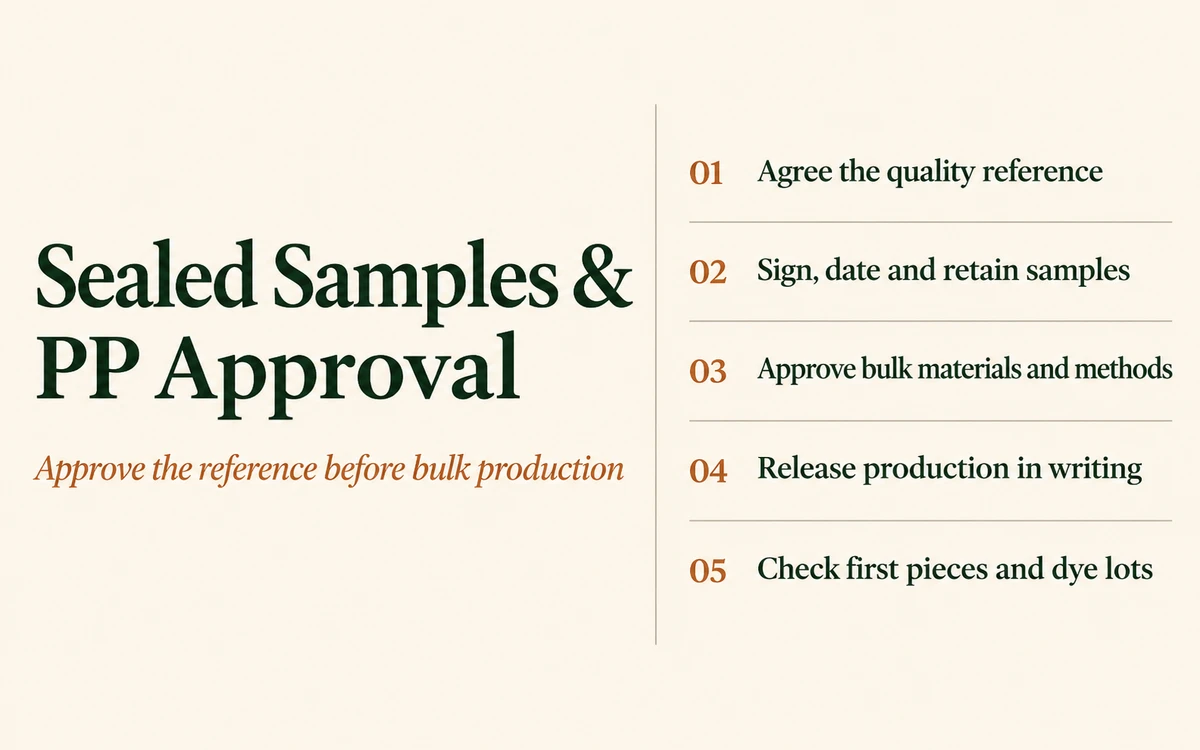
Not every order needs both a lab dip and a strike-off: solid-dyed and printed fabrics have different approval paths. Identify which reference controls color, artwork, construction or handle and keep its revision. Counter samples can appear during development; a bulk hanger comes from production and is not automatically a final inspection.
Color approval does not approve shrinkage, fastness or every future dye lot. Record limitations and outstanding requirements so the supplier knows what may proceed.
| Term | Meaning | What the buyer should confirm |
|---|---|---|
| Lab dip | Small laboratory-dyed swatch for shade approval. | Confirm reference, lighting and approval scope. |
| Strike-off | Trial print for artwork and color review. | Confirm substrate, repeat, scale and print system. |
| Handfeel | Perceived touch, texture and handle. | Keep an approved physical reference. |
| Colorway | Color version of a design or product. | Identify each palette and approved reference. |
| Repeat size | Dimensions of one repeating design unit. | State both directions and repeat arrangement. |
| CAD | Computer-aided design; digital artwork in print development. | Confirm file format, scale and color references. |
| Greige fabric | Unfinished fabric before relevant wet-processing and finishing. | Confirm actual preparation state. |
| Counter sample | Supplier sample developed against a buyer reference. | Agree what it matches and which points remain provisional. |
| Bulk hanger | Presentation swatch cut from bulk production. | Record lot/roll traceability; it does not replace inspection. |
| Development sample | Early sample for exploring construction, material or finish. | Identify purpose, substitutes and approval limitations. |
2. Production and Printing
Rotary and digital describe application methods; reactive and pigment describe colorant systems. They are not four mutually exclusive alternatives. CottonWorks distinguishes these categories and explains that screen-based printing can use different colorants. [4]
There is no universal meter threshold or color count that determines the cheapest route. Compare quotations for the same substrate, artwork, repeat, quantity and finishing requirements. Reactive is not automatically the most colorfast option, and pigment does not inherently mean poor quality.
Likewise, GSM and width are specifications, not fixed thickness categories. Confirm their measurement conditions before using them for costing.
| Term | Meaning | What the buyer should confirm |
|---|---|---|
| Rotary screen printing | Continuous printing through cylindrical screens. | Compare setup costs and repeat constraints for the actual design. |
| Digital printing | Digitally controlled textile printing, commonly inkjet. | Confirm ink chemistry, preparation and finishing. |
| Reactive printing | Printing with reactive dyes that bond with suitable fibers. | Check compatibility, fixation, wash-off and fastness results. |
| Pigment printing | Pigments held on fabric by a binder system. | Review curing, handle and rubbing/wash performance. |
| Screen printing / flatbed | Screen printing is broad; flatbed uses flat screens. | Specify flatbed if intended; rotary is also screen printing. |
| Finishing | Treatments modifying appearance, handle, dimensions or function. | List required finishes, durability and trade-offs. |
| Colorfastness | Resistance to color change or transfer under specified exposure. | State each test method, grade and acceptance criterion. |
| GSM | Grams per square meter: fabric mass per unit area. | Specify finished condition, target and tolerance. |
| Width | Fabric width under an agreed measurement convention. | Distinguish overall from usable/cuttable width. |
| Shrinkage | Dimensional reduction after a stated process or care cycle. | Specify length/width limits and conditions; growth may also occur. |
3. Orders, Prices and Shipping
Confirm the price unit, currency, quantity split, specification and included charges before comparing offers. A lower per-meter quotation may not be cheaper if usable width differs. Lead time needs an agreed start trigger and endpoint.
FOB and CIF are sea/inland-waterway rules, not shorthand for delivery to any port. Under both, normal risk transfer occurs on board at origin. CIF adds seller-arranged freight and insurance to the named destination port without moving risk transfer to arrival; it does not automatically include every import or destination charge. Name the relevant port and Incoterms edition. For containerized or multimodal movements, discuss an appropriate term such as FCA rather than defaulting to FOB. [1][2]
| Term | Meaning | What the buyer should confirm |
|---|---|---|
| MOQ | Minimum order quantity under stated conditions. | Clarify per fabric, color, design, dye lot or order. |
| Lead time | Time between agreed start and completion milestones. | Define start trigger and ex-mill, shipment or arrival endpoint. |
| Bulk order | Production order beyond development sampling. | Confirm revision, approvals, quantity and production release. |
| Sampling order | Order for trial or development samples. | Agree scope, fees, materials and delivery milestone. |
| Repeat order | New order based on an earlier approved product. | Reconfirm shade, availability, price and performance. |
| FOB — Free on Board | Sea/inland-waterway rule: normal delivery and risk transfer on board at the named shipment port. | State port and Incoterms edition; buyer arranges main carriage. |
| CIF — Cost, Insurance and Freight | Seller arranges freight and insurance to a named destination port; normal risk transfer is on board at origin. | Confirm insurance and destination/import charges; not an all-in delivered price. |
| Capacity | Supplier output within a stated period and product scope. | Separate total output from capacity reserved for your order. |
| Margin | Profit measure relative to an identified cost/revenue basis. | Distinguish profit amount, margin percentage and markup. |
| Price point | Target or quoted price level for a defined product or market. | Separate retail targets, fabric purchase price and landed cost. |
4. Quality and Inspection
Agree the inspection method and release decision before production, not after a report fails. Bowing and skewing describe geometry; they do not automatically establish which processing stage caused the problem. Colorfastness also needs an exposure, method and criterion rather than a general promise that color will not fade.
AQL is an acceptance quality limit used in a sampling system, not itself a complete inspection standard. AQL 2.5 does not mean precisely 2.5% defective goods are allowed in every lot. Lot size, inspection level, defect classes and the selected plan determine the decision. Fabric roll grading with a four-point system is a different assessment and should not be confused with AQL sampling. [3]
| Term | Meaning | What the buyer should confirm |
|---|---|---|
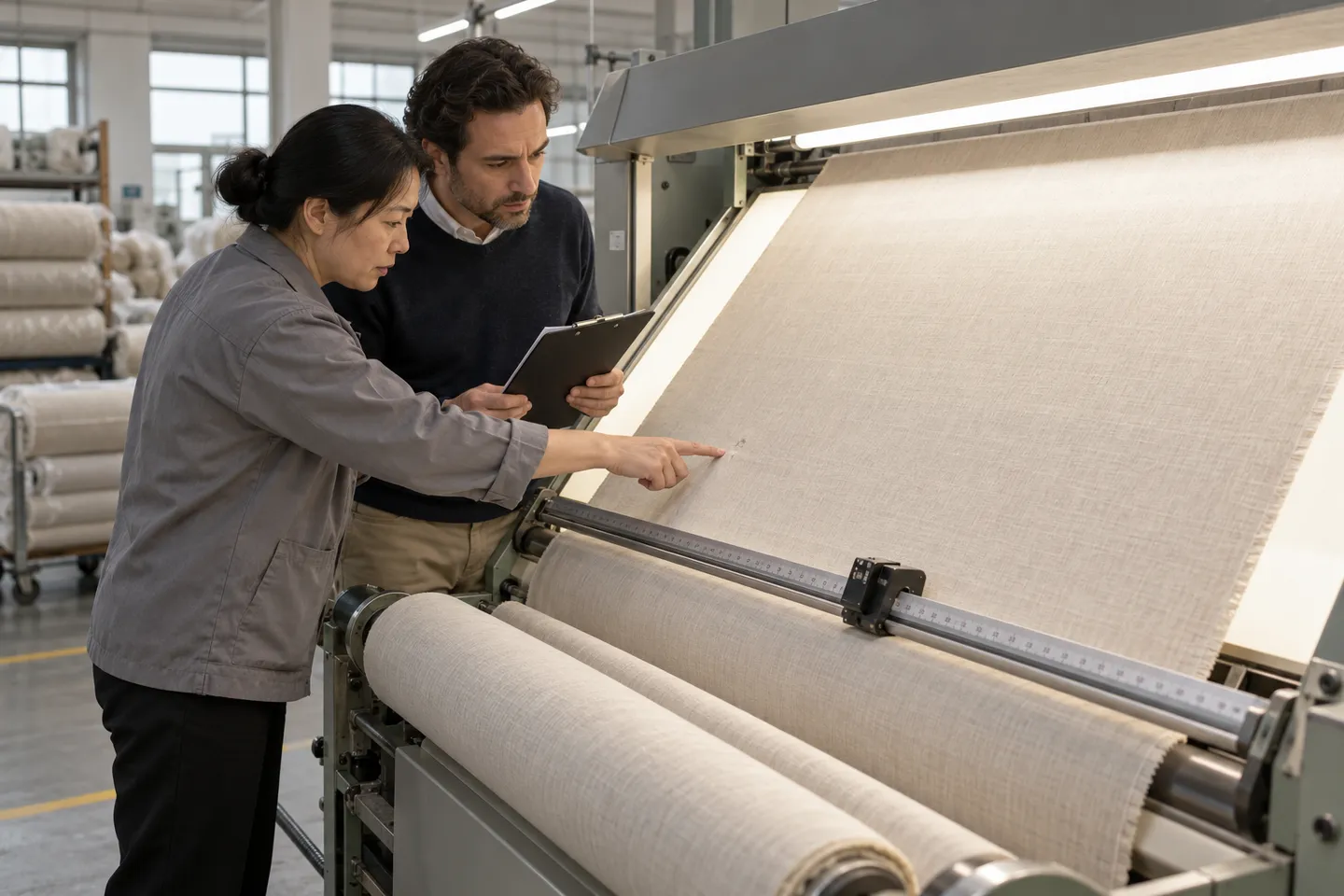
| Fabric inspection | Assessment against agreed specifications and inspection methods. | Agree roll coverage, defect recording and release authority. |
| Defect | Nonconformity against an agreed requirement. | Define severity and limits, including nonvisual requirements. |
| Shade variation | Color differences within rolls, between rolls or between lots. | Compare under agreed lighting and control shade grouping. |
| Pilling | Small entangled fiber balls on a fabric surface. | Specify method, exposure and required grade. |
| Bowing | Curvature of crosswise yarns or courses from intended alignment. | Agree measurement and limits; shape alone does not establish cause. |
| Skewing | Angular displacement of yarns or courses from intended perpendicular alignment. | Measure separately from bowing and assess garment effects. |
| Tensile strength | Resistance to breaking in a specified tensile test. | State method, direction, units and conditioning. |
| Tear strength | Resistance to propagation of a tear in a specified test. | Confirm method/direction; tensile results are not substitutes. |
| Color migration | Colorant movement into another area or material. | Identify heat, storage, contact or washing exposure. |
| AQL — Acceptance Quality Limit | Index used within an acceptance-sampling system. | Specify standard, lot size, level and defect classes; not a guaranteed defect percentage. |
Turn Definitions into Purchasing Decisions
Before approving a sample, identify what it represents and what remains provisional. Before ordering, confirm the finished specification, tolerances, quantity breakdown and commercial scope. Before shipment, agree which evidence permits release.
If a mill reports 145 GSM against a 150 GSM target, acceptance depends on the agreed tolerance, measurement conditions and product use. A width figure is useful for consumption planning only when you know how much is cuttable.
Keep current specifications and unresolved exceptions together. These terms become useful when they let you control what is sampled, purchased, inspected and shipped—not simply when you can expand the abbreviation.
Adapted from user-supplied Chinese notes attributed to Knit Export Notes. All 40 terms retained in four tables; duplicate alphabetical appendix consolidated. Seller-facing language changed to buyer decisions. FOB/CIF, AQL, printing categories, width, shrinkage, margin and approval sequencing corrected. No source URL for Knit Export Notes was provided, so none is invented.
Practical glossary, not full standards text or a contract. Source attribution supplied by the contributor; no independent claim about the source organization or publication rights is made.
Sources
Prepare a clearer fabric sourcing brief
Share your intended use, composition, finished GSM, usable width, color or print reference and performance priorities when comparing candidate materials.
YOUR NEXT STEP
Put the details to work.
Estimate an order or turn your specifications into a supplier inquiry.