A Grade 4 Report Can Answer the Wrong Question
A white shirt develops a gray mark on the shoulder where a crossbody strap has rubbed against it. The customer calls it color bleeding. The supplier produces a report showing Grade 4 and says the material passed.
They may be discussing different properties. The report could describe color change after washing, while the complaint concerns transfer under rubbing. A good washing result does not establish rubbing performance. This illustrative scenario explains why the phrase “color fastness” must be broken into specific test items before accepting a lot or investigating a claim.
Color Change and Staining Are Different Results
Color change describes how the tested specimen changes shade. Staining describes color transferred to another material. Many washing and perspiration methods assess both; rubbing commonly assesses staining of a rubbing cloth, while light fastness evaluates fading under its own specified system. Not every test produces the same pair of results.
Grey scales commonly run from 1, the poorest rating, to 5, the best, with intermediate ratings such as 3–4. Separate scales are used for change in color and staining; they are not interchangeable. Light-fastness results often use blue-wool references numbered 1–8, so a light-fastness 4 is not equivalent to a washing 4. State the assessment scale and the applicable method explicitly.
Which Color Fastness Tests Do You Need?
Choose tests that reflect the product’s use, care instructions, materials and mandatory requirements in its destination market. GB/T and ISO methods may cover similar subjects, but their editions and procedures must be specified; do not assume interchangeable results or a predictable half-grade conversion.
Washing methods can have different temperatures, detergents, mechanical action and durations. Steel balls and a particular liquor ratio are not universal requirements for every procedure. In rubbing, the cloth, load, travel and wet pickup must follow the selected method. Perspiration testing uses prescribed artificial solutions and contact conditions rather than an improvised soak.
Additional exposures can matter: chlorinated water for swimwear, seawater for marine use, saliva where relevant to infant products, and dry-cleaning or other care processes for appropriate garments. Do not omit applicable compliance tests merely because one risk appears more likely.
| Exposure | GB/T reference family in the manuscript | Result to clarify |
|---|---|---|
| Washing | GB/T 3921 | Color change and staining; exact procedure and care conditions |
| Dry and wet rubbing | GB/T 3920 | Rubbing-cloth staining; report dry and wet separately |
| Artificial light | GB/T 8427 | Fading assessment, reference system and exposure method |
| Perspiration | GB/T 3922 | Color change and staining under the specified solutions |
| Pool water | GB/T 8433 | Applicable chlorine exposure and specified assessment |
Why Fiber, Dye, Shade and Finish Change the Risk
The fiber name is a starting point for risk assessment, not a prediction of a fixed grade. Deep cotton shades can warrant particular attention to wet rubbing and removal of unfixed color. Polyester with disperse dyes can require migration or heat-related investigation, especially where dark and light components touch. Nylon and wool shade systems may need careful light-fastness assessment. Viscose constructions may require attention to wet-state abrasion and color transfer.
These are sampling priorities, not claims that every polyester has excellent rubbing or that every viscose has the worst performance. Dye selection, fixation, afterwashing, surface condition and finishing can change the result substantially. Pigment coloration depends on the binder system, and both dry and wet rubbing may be limiting; do not assume wet rubbing is irrelevant.
A report represents the submitted sample and test conditions. It does not automatically cover the complete color card, another production lot or every component of a multicolor garment. Include risk shades and representative high-color areas without substituting selective sampling for the prescribed test method.
Light Fastness: The Failure That Washing Does Not Reveal
A garment can retain its color in laundering yet fade on a shop display or during outdoor use. Brighteners, dyes, fiber yellowing and exposure conditions can all affect the appearance. Both light and dark shades deserve consideration; there is no universal rule that one group is always easier.
Use the agreed artificial-light or other exposure method for acceptance. A retained sample and an informal window-exposure comparison may help investigate a practical concern, but orientation, glass, season and temperature are uncontrolled. It cannot establish a standardized grade, an acceleration factor or a claim that window exposure is always harsher than laboratory testing.
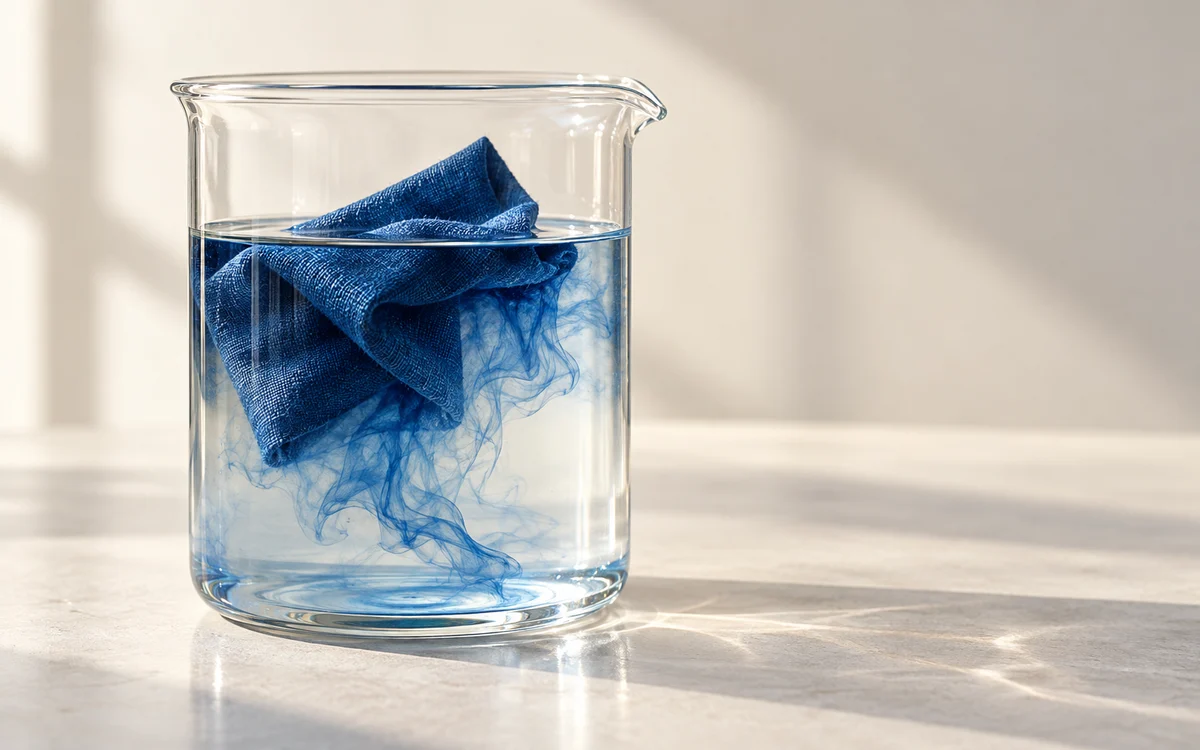
When Color Bleeds, Separate Three Possible Causes
First ask whether the article stained something else, changed its own shade, or did both. Record whether the problem appeared while wet, under friction, after washing, after heat exposure or during storage. These observations help select the investigation; they do not independently prove a root cause.
Unremoved surface color can contribute to transfer. Inadequate fixation or unstable coloration can contribute to color loss. Dye migration can involve transfer between contacting components under particular storage or processing conditions. Similar symptoms can have different mechanisms, so review retained samples, process records and appropriate tests together.
For example, a navy sweatshirt with acceptable washing color change but poor wet rubbing could stain a pale backpack strap. That is a plausible diagnostic scenario, not evidence that a specific soaping step was skipped. Rework should follow a confirmed cause and a pilot trial, not an automatic instruction to add fixative.
Improving Wet Rubbing Without Creating Another Problem
Wet rubbing can be more demanding than dry rubbing, particularly on some deep shades. The actual difference depends on the material and coloration system. No universal Grade 3 baseline, guaranteed Grade 4 route or fixed cost per kilogram applies to all fabrics.
The dye house should review dye choice, fixation, washing-off, surface deposits and finishing compatibility. Appropriate washing-off can remove unfixed material, but temperatures and chemistry must suit the fiber and dye. Fixatives may help some systems and harm other properties; evaluate color, light fastness, handle and relevant chemical requirements after any change.
Softener and other auxiliary effects are formulation-dependent. Do not assume the softest fabric inevitably loses half a grade, or that a fixative always adds a full grade. Verify the revised route on production-representative samples and repeat the affected acceptance tests.
A wet wipe contains its own liquid and ingredients and is not a substitute for standard rubbing cloth. Its result can still document a customer’s use condition, but it should not be presented as a GB/T or ISO grade. Keep practical complaint evidence separate from standardized test results.
Write Acceptance Criteria Before Bulk Production
A test method tells the laboratory how to test; it does not necessarily prescribe the pass grade for every product. Acceptance criteria may come from applicable product regulations, buyer specifications and the agreed contract. Clarify those requirements before sampling rather than introducing a stricter target after the lot is complete.
Record the method and edition, exact procedure, result assessed, minimum grade and sample scope. For staining, identify the required adjacent fabric and report the relevant components separately. A multifiber strip helps show transfer to several fibers, but its staining pattern alone does not conclusively identify the dye chemistry.
If the report omits essential conditions, place the decision on hold and request clarification or appropriate retesting. Incomplete documentation does not itself prove the physical lot failed. Likewise, the sampling location should be representative and method-compliant, not simply chosen to obtain the most favorable result.
| Example requirement | Details still to agree |
|---|---|
| Wet rubbing: minimum Grade 3 | Selected method/edition, specimen preparation, wet pickup and sampling |
| Washing color change: minimum Grade 4 | Selected method/edition, test variant, temperature, detergent and duration |
| Washing staining: agreed minimum for each relevant fiber | Adjacent fabric, assessed components and required grade |
| Light fastness: buyer-defined target | Reference scale, method, exposure and relevant shades |
Check That the Report Represents the Goods
Confirm the sample identification, color, batch, substrate and finish against the delivered fabric. A lab-dip result may support development but does not establish the afterwashing and finishing quality of every bulk lot. Use lot-linked evidence and an agreed sampling plan; verify that high-risk colors were not omitted.
For failures, preserve affected and unaffected retains with clear identification, obtain the original report and review the actual dyeing and finishing records. Independent retesting can help resolve disputed results when the method and sample are agreed. Prevent production changes from invalidating an earlier approval.
Suppliers should communicate both shade and performance requirements to the dye house. A precise shade match does not compensate for missing rubbing, washing or light performance. Recheck relevant fastness after changes to dye selection, fixing, softening, coating, printing or heat processing.
The One Question to Ask First
When someone says a fabric is bleeding color, ask: “Did it stain another material, or did the fabric itself become lighter?” Then establish the exposure, method, sample and applicable acceptance criterion. That first distinction prevents a washing report from being used to dismiss a rubbing complaint.
Color fastness is a group of properties, not one overall Grade 4. Buyers need item-specific evidence; factories need a controlled and documented process. Clear specifications, retained samples and production-linked testing are more useful than a single impressive number on a report.
Edited from the contributor’s manuscript. Test-specific assessment clarified using official ISO method descriptions. GB/T references retained as method families, with edition and procedure confirmation required. Unsupported prevalence, fixed grade improvements, universal recipes, costs and purported real-order attribution removed or reframed as illustrative.
Not a complete test procedure or a universal acceptance schedule. Requirements depend on product, destination market, care, buyer specification and the applicable method. No fabric was tested for this article.
Sources
YOUR NEXT STEP
Put the details to work.
Estimate an order or turn your specifications into a supplier inquiry.