Who Takes the Fall for a Defective Roll of Fabric?
From yarn to finished garment, a single roll of fabric passes through multiple manufacturing stages: spinning, weaving or knitting, pretreatment, dyeing, finishing, cutting and sewing. When a quality failure occurs, operators at every stage may believe they are blameless.
The greige mill claims: “The greige fabric was inspected before dispatch; all defects were within the agreed limits.”
The dye house claims: “We processed the greige fabric provided; the shade variation was caused by inconsistent yarn lots.”
The garment factory claims: “We cut the fabric as soon as it arrived; we only spotted the shade variation after sewing—do you expect us to unpick the seams?”
When the end customer presents a finished garment with shade variation, fabric defects or weft skew, who ultimately foots the bill? Quality failures are not dark magic. Many can be traced to one or more manufacturing steps, provided the evidence has survived. The key is identifying where a flaw first appeared and whether a later stage created, worsened or failed to detect it.
| Common quality issue | Stages to investigate | Evidence to compare | Potential responsibility to investigate |
|---|---|---|---|
| Shade variation within/between rolls | Dyeing; greige/yarn consistency | Greige batch identities and whether fabric was processed in the same dye vessel | Inconsistent incoming lots: investigate the greige/yarn supply. Differences within one vessel: investigate dyeing uniformity as well. |
| Horizontal barré / bands | Weaving or knitting; yarn; dyeing interaction | Yarn count/evenness, lot identity, machine tension and before/after-dyeing samples | Yarn variation may originate upstream; tension variation may arise during fabric formation. Dyeing can reveal or amplify the effect. |
| Dye-lot variation | Dyeing | Approved shade, vessel records and lot-to-lot comparisons | Investigate scheduling, matching and process control; verify incoming material consistency too. |
| Weft skew / bow | Fabric formation; finishing | Yarn direction, greige condition and straightening records before setting | Investigate original distortion and whether finishing introduced or failed to correct it. |
| Holes / broken warp ends | Weaving and subsequent handling | Position, broken yarn condition and stage-by-stage samples | Weaving may be the origin, but mechanical or chemical damage later in the chain must be excluded. |
| Insufficient colorfastness | Dyeing; after-treatment | Dyestuff selection, fixation/washing process and specified test results | Investigate dyeing/finishing against the agreed method and grade. |
| Low GSM | Fabric formation; pretreatment; finishing | Conditioned greige and finished GSM, widths, material losses and tension | Low incoming mass may originate at the mill; excessive loss or extension can arise during processing. |
| Hand feel differs from approval | Finishing and preceding processes | Approved reference and equivalent conditioned samples | Investigate softener, setting conditions and the full processing history. |
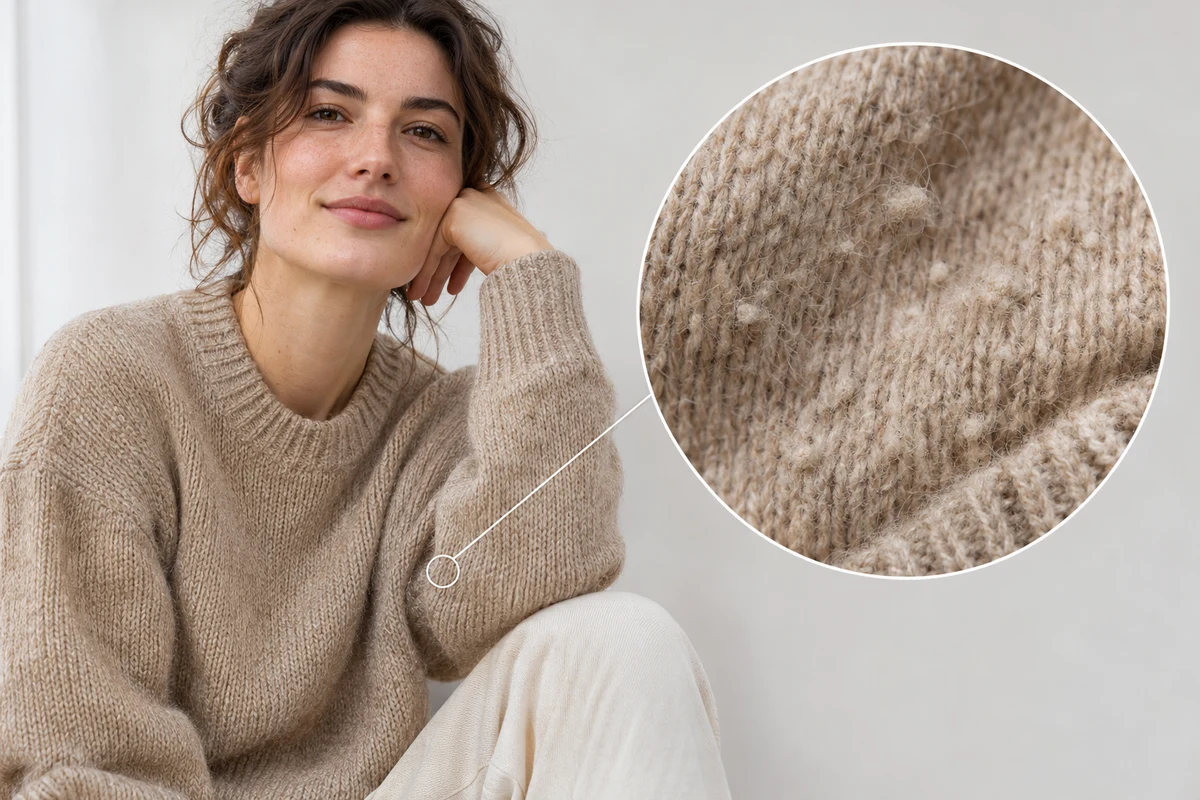
| Fuzzing / pilling | Yarn; construction; dyeing/finishing | Fiber/yarn properties, singeing where applicable, finish and agreed pilling test | Several stages can contribute; the visual symptom alone does not allocate liability. |
The Three-Party Tug-of-War Across the Claim Chain
While the matrix looks straightforward, many quality issues involve compound failures across multiple stages. If shade variation and horizontal barré appear together, structural or yarn-related differences may be made more visible by dyeing. That interaction is precisely when a fabric mill and a dye house may start passing the buck.
The commercial conflict is familiar: a customer approaches its immediate supplier, while the physical root cause may lie further upstream. Who is contractually accountable still depends on how the order and supply relationships were arranged.
Consider an illustrative 10,000-meter poly-cotton order. Mill A weaves the greige, Dye House B dyes and finishes it, and Garment Factory C manufactures shirts. Finished-garment inspection finds shade differences within cartons and prominent barré on some pieces.
The brand holds C accountable. C says: “We cut the fabric upon arrival. The fabric came from B—take it up with B.” B replies: “The dyed fabric reflects what we received. A supplied the greige; the barré and yarn-lot inconsistency began there.” A responds: “The greige passed the Four-Point System before shipment.”
An inspection pass at one stage does not settle all later performance questions. The parties need the actual reports, acceptance terms and comparable samples—not simply assertions that a roll once passed inspection.
| Resolution route | Illustrative share supplied by contributor | Who may bear the cost | Indicative customer response |
|---|---|---|---|
| Negotiated discount | About 50% | Shared among parties under the settlement | Mixed / moderate |
| Return and remake | About 20% | The party or parties found responsible, as agreed or determined | Often more favorable if replacement succeeds |
| Downgrade / discount channel | About 15% | The brand may absorb a substantial part | Low |
| Litigation / arbitration | About 5% | Allocated by the applicable award, judgment or settlement | Can be low where resolution is prolonged |
| No resolution / claim abandoned | About 10% | The claimant may absorb the loss | Very low |
Why Is Assigning Responsibility So Difficult?
Notice the “no resolution” outcome in the illustrative breakdown. A customer may absorb a loss because proving the defect’s origin costs more than recovery is likely to yield. The 10% figure above is not a measured frequency for the textile industry.
Once fabric has passed through several stages without comparable retained samples or records, reconstructing its earlier condition becomes much harder. The practical challenge is not merely naming a potentially responsible party; it is demonstrating how its actions or contractual obligations relate to the failure.
Three gaps repeatedly undermine that process: inconsistent swatch retention, acceptance standards that do not connect across handovers, and a time lag that makes production evidence harder to retrieve.
The Three Evidence Gaps: Samples, Standards and Records
1. Non-standard swatch retention. Without greige retains, first-vessel or approved lot samples, and pre-cutting references, there is no reliable physical baseline. A written six-month retention arrangement can be useful, but the appropriate period and sample size depend on the contract, product lifecycle and testing needs. No universal six-month rule or facility-compliance percentage is established here.
2. Disconnected testing and acceptance criteria. Different materials and stages can use different inspection methods. As of October 27, 2026, the SAMR catalog lists GB/T 17759-2018 for greige surface-defect inspection; the 2009 edition is withdrawn, and the 2026 edition is scheduled for August 1, 2027. GB/T 17760-2019 addresses printed/dyed fabric surface defects, while GB/T 21295-2024 concerns garment physical and chemical performance. These references have different scopes and do not automatically establish contractual liability. [1] [2] [3]
The important missing link is often the parties’ own handover procedure: what is checked, against which approval, who signs, and what happens if the next stage finds a hidden defect? Greige acceptance alone does not guarantee dyed-fabric conformity, and dyed-fabric acceptance alone does not guarantee a finished garment meets every requirement.
3. Evidence decay and time lags. An order may take weeks or months to move from weaving through inspection. Records can be overwritten, samples discarded and roll identities lost. Preserve production and acceptance records against a retention schedule agreed before the order, rather than hoping they will still exist after a claim.
What Is the First Step When a Quality Failure Appears?
Whether you are a brand owner, garment manufacturer or fabric trader, the immediate priority is securing evidence and preventing further loss. Identify and segregate affected stock, preserve traceability and notify the relevant contracting party promptly in writing. Do not wait for a complete root-cause report before giving a notice that the contract or applicable law requires.
Record the defect under consistent lighting, identify affected rolls, dye lots, cartons and garment sizes, and preserve both defective and apparently conforming material. Agree a sampling protocol with the laboratory and, where practical, the other party before destructive testing. A 30 × 30 cm swatch may help document a local defect, but may be insufficient for full-width barré analysis or the required tests.
| Step | Specific action | Why it matters |
|---|---|---|
| 1. Preserve the material | Keep affected material and normal-looking controls from the same lot. Seal, identify and date samples; retain larger/full-width material when needed. | Preserves a physical comparison and its chain of custody. |
| 2. Retrieve production records | Collect dye-vessel records, fabric inspection reports, cutting records and lot/roll mappings. | Connects the observed problem to the sequence of processing and handovers. |
| 3. Arrange suitable testing | Use a competent laboratory, such as SGS or another appropriately qualified provider, for the relevant defect analysis and agreed performance tests. | A suitable report can support a claim; the report does not automatically decide liability. |
| 4. Review the contract | Check quality criteria, approved samples, inspection/notice deadlines, warranty and dispute-resolution terms. | Identifies the obligations and process relevant to the parties’ claim. |
| 5. Negotiate using the evidence | Present the documented defect, samples and test findings; agree containment, remedy and cost allocation in writing. | Creates a practical route to settlement without losing the evidence needed if talks fail. |
Check the Claim Deadline—Do Not Assume a Universal 30-Day Rule
The critical factor is the applicable claim and notice process. A purchase agreement may require quality objections within 30 days of delivery, but that is not a universal textile-industry legal deadline. Visible and latent defects, contractual guarantees and governing law can lead to different requirements.
For example, where the CISG applies, Article 39 addresses notice within a reasonable time after discovery or when the buyer ought to have discovered the nonconformity, together with a general two-year outer limit subject to its conditions and exceptions. That is not permission to wait two years, and it is distinct from a time limit for commencing proceedings. [4]
Check the actual order terms and obtain qualified advice for the relevant jurisdiction when a dispute is material. Record delivery, inspection, discovery and notice dates. Do not assume that a hidden defect automatically preserves every remedy after a contractual deadline.
Agree Retained Samples Before the Crisis
A well-run dye house can retain approved or first-vessel swatches by dye lot, a weaving mill can preserve representative greige material, and a garment factory can keep incoming and pre-cutting references. Together, they provide a stronger comparison than any one finished-garment photograph.
A useful contract discussion might begin with: “Retain identified samples from each greige and dye lot for at least six months, or longer where the agreed claim or warranty period requires it.” Then specify the sample quantity, locations across the width or roll, labeling, storage, access and release procedure. The period must suit the order; it is not a universal statutory standard.
Make clear which approved sample controls acceptance and whether the retain represents the whole batch or only one selected position. A first-vessel swatch alone may not show center-to-selvedge or roll-to-roll variation. Shared sample identification and signed handover records are more useful than two parties keeping untraceable scraps.
Who Ultimately Pays? Evidence Strengthens the Claim; It Does Not Replace the Contract
Returning to the headline question, the outcome depends on the proven facts, the parties’ obligations, timely notice and the remedy available. The party that failed to preserve evidence is commercially vulnerable, but missing a swatch does not automatically make that party legally liable for the whole loss.
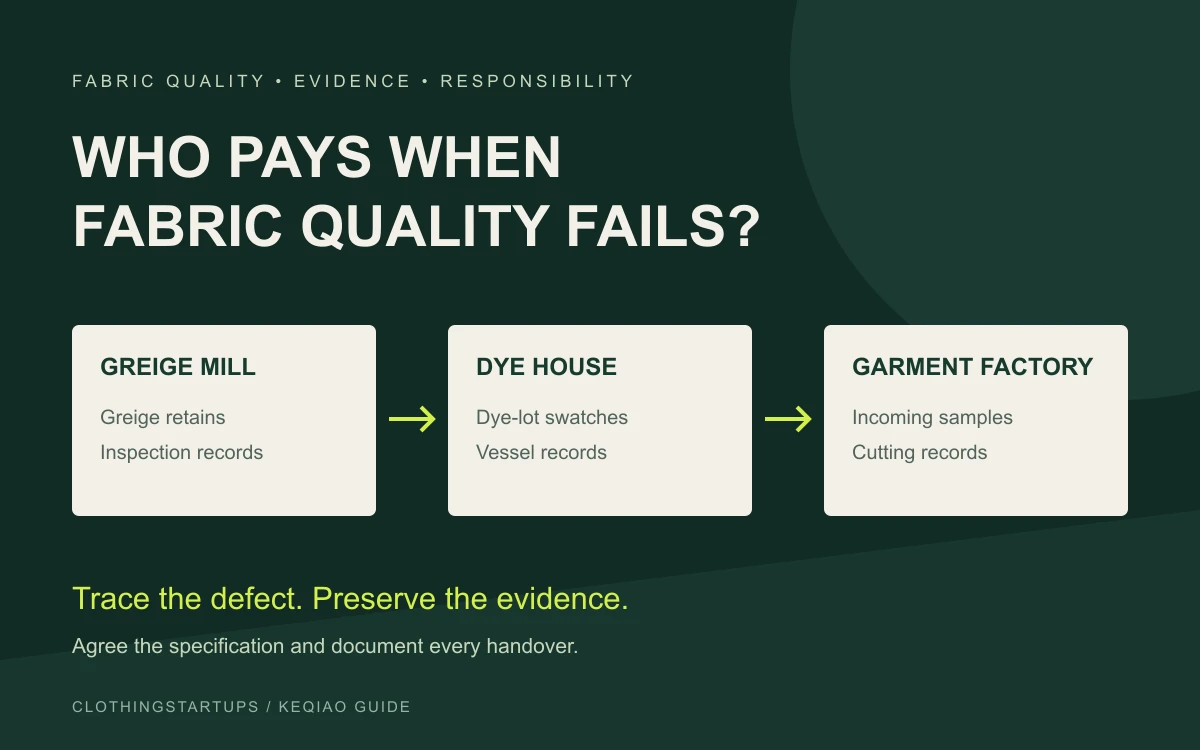
Greige inspection logs and physical retains help establish incoming condition. Vessel records and dye-lot swatches help reconstruct processing. Cutting records and incoming references help show what was available to the garment factory before manufacture. Each record supports a part of the story; none is an automatic defense against every defect.
A few well-identified pieces of fabric and clear records can be worth far more than the space they occupy. Preserving samples, documenting handovers and drafting unambiguous contract terms will not eliminate every dispute, but they put the business in a stronger position than finger-pointing after the damage is done.
Bookmark this guide so that the next quality complaint begins with evidence preservation and prompt notice, not an argument about whose factory touched the fabric last.
Adapted from the contributor’s four-part English manuscript and three Chinese-language tables. Tables were translated into accessible English HTML. The case is presented as an illustrative scenario because identifying evidence was not supplied. Settlement percentages remain explicitly illustrative contributor estimates. Outdated standards and universal deadline/retention claims were corrected or qualified.
Operational guidance, not a legal determination. Defect patterns suggest investigation routes, not automatic liability. Contracts, applicable law, timely notice and the complete evidence determine a claim. The settlement split is not a measured industry survey, and six-month sample retention is a suggested contractual arrangement rather than a universal rule.
Sources
- SAMR national standards catalog — GB/T 17759 editions and implementation dates
- SAMR — GB/T 17760-2019, Inspection method for printed or dyed fabric surface defects
- SAMR — GB/T 21295-2024, Requirements of physical and chemical performance of garments
- UNCITRAL — 2016 CISG Digest, Article 39: notice of lack of conformity
Need documented observations at a supplier’s site?
An agreed supplier visit can help document the site, relevant operations and available records. It does not replace laboratory root-cause testing, legal advice or a determination of compensation.
Review the China supplier site visit scope and request form →
YOUR NEXT STEP
Put the details to work.
Estimate an order or turn your specifications into a supplier inquiry.