1. What Is a Sealed Sample, and Why Does It Matter?
The sample was approved, but the bulk garments look different. You want to challenge the factory. The hardest part is often not making the argument; it is finding a reference that both sides agree to use.
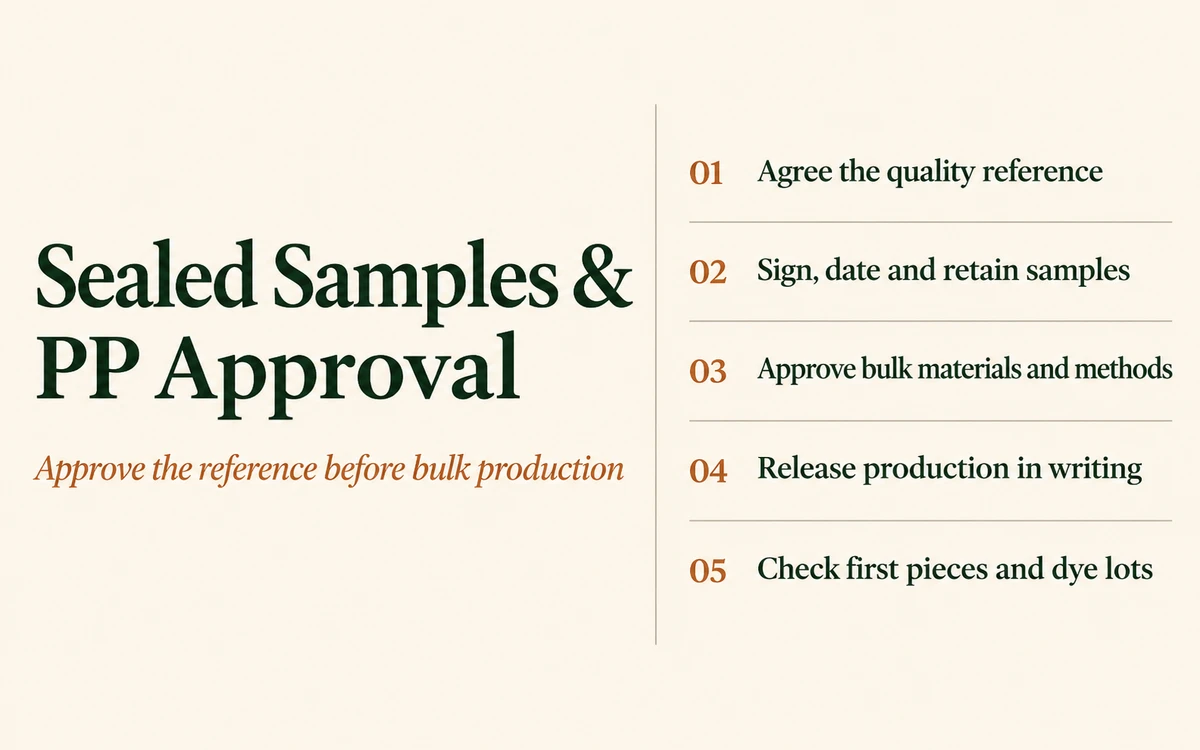
That reference is the sealed sample: a physical garment jointly identified and approved by the buyer and factory, then retained as a quality benchmark. It can also be called an approved reference sample or, in some sourcing contexts, a golden sample. Agree what the term means in your order.
Without a controlled final reference, the factory may say it followed the tech pack, while you say the result is not what you approved. An earlier sample can be disputed as superseded, and a written description may not fully capture the intended appearance or handle.
A sealed sample helps establish the standard, preserve evidence and give both parties a common comparison point. It should work alongside the contract, measurement tolerances, quality specifications and applicable safety requirements. Calling it the “only standard” leaves a gap: one garment cannot demonstrate every size, color, test result or legal requirement. State which reference controls each issue and how conflicts are resolved.
2. How Many Samples Should You Keep, and How Should They Be Stored?
A useful arrangement is three agreed copies: one for the brand, one for the factory, and a protected reserve for a dispute. This is a recommended setup, not a universal minimum. The quantity, sizes and colors should match the order’s risk and the agreement. If a reserve is intended for dispute resolution, agree who holds it and how it may be opened; a third sample does not automatically become an arbitration decision.
Have authorized representatives identify and approve the samples with a date. Record the style, purchase order, size, color, sample revision and linked tech-pack version. Photograph the garment and approval tag, and keep the written approval together with the sample record. Signing and dating improve traceability; they do not by themselves guarantee legal enforceability.
Use protective packaging and a tamper-evident seal where appropriate. Label the package and record the seal identifier. If company stamps are required by the contract or relevant procurement procedure, include them. Keep a working reference available for routine checks so the dispute reserve does not have to be repeatedly opened.
There is a specific local example in China: Huoshan County’s 2023 trial school-uniform procurement measures set out sealed retention of confirmed sample garments, with labeling and company stamps. This illustrates a documented procurement control; it should not be generalized into a legal requirement for every garment order. [1]
A practical drafting starting point is: “Bulk production shall be assessed against the mutually approved pre-production sample identified in this agreement, together with the attached quality specifications. Each party shall retain an identified copy.”
3. Approve the PP Sample Before Bulk Cutting
The pre-production sample, or PP sample, should represent what the factory intends to manufacture. Use the intended bulk fabric, trims, artwork and production methods. If a substitution is unavoidable, document it and leave the affected point explicitly unapproved until the final material or process has been checked.
Set a clear release gate: no bulk cutting or production before the agreed PP approval is recorded in writing. Email or an ERP approval record can make the decision traceable, provided the parties have agreed who may approve, which revision is approved and which channels count. An informal message about an earlier sample should not silently release a different version.
Making one or two PP garments can reveal issues such as an unsuitable fabric shade, inaccurate logo execution or unexpected construction details while the order is still easy to change. The exact sample quantity depends on what needs checking, including sizes, colors and tests.
A sample correction mainly affects the sample, its materials and the development schedule. Bulk rework can add labor, material losses, transport, repeat inspection and delayed delivery. That is why catching an error early can matter so much. There is no reliable universal rule that a correction costs only 10–20% of bulk rework, and sampling is not cost-free.
If a factory starts without approval, your options depend on the agreed terms and applicable law. Specify the consequences in advance: who carries the resulting costs, when production must stop, and whether correction, replacement or rejection is available. Do not assume that an approval breach automatically gives an unrestricted right to reject the whole order.
4. After Cutting: First-Piece Checks, Dye Lots and Inspection
First, check the initial production pieces. Compare the actual bulk-made garments with the approved reference before the line proceeds at scale. Review measurements, construction, seam quality, artwork and materials. Investigate a mismatch before it is repeated across the order.
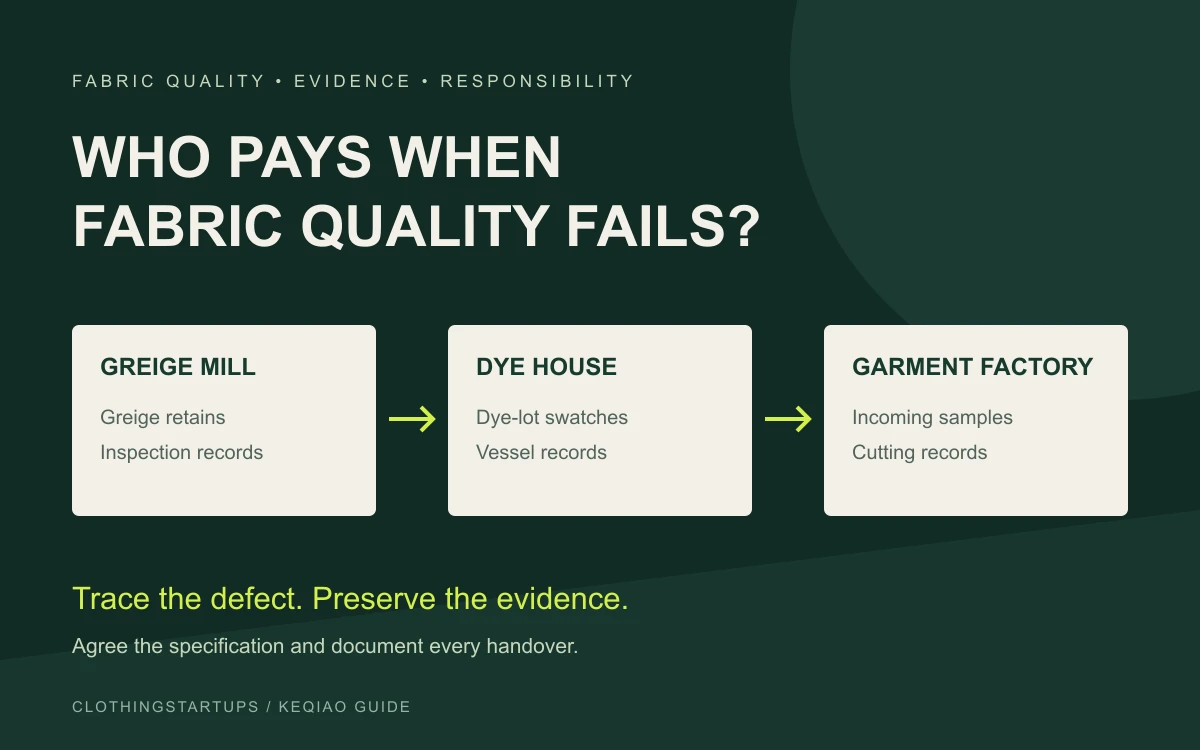
Second, control fabric lots and shade grouping. Avoid mixing visibly different shades within a garment. Record dye-lot and roll allocation, check shade variation, and agree any proposed lot change before cutting the affected fabric. A large order may legitimately use more than one dye lot; the important controls are approved shade consistency, traceability and allocation. One dye lot can still contain roll-to-roll variation.
Where feasible, use the approved bulk lot for the PP sample. If that is not possible, retain the approved shade reference and require approval of the actual bulk material. Do not assume that every order can use the exact sample lot.
During production, inspect fabric, workmanship, construction and sizing while changes can still be made. A check around 30–50% completion can be a planned milestone, but it is not a universal rule or the final opportunity to intervene. High-risk processes may need earlier and continuing checks. Intertek describes inspections at pre-production, inline and before-delivery stages. [2]
For final random inspection, agree the sampling system, lot definition, inspection level, defect classifications, acceptance limits and additional test requirements. AQL is part of an acceptance-sampling system, not a guarantee that every garment is defect-free. ASQ describes Z1.4 as an attributes-based acceptance-sampling system using specified AQLs and switching rules. [3]
5. Put These Three Points in the Agreement
The following wording is a starting point for discussion. Adapt the references, approval authority and remedies to the transaction, and have the final contract reviewed for the applicable jurisdiction.
Sealed reference: “Bulk goods shall conform to approved PP sample [ID/revision/date] and the attached quality specifications, including agreed measurement tolerances. Each party shall retain an identified sample. Any conflict between the sample and written requirements shall be resolved in writing before production.” Include the agreed signing, dating, packaging and seal-record procedure.
Production release: “Bulk cutting and production may begin only after written approval of the identified PP sample by [authorized person], through [agreed channel]. The PP sample shall use the agreed bulk materials and methods. Any substitution or unresolved exception requires separate written approval. Unauthorized production shall be handled under [agreed remedy and cost-allocation clause].”
Acceptance and nonconformity: “Acceptance shall be based on the identified sample, quality specification and agreed inspection plan. Nonconforming goods shall be handled through the agreed correction, replacement, return or price-adjustment process, with responsibility for associated costs stated in the agreement.”
Also record the approved bulk fabric lot or shade reference. Require written approval for proposed changes that could affect appearance or performance. Define the notice period, evidence and decision process for a quality claim instead of leaving these details until the shipment arrives.
6. Give Both Parties the Same Reference
Sealing and retaining a sample is a small administrative step compared with the potential consequences of an uncontrolled bulk run. It still requires time, sample materials and proper storage, but it makes the approval decision much easier to trace.
The most useful instruction to agree with the factory is simple: “Use the jointly approved PP sample and written specification as the acceptance reference. Keep identified copies, and obtain written release before bulk production.”
Before cutting, confirm that the sample ID, revision, materials, outstanding exceptions and approval authority are clear. After cutting, use first-piece checks and the agreed inspection plan to verify that the production process is following that reference.
The purpose is to move a quality discussion from competing recollections to an agreed garment, a documented specification and an approval record that both parties can find.
Translated from the contributor’s Chinese manuscript, preserving its six-part argument and practical clause examples. Unsupported court quotation and fixed rework-cost ratios omitted. Three-copy retention presented as a recommended arrangement, not a universal rule. Sample priority, stamps, rejection remedies, dye-lot matching and inspection timing qualified by contract and product context.
Practical production guidance. Clause examples are drafting prompts, not legal advice or ready-to-sign terms; enforceability and remedies depend on the agreement and applicable law. The cited school-uniform procedure is a local example rather than a rule for all apparel contracts.
Sources
Clarify the supplier and the production brief
For an on-site supplier visit, specify the documents, facilities or business information you want checked. This service is separate from garment sampling, laboratory testing, production supervision and lot inspection.
YOUR NEXT STEP
Put the details to work.
Estimate an order or turn your specifications into a supplier inquiry.