A Mature Supply Chain Still Needs Brand-Level Coordination
A mature supply chain offers abundant choices—so why do some brands still struggle with product consistency?
Bringing top-tier factories, premier material suppliers, and strong design teams under one roof proves a brand’s power to attract high-caliber resources. However, execution doesn’t stop there: someone must clearly articulate consumer demands, orchestrate every partner to bring the collection to life, and safeguard quality stability across bulk production runs.
Our editors have curated the following checklist to help founders of small-to-midsize brands, merchandisers, and supply chain managers audit their operations.
The central question is not simply whether good partners are available. It is whether those partners are working toward the same product definition, using the same approved information, with clear responsibility for checking the result.
Checkpoint 1: Good Resources Need Good Organization
A strong factory, capable material suppliers and a skilled design team can all be present while the product still falls short. Access to resources is different from the ability to organize them. Before adding another partner, break the problem into product direction, resource fit and ownership.
Ask: “Have we explained this style’s requirements clearly? Is the current partner missing the capability—or missing a clear basis for execution?”
The takeaway: suppliers provide options; the brand is responsible for selecting and coordinating those options into a product.
| Check | What to confirm |
|---|---|
| Product direction | Define who the product is for, the use scenario and the intended price point. Do not leave each partner to guess. |
| Resource fit | Check whether each garment factory, material supplier and design studio suits the category, quantity and specific requirements—not just whether it has a good reputation. |
| Organizational ownership | Assign who confirms needs, decides trade-offs, hands over documents and verifies the outcome. Every step needs an accountable owner. |
Checkpoint 2: Translate “Comfortable” into Requirements a Factory Can Use
Consumer language describes an experience; production teams need a way to make and verify it. A commuter shirt offers an illustrative example: the wearer wants fewer creases after sitting, freedom of movement and a shape that remains acceptable after washing.
Those statements should lead to coordinated decisions about fabric, fit, construction and validation. They are not test results or universal performance thresholds. Define appropriate measures and methods for the category, intended market and applicable standards.
Ask: “What makes this selling point possible? Who will verify it, and where will the result be recorded?”
| Check | Who does what |
|---|---|
| Fabric solution | The material team checks appearance, hand feel and post-wash behavior and explains the conditions under which the fabric is suitable. |
| Fit and construction | Technical staff check measurements and movement allowance. The factory verifies sewing, finishing and the production conditions needed to reproduce the result. |
| Validation evidence | Quality staff arrange wear trials, post-wash observation and relevant tests. Approved results must be reflected in the measurement specification, bill of materials (BOM), patterns and construction documents. |
Checkpoint 3: An Approved Sample Is the Starting Point for Bulk
Getting one sample right does not establish that every unit in bulk will be right. Production and inspection should use the approved reference sample, final approved patterns, construction specifications and BOM as a consistent set.
Development, purchasing, costing, planning, quality and production need to coordinate from the development stage. Resolving details before cutting is more effective than trying to reconstruct approval decisions after defects appear.
Ask: “Has the factory checked that its approved sample, patterns, construction sheet and BOM are complete, aligned and current?”
| Control point | What to confirm |
|---|---|
| Before placing the order | Development confirms the sample and technical documents; purchasing confirms fabrics and trims; costing checks the price; planning checks the launch date against factory capacity. |
| Before cutting | Confirm that fabrics and trims are complete and inspections finished. Check that the technical handover is clear and issues from the pre-production sample have been resolved. |
| After a sample or material change | Assess effects on fit, construction, quality, cost and delivery. Obtain approval from an authorized decision-maker and notify the factory and all affected functions. |
Checkpoint 4: Find the First Deviation Before Replacing the Supplier
When a product falls short, changing partners can be appropriate—but repeated changes are a diagnostic clue, not proof of the root cause.
The source notes describe an anonymous, unverified management scenario: a founder is effective at marketing and attracting professional partners but gives less attention to supply-chain management, then attributes disappointing products primarily to insufficient resources. This is an illustration for review, not a finding about any identifiable company or an explanation for changes in its business performance.
Ask: “After the last supplier change, which specific part of the process actually improved?”
| Check | What the evidence should show |
|---|---|
| Locate the earliest deviation | Take a recent problem style and find where the brief, sample, material, technical documents or production first diverged from the agreed requirement. |
| Review the basis for the change | After replacing the partner, did product definition, responsibility and verification improve? If those stayed unclear, the same problem may recur. |
| Choose the adjustment from evidence | Replace a partner when capability genuinely does not fit. Correct the brand’s own management when requirements are unclear or technical information conflicts. Both problems can exist together. |
Checkpoint 6: Match the Supply Model to the Business
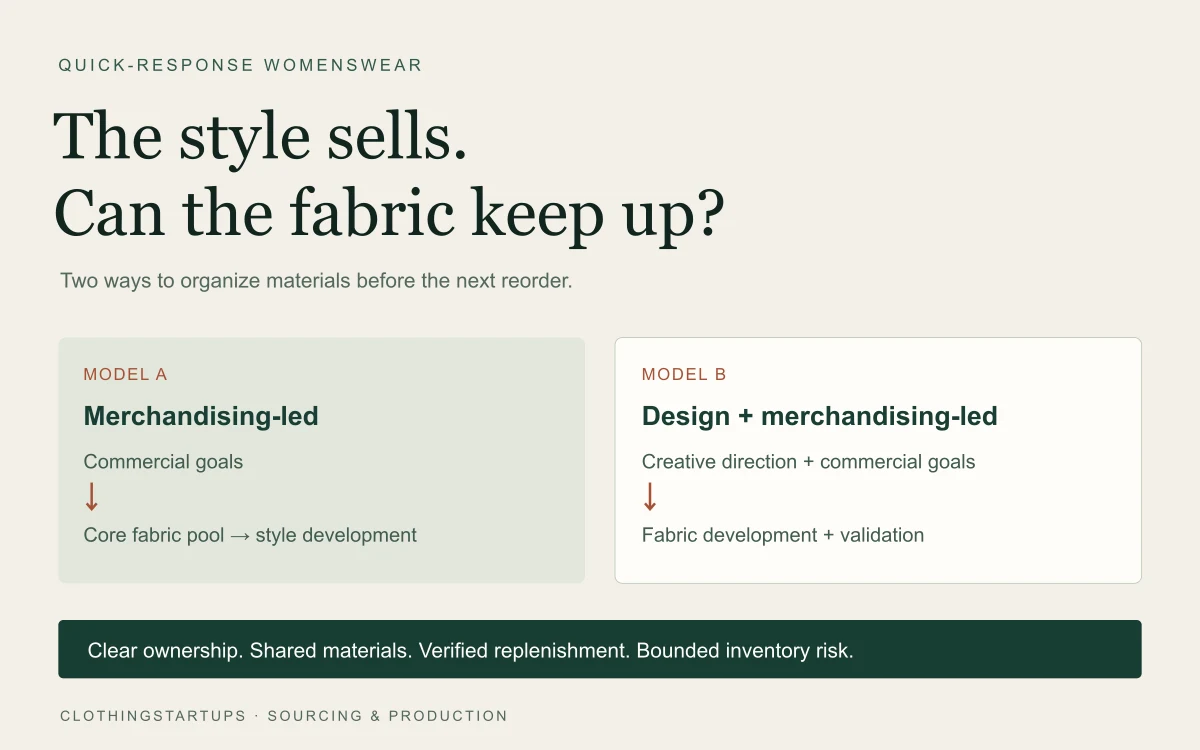
Different stages of a business need different forms of supplier cooperation. Even within one brand, established core styles and exploratory products can use different development and production arrangements. This is a discussion framework, not a fixed sequence of growth stages.
Ask: “What does this product most need us to validate now, and does the current supplier relationship support that work?”
Marketing can encourage a first purchase; wearing the product tests the promise. Value for money depends on whether the experience is consistent and appropriate for the price. Repeat purchase and business performance are also affected by the product, service, sales channels and marketing—not one supply-chain variable alone.
| Business situation | What to prioritize |
|---|---|
| Exploring a product | Development cooperation, small trial orders and wearer feedback. First establish whether the product suits the target customer. |
| Growing sales | Bulk consistency, replenishment and delivery reliability so the product experience can be repeated. |
| Adding categories or channels | Segment supplier resources and coordinate planning, inventory and cash commitments. Increasing the supplier count alone is not a strategy. |
Put the Checklist to Work: Review One Recent Style
Start with one style that missed expectations. Agree the intended customer experience, collect the approval documents and trace the earliest deviation. For each gap, record an owner, a corrective action and the evidence needed to confirm improvement.
That review may reveal a supplier capability gap, an unsuitable material, unclear technical requirements, an uncontrolled change or a mismatch between responsibility and authority. Avoid choosing the explanation before reviewing the evidence.
A mature supply chain gives a brand access to choices. Consistent products require the brand and its partners to define, coordinate, verify and preserve those choices throughout development and production.
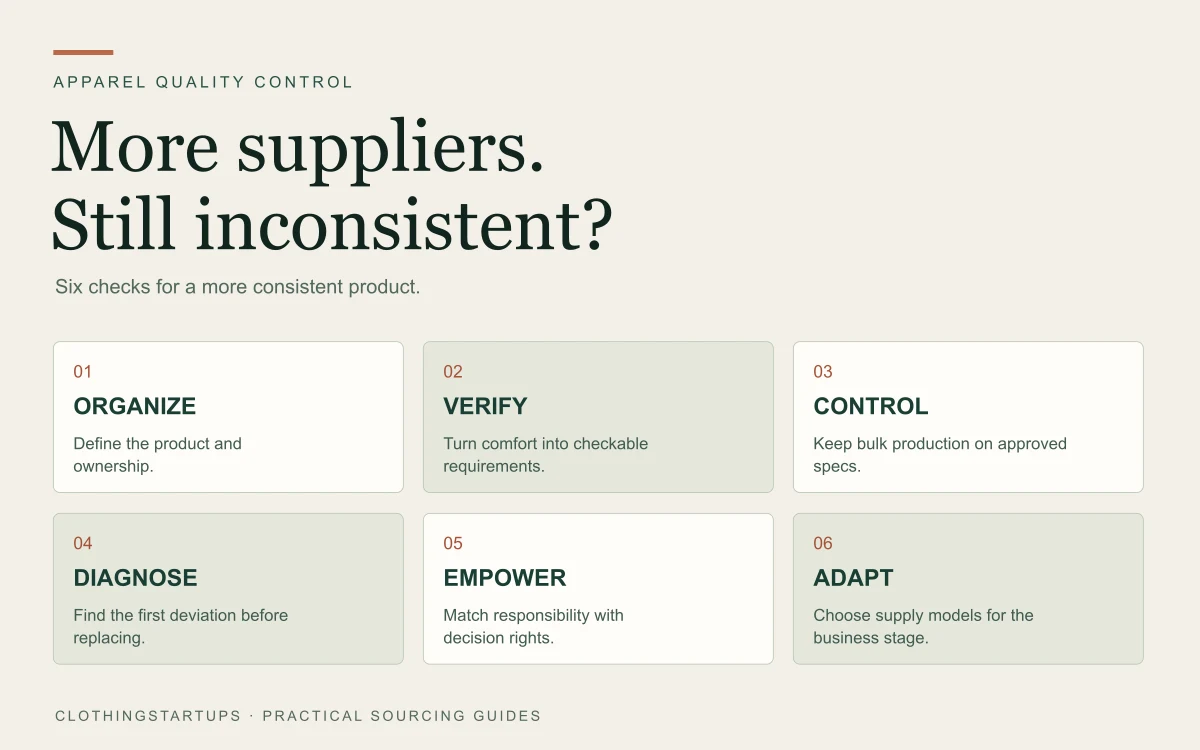
The opening was supplied in English. All six Chinese-language checklist images were translated and organized into editable English text, six tables and review questions; no original text panels are embedded as images. Source attribution visible in the supplied notes: WeChat public account 李勇华-供应链赋能. The opening and closing explanations connect the six modules; the cover diagram is an original editorial summary.
A discussion and self-audit framework, not a fixed maturity model, test protocol or verified investigation of a particular brand. The commuter-shirt and management scenarios are illustrative. Test methods, limits and acceptance criteria depend on product category, destination market and applicable requirements. Supplier changes or personnel turnover alone do not establish a root cause.
Turn a quality concern into a defined check
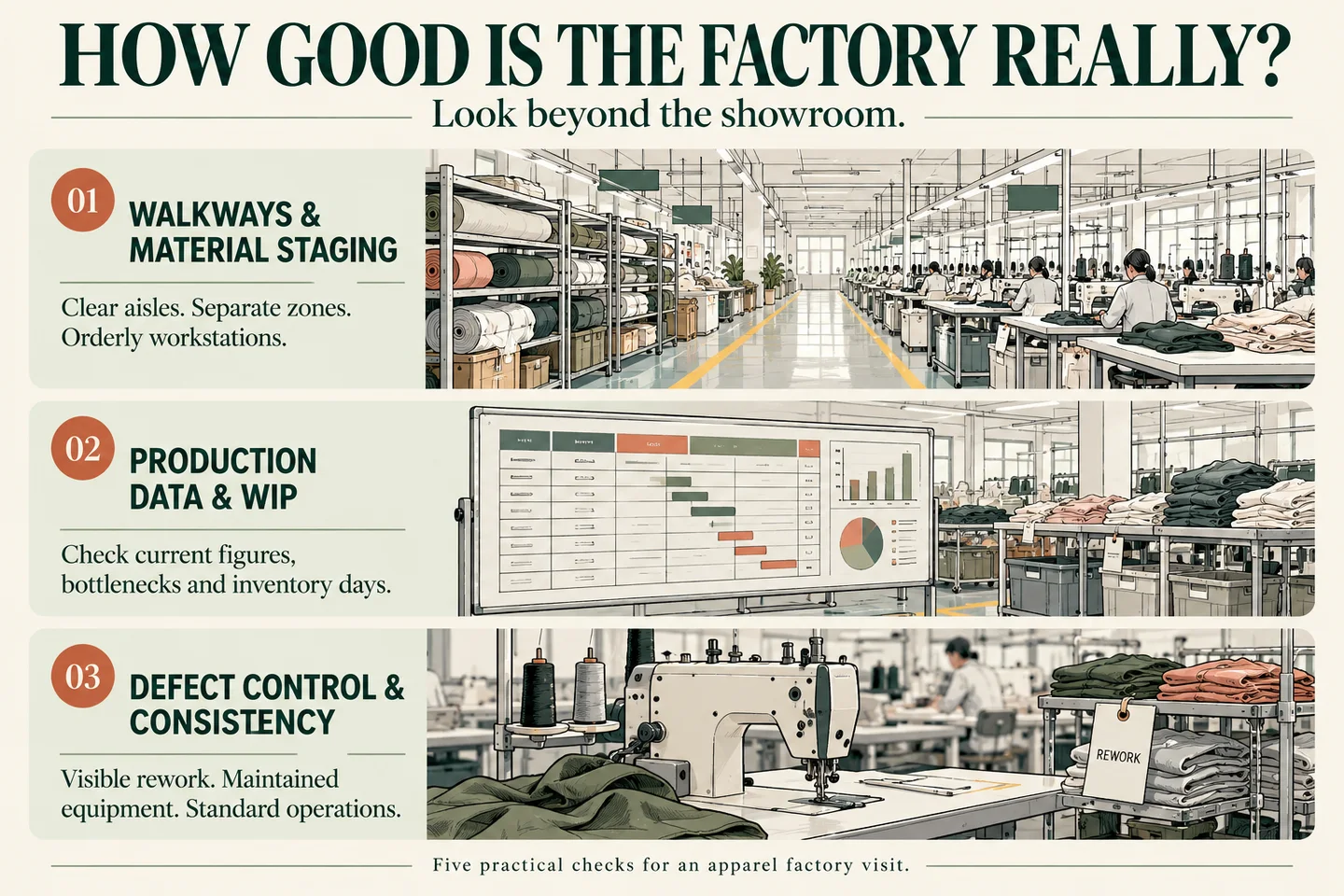
An on-site supplier visit can document agreed observations. It does not replace product specifications, laboratory testing or your own approval process.
YOUR NEXT STEP
Put the details to work.
Estimate an order or turn your specifications into a supplier inquiry.