The Fabric Bottleneck Behind Quick Response
To address this question, we must examine the underlying logic of product development and the allocation of organizational responsibilities—exploring how brands choose between two distinct fabric management models. Clear material planning creates a foundation for resolving many downstream supply-chain bottlenecks; it does not eliminate every production constraint.
In quick-response womenswear, we frequently run into a classic dilemma: a style takes off, factories are ready to take reorders, but the fabric runs short. Materials were available for the initial run, yet reorders require sourcing from scratch; buying fabric in advance, however, raises the specter of deadstock.
01. A Style Takes Off, but Reorders Get Stuck at Fabric
Looking upstream, the problem is often already taking shape during sample development. How material demand is organized, and what the fabric team is authorized to decide, influence whether execution can move quickly later.
A factory may be willing to take the reorder, but its schedule still has to wait if the material is not ready. Replenishment needs both responsive garment production and fabric supply that can continue beyond the first run.
Check fabric readiness before asking how quickly the factory can sew. Minimum quantities, dyeing and finishing lead times, and lot-to-lot stability also affect whether a reorder can proceed.
| Situation | Why it disrupts quick response |
|---|---|
| Fabric for the first order, none for the reorder | Having sample or initial-order yardage does not establish continued supply. |
| Fabric must be produced again | Weaving or knitting, dyeing and finishing have their own lead times and may miss the selling window. |
| A replacement fabric is proposed | Hand feel, color and processing suitability need renewed confirmation; the resulting garment may differ. |
02. Sourcing Fabric Separately for Every Style Makes Quick Response Harder
When each style generates an independent fabric request, the development team may add more material types without consolidating similar needs. Demand per fabric becomes smaller and is then divided again by color.
The sequence is familiar: separate style development → more fabric varieties → smaller quantities per material and color → MOQ and delivery constraints → another search once sales grow. Procurement volumes become harder to concentrate, and replenishment terms become less stable.
Waiting for a fresh production cycle after the style takes off may mean losing the sales window. The issue forms during development, while purchasing and production inherit the consequences later. Material preparation therefore needs to enter development early, rather than being added only after a strong sales result.
03. Material Readiness Means More Than Buying Cloth
To establish a workable foundation for quick response, clarify both the product requirement and the supply conditions. An approved-looking fabric alone does not answer whether it can be reused, replenished or held within an acceptable risk limit.
Getting materials organized can remove a major source of downstream uncertainty. It is not a promise that all supply-chain problems will disappear.
| Question | What needs to be clear |
|---|---|
| What should we use? | The material suits the style and wearing requirements and works with the pattern and construction. |
| How can it be shared? | There is genuine demand across styles, so procurement can be consolidated without forcing an unsuitable fabric onto a product. |
| Can it be replenished? | Quality and lot stability are acceptable, with evidence for available quantity and delivery timing. |
| How far should we commit? | Material preparation has a defined financial boundary and an agreed plan for unused balances. |
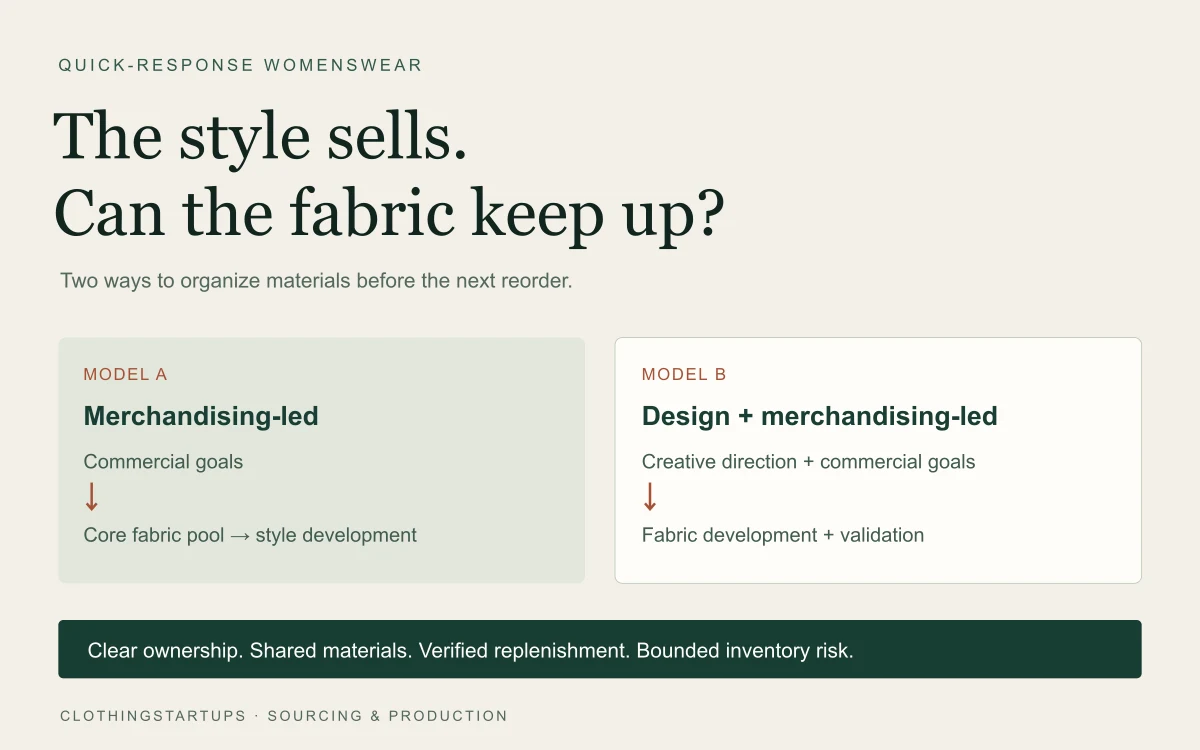
05. Model A: Merchandising-Led Fabric Planning
In this model, the fabric center sits within the merchandising or product organization, managed separately from design. A president or product decision committee oversees merchandising, design and production/supply-chain leadership; the merchandising center contains both product planning and fabric coordination.
Material planning comes earlier in the process. A core pool of proven fabrics provides a starting point, and design develops styles around that foundation. The working sequence is commercial objectives → core fabric pool → style development.
This can suit brands with a relatively stable style identity and a substantial core assortment. Priorities include fabric reuse, ongoing replenishment and inventory turnover. Proven materials take precedence, while genuinely necessary innovations remain eligible for a dedicated review. It is not a rule that designers must never introduce a new fabric.
06. Model B: Joint Direction from Design and Merchandising
In the second model, a fabric research and development center sits alongside merchandising, design and production/supply-chain functions under the president or product committee. Its position gives material development a distinct place in the decision process.
The working sequence combines creative direction and commercial goals, followed by fabric development and validation. Design can propose a distinctive material direction, while cost, quality and supply feasibility are evaluated before investment.
This can suit labels whose collection concepts and differentiated materials are central to the product proposition. The focus is to preserve creative expression while establishing commercial feasibility. Creative proposals are welcome; financial commitments still require review and authorization.
07. Choose the Model Around What Makes the Product Sell
Both arrangements can work. There is no universally optimal organization chart; the choice should return to the product’s characteristics and the brand’s commercial requirements.
The same brand can also use different approaches for different product groups. Routine styles may prioritize approved fabric reuse, while an innovative collection receives a dedicated development process. Core products and experimental ranges do not necessarily need identical arrangements.
| Decision factor | Model A: Merchandising-led | Model B: Joint design and merchandising direction |
|---|---|---|
| Product emphasis | Stable style identity and core products | Collection creativity and distinctive materials |
| Material priority | Reuse and established supply | Development, experimentation and validation |
| Operating need | Continued replenishment and turnover | Differentiation with commercial feasibility |
| Within one brand | Apply to suitable repeat programs | Apply to suitable innovation programs |
08. Clarify Accountability, Then Coordinate Around One Material Plan
Both approaches depend on clear answers to three questions: who coordinates the fabric plan, who reviews additions, and who approves the commitment?
One material plan should connect planning, development, purchasing, costing, quality and production. Materials, styles, patterns and construction must correspond. If one changes, assess the effect on cost, quality and delivery together, rather than approving the change in isolation.
Sales and quality feedback then inform whether to continue, increase the commitment or stop. Managing material readiness in advance is not the same as accumulating large quantities of fabric. Clear preparation makes it easier for responsive factories to turn capacity into actual replenishment.
What Emerging Brands Can Do First
Emerging brands don’t need to build out a full-fledged department overnight. What matters first is establishing clear ownership over fabric coordination, evaluation, and commitment decisions—ensuring material strategies are integrated into the joint preparation across planning, development, sourcing, costing, quality control, and production.
A garment is a balance of materials, pattern making, and construction. A change in material can ripple through sample development, costing, quality, and delivery schedules. When core materials are thoroughly prepared upstream, downstream work requires fewer last-minute adjustments.
Building an agile supply chain in womenswear requires mobilizing material capabilities right from the development phase. The choice between organizational models ultimately depends on the product’s profile—but regardless of the approach, expert judgment should precede a financial commitment to sourcing.
When Custom Fabric Falls Behind: Build a Verified Stock-Fabric Backup
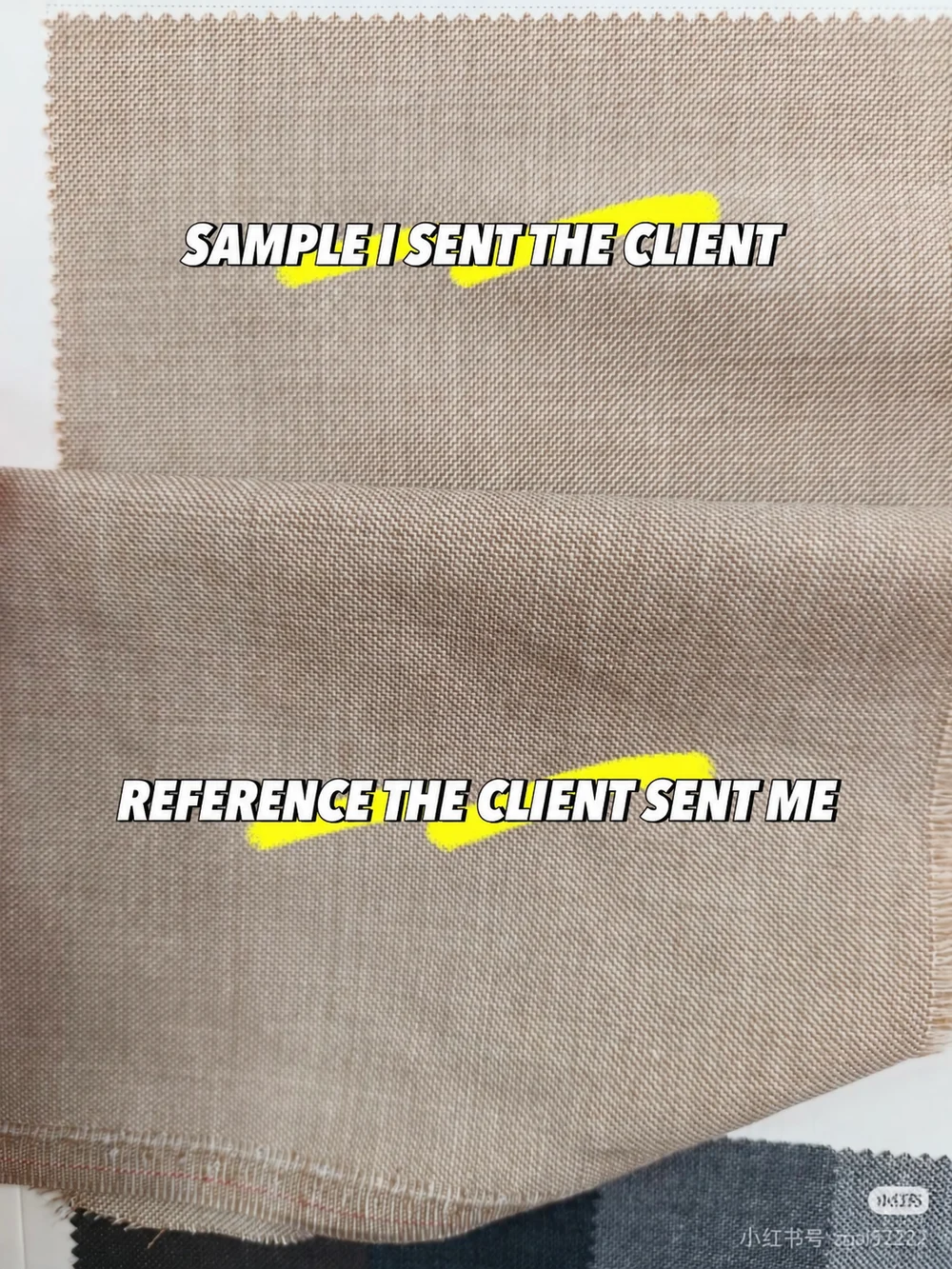
Upstream planning is the main lesson, but a live order can still face a delayed custom fabric. In that situation, a professional fabric sample search can help the brand investigate a practical fallback: an existing market fabric that matches the reference, or a close alternative that the product team can approve.
A local swatch runner can search across vendors and compare candidates against your reference and requirements. Stock fabric may avoid part of a fresh custom-production cycle when suitable material is genuinely available. It cannot guarantee immediate dispatch, an exact match or enough yardage for the whole order.
Before changing the material, confirm composition, GSM, usable width, stretch, hand feel, color, shrinkage and relevant performance. Verify the actual available quantity by dye lot and whether it can be reserved. Review the pattern, sewing process, cost and finished-garment sample with the authorized team before releasing the replacement.
Our fabric sample search service is designed for this reference-based shortlisting step. The US$99 service targets 2–5 matching or similar swatches within 1–3 days after receiving the complete brief and photos or physical reference. Courier charges are paid by the customer; transit time is additional. Exact matching is subject to availability, and sample-yardage purchases, bulk orders and laboratory testing are outside the search fee.
Use the request form below to specify what must match and which differences are acceptable. For sample yardage or bulk ordering, email [email protected] to discuss the next step. Treat a successful search as the start of replacement approval, not permission to bypass it.
The opening and conclusion were supplied in English. Eight numbered Chinese-language image panels were translated and reorganized into English sections, explanatory tables and review points in their original order. Source attribution shown in the supplied panels: WeChat public account 李勇华-供应链赋能. A practical stock-fabric fallback section and a link to this website’s sample-search service were added. The cover is an original diagram.
A management framework, not a guarantee of lead time, stock availability or commercial results. The organizational models are options rather than universal best practice. Stock fabrics require lot-specific checks and garment approval; finding a similar swatch does not establish an interchangeable bulk material.
Need a stock-fabric alternative for a delayed material?
Use a reference-based search to build a shortlist, then approve the actual material and available lot before replacing a custom fabric.
Fabric sample search — US$99: requirements and request form →
Check the revised quantity and budget with the fabric costing tool →
YOUR NEXT STEP
Put the details to work.
Estimate an order or turn your specifications into a supplier inquiry.