1. What Is Fabric Consumption (Unit Consumption) and Why It Drives Pricing
Garment buyers care about styling; garment manufacturers look at unit consumption (fabric consumption per garment) first. Fabric consumption refers to the exact amount of fabric required to produce a single piece of apparel—often measured in meters for woven fabrics and kilograms for knits, depending on the supplier’s quotation basis.
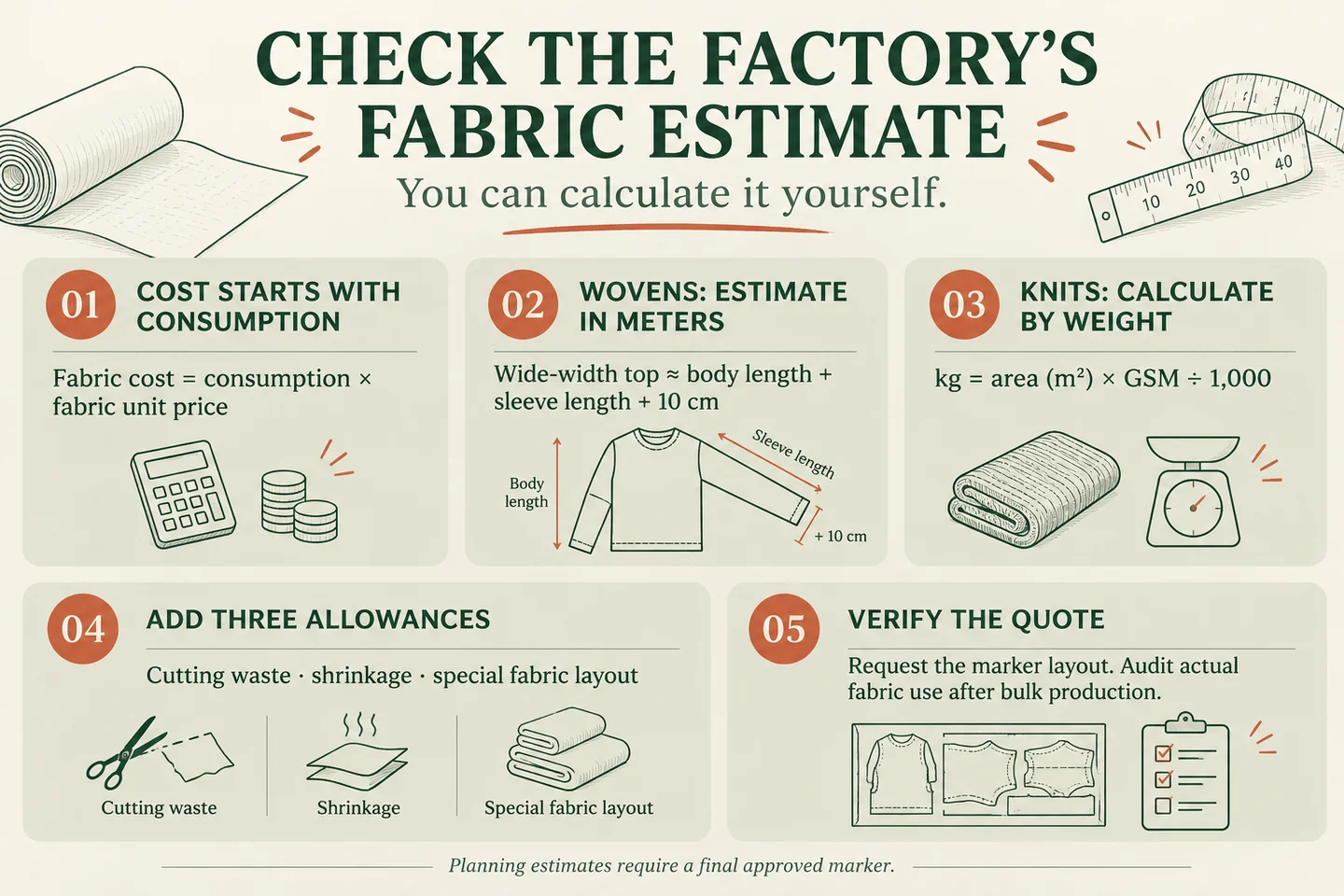
Why does it matter? Because Fabric Cost = Consumption per Piece × Unit Price of Fabric. Change the consumption figure, and the entire garment quotation shifts accordingly.
The problem is that many cost sheets simply state "fabric including waste/allowance" without breaking down the exact net consumption or the specific waste percentage. Without auditing this number yourself, it’s impossible to determine whether a price is fair or inflated.
The good news is that you can rough-calculate consumption yourself. You don’t need decimal-point precision; if the scale is off, you'll spot it immediately and can challenge the quote on the spot.
2. Woven Fabrics: Estimating by the Meter Using Rule-of-Thumb Formulas
Woven fabrics have fixed widths and are typically calculated in meters. You don’t need a measuring tape for a rough estimate—use the size specifications and the following rule-of-thumb formulas as a first check.
Tops: Wide-width fabric (140–150 cm) ≈ body length + sleeve length + 10 cm. Narrow-width fabric (90–110 cm) ≈ body length × 3.
Pants: Wide-width ≈ pant length + 5 cm. Narrow-width ≈ pant length × 2 + 10 cm.
Flared skirts (typically calculated with narrow-width): ≈ 2.5 × skirt length.
Example: For a top with a 70 cm body length and 58 cm sleeve length, wide-width fabric yields roughly 70 + 58 + 10 = 138 cm, or 1.38 meters. A buyer might round this to approximately 1.5 meters for an initial budget, while checking whether allowances have already been included. Narrow-width fabric requires roughly 70 × 3 = 210 cm, or 2.1 meters.
The noticeable difference in yardage between wide and narrow widths explains why identical garment designs can have very different quotes. These formulas are preliminary checks: size, garment girth, sleeve shape, usable width and marker feasibility can change the result.
| Garment | Wide width (140–150 cm) | Narrow width (90–110 cm) |
|---|---|---|
| Top | Body length + sleeve length + 10 cm | Body length × 3 |
| Pants | Pant length + 5 cm | Pant length × 2 + 10 cm |
| Flared skirt | Verify the actual marker | Approx. 2.5 × skirt length |
3. Knit Fabrics: Calculating by Weight via Area and GSM
Knit fabrics such as single jersey, fleece and sherpa are stretchable, and usable width can change with relaxation and finishing. They are often quoted by the kilogram, so consumption may be calculated by weight. Confirm the actual pricing unit: knits can also be sold by length.
Consumption (kg) = Area (m²) × GSM (g/m²) ÷ 1,000
Example: Hoodie body only, using the contributor’s approximate two-panel method:
Body fabric area (m²) = [(Half chest + Half hem + 6) ÷ 2] × (Body length + 6) × 2 ÷ 10,000
Body fabric weight (kg) = Body fabric area (m²) × GSM ÷ 1,000
In this area formula, half chest, half hem and body length are entered in centimeters. Dividing by 10,000 converts cm² to m². If dimensions are entered in meters instead, convert the 6 cm allowances to 0.06 m and omit the area conversion.
Units must be consistent, and GSM should be based on measurements of the actual fabric. This estimates only the hoodie body; sleeves, hood, pockets, rib trim and other pieces must be calculated separately. The formula yields approximate net panel consumption with the stated dimensional additions, not the final total including marker waste and all production allowances.
4. The 3 Essential Additions: Why Neglecting Allowances Yields Flawed Estimates
The most common mistake in self-estimation is treating net consumption as actual consumption. Fabrics must be cut, cutting generates waste, and you must account for shrinkage and special layout constraints.
① Marker Waste / Cutting Allowance: The manuscript suggests a 12% starting allowance for cutting, spreading and nesting waste, with complex panel layouts potentially reaching 20–30%. Confirm what is included and whether the percentage is measured against net consumption or total fabric issued.
② Fabric Shrinkage: Planning ranges supplied here are 2–5% for 100% cotton and 5–8% for wool. Actual results depend on fabric construction, finishing and care procedure, so use the approved test result before production, especially for garments requiring washing or preshrinking. Avoid adding shrinkage again if it is already built into the pattern or supplied fabric condition.
③ Special Fabric Additions: Add an extra 5–10 cm as a preliminary allowance for matched plaids or stripes, then verify against repeat size and the marker. Directional pile fabrics such as velvet and corduroy require a one-way layout; the manuscript suggests roughly 20% additional yardage as a planning reference.
Actual consumption can commonly be 10–30% above a simple net estimate, but these are not universal limits, and combined constraints can exceed that range. If a factory’s quote exceeds your raw calculation, don’t automatically assume you’re being overcharged—check whether it includes these allowances.
Clarify percentage arithmetic. A 12% addition to net fabric gives net × 1.12; a 12% loss measured as a share of gross fabric instead gives net ÷ 0.88. Those figures are different. Agree the basis and avoid double-counting losses already included in the quoted consumption.
5. How to Verify Factory-Quoted Fabric Consumption
Run your own preliminary estimate. Apply formulas based on the size specification chart; if the scale differs substantially, question it directly.
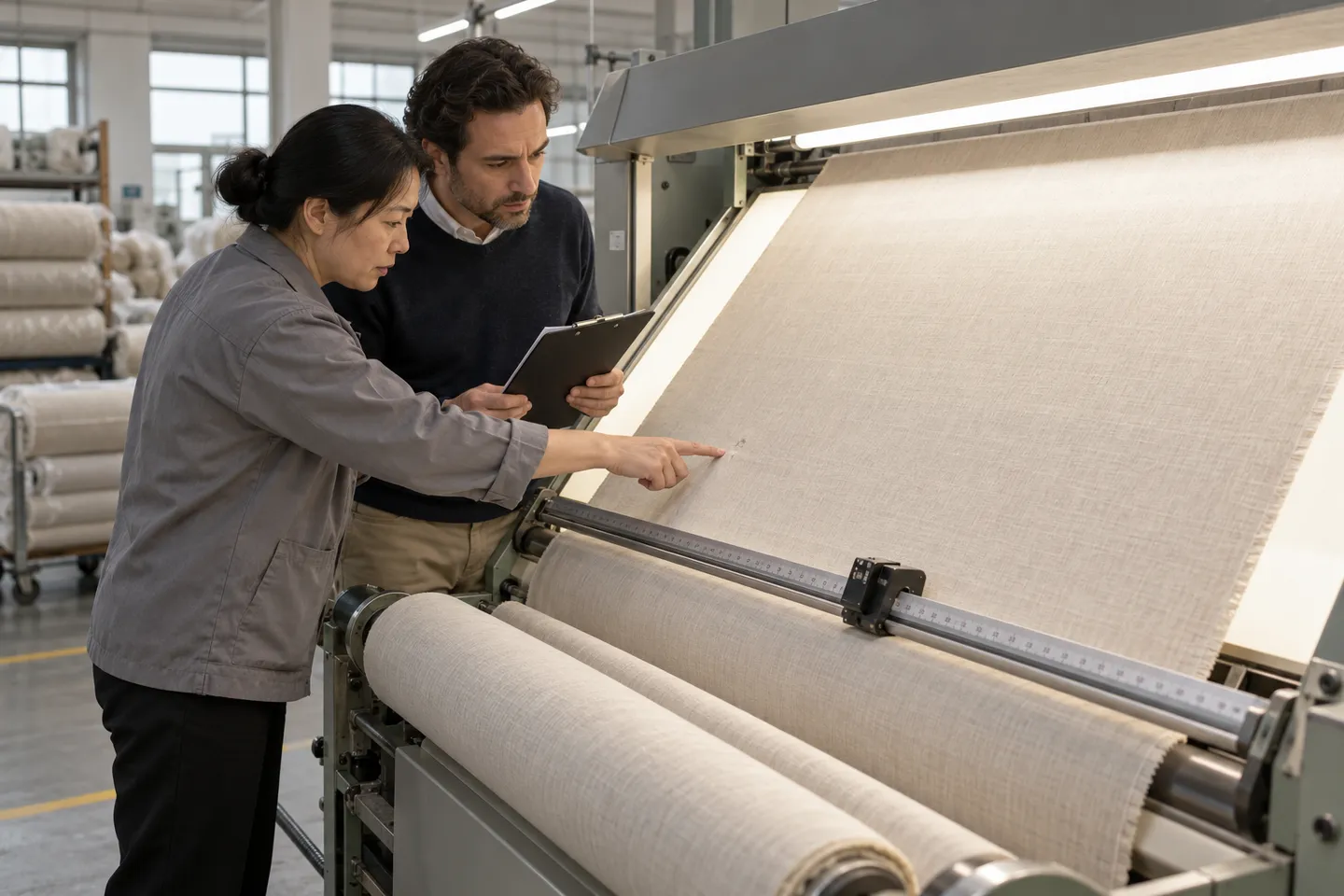
Request the marker diagram (nesting layout). Examining the marker reveals whether the factory optimizes fabric efficiency—for example, by nesting smaller pattern pieces into gaps between large garment panels. Check that the marker uses your actual size ratio, usable width, grain direction and matching requirements.
The contributor supplies the following cutting-waste reference ranges: single jersey 15–16%, fleece 17–18%, spandex jersey 18–20%, and yarn-dyed fabrics 22–32%. These are comparison benchmarks, not fixed waste rates for every order. Agree the denominator and included loss stages before using them to challenge a quote.
Conduct a post-production audit. Divide total actual fabric consumed by total units produced and compare it with the quote sheet. Reconcile fabric issued, unused returns and remaining stock, and state whether the denominator is all produced pieces or accepted garments. Significant discrepancies provide useful benchmark data for future cost negotiations.
| Fabric category | Contributor’s cutting-waste reference |
|---|---|
| Single jersey | 15–16% |
| Fleece | 17–18% |
| Spandex jersey | 18–20% |
| Yarn-dyed fabrics | 22–32% |
Conclusion
While rough fabric calculations help you gauge magnitude rather than serve as binding contract figures—true precision requires a finalized marker diagram—possessing this estimation capability gives you useful leverage.
When negotiating prices with a factory, you have an objective yardstick to evaluate whether their material figures add up. During discussions, simply ask:
“Can you share the marker layout? And let’s audit the actual fabric consumption once bulk production is completed.”
Adapted from the contributor’s supplied manuscript. The Chinese reference graphic was translated and redesigned in English. Formula units were made explicit, including the cm²-to-m² conversion. The garment formulas, waste percentages and shrinkage ranges are practitioner-supplied planning references, not a universal cutting standard or a factory quotation.
Use the actual size mix, pattern pieces, cuttable width, tested GSM, shrinkage and approved marker for production costing. Confirm the loss-percentage basis and avoid duplicate allowances.
YOUR NEXT STEP
Put the details to work.
Estimate an order or turn your specifications into a supplier inquiry.