Three Types of Factory Price Hikes—and Why They Need Different Responses
What is the biggest fear when partnering with a garment manufacturer? It isn't quality defects or delivery delays; it is the factory suddenly announcing a price hike mid-production. Rising fabric costs, increasing labor fees, and peak-season surcharges—each can leave you completely blindsided. Today, we break down the 3 types of factory price increases, how to respond to each, the key negotiation levers you hold, and the common supplier tactics to watch out for.
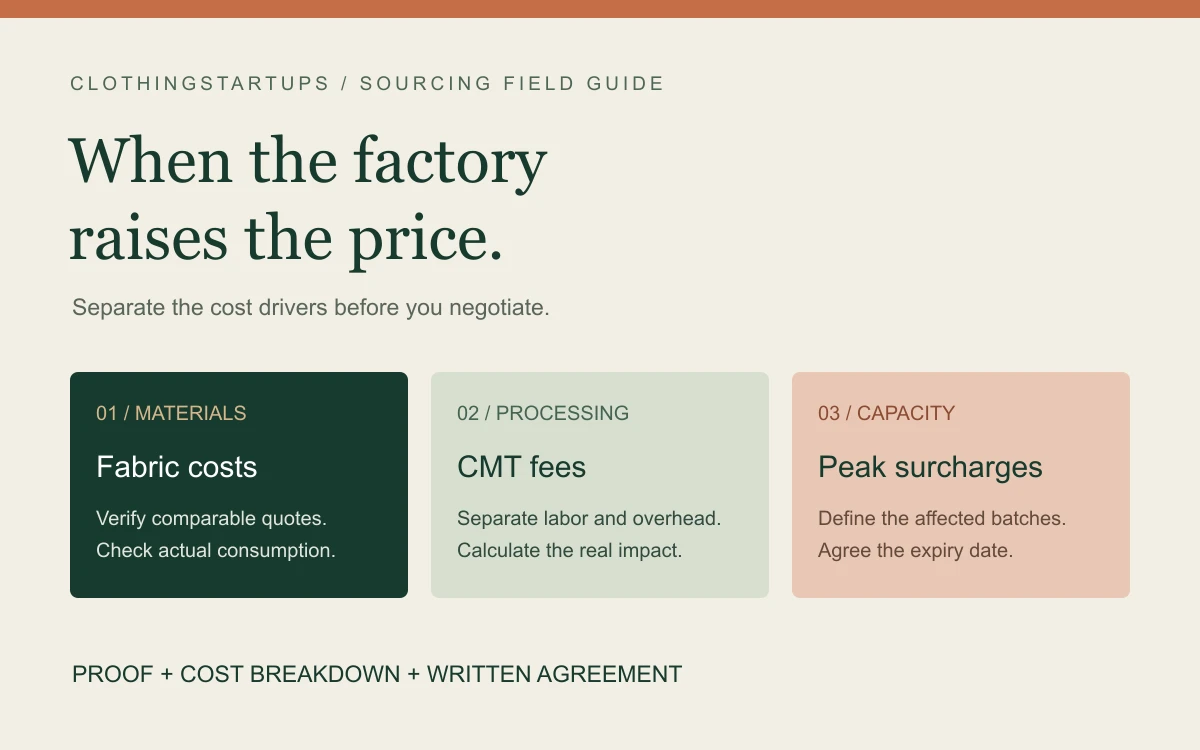
Price adjustments can arise in a manufacturing relationship, but different cost drivers demand different responses. Separate a verified change in cost from an unexplained change in margin before agreeing to a revised garment price.
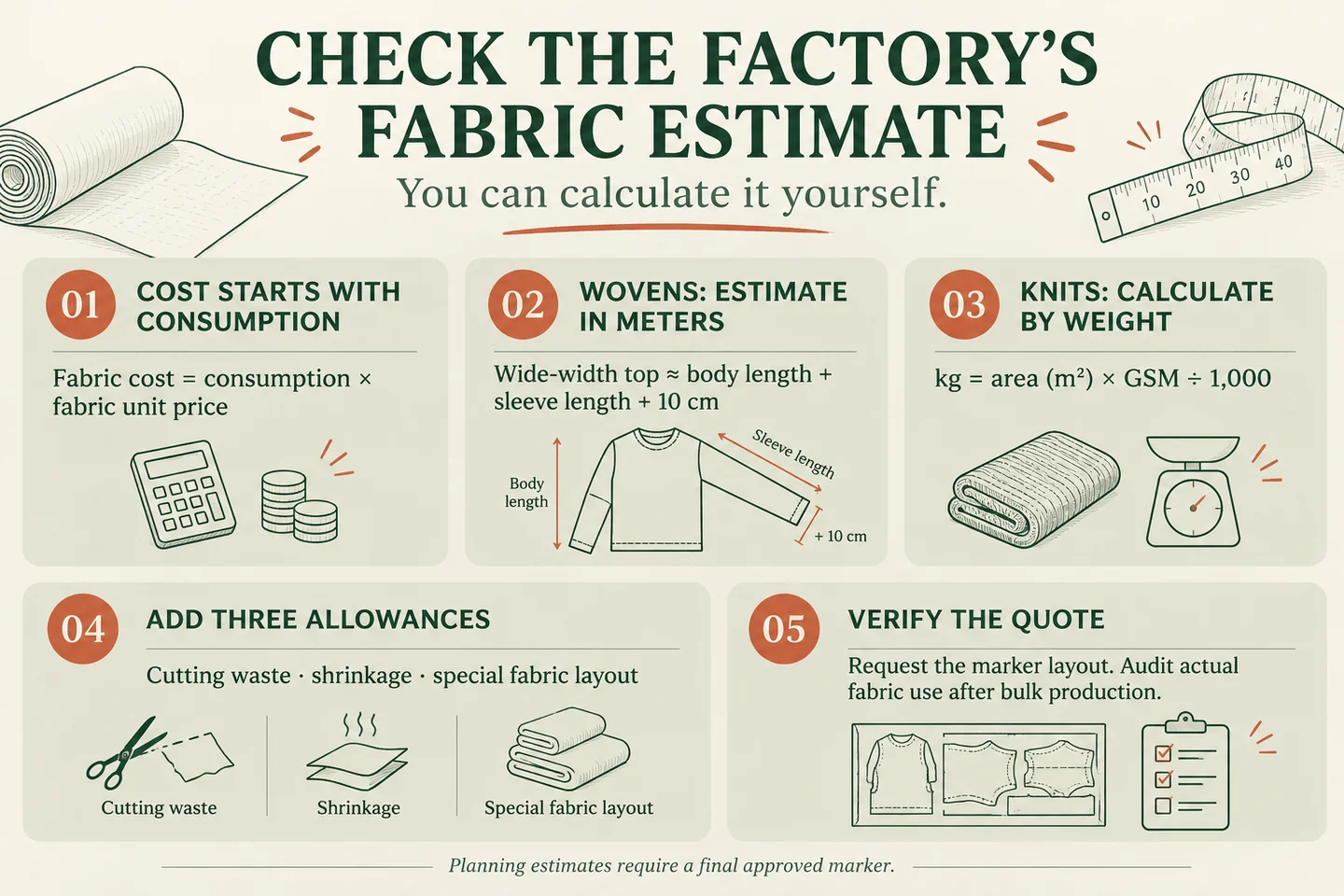
Fabric suppliers may raise their rates and the factory may pass the added cost to the brand. This is one potential source of a garment price increase, but a statement such as “fabric costs rose by 10%” does not establish how much the finished garment should increase. Verify the actual fabric rate, the affected quantity and the agreed consumption before calculating the impact.
Labor costs can lead a factory to request higher CMT (cut, make and trim) fees. Ask which operations and workers are affected and whether production time, efficiency or the specification has also changed. A rise in selected wage rates is not automatically the same percentage rise in the complete processing fee.
A factory with constrained capacity may request a temporary peak-season surcharge. The busy period depends on product, region and the factory’s order book; August to October is a planning example for some Autumn/Winter programs, not a universal calendar. Agree the reason, affected batches, base price and end date so a temporary charge does not silently become permanent.
| Price driver | Evidence to request | Question to resolve |
|---|---|---|
| Fabric and trims | Old and new comparable quotes; consumption; affected stock | Which uncommitted materials actually cost more? |
| CMT and labor | Operation breakdown; labor share; time and efficiency assumptions | How much does the changed input affect the full fee? |
| Peak-season capacity | Reserved schedule; affected batches; base rate and expiry | Is this a temporary surcharge or a new base price? |
When Fabric Prices Rise: Verify, Compare and Prepare Alternatives
Step 1: Demand Official Verification
Request supporting evidence rather than accepting a verbal statement that fabric prices have risen. An original supplier notice with a date and identifiable issuer is useful; a company stamp, where normally used, helps identify the document but does not prove the increase applies to your order. Ask for the old and new quotations, effective date, fabric specification and affected purchase quantities. Where confidentiality prevents sharing an invoice, agree an appropriate redacted record or other verification.
Step 2: Cross-Check the Inflation Rate
Cross-check comparable supplier quotations, including wholesale markets or B2B platforms such as 1688 where relevant. A public listing is a lead, not proof of the transaction price. Differences between a factory’s claim and a market listing should trigger questions about specifications and terms, not an automatic accusation of dishonesty.
Compare the same construction, GSM, fiber composition, usable width, finish, color, testing requirements, quantity and commercial terms. Normalize kilograms, meters and yards before comparing prices; confirm tax, freight and currency treatment. A cheaper fabric with a different specification is not a like-for-like benchmark.
Step 3: Lock Prices via Contract Clauses
Discuss a clear price mechanism in the purchase agreement. For example: “The agreed fabric price for the specified order remains fixed through delivery, except for adjustments expressly permitted under this agreement and confirmed through the agreed written procedure.” Define the baseline, notice period, evidence, cap and affected quantities. Existing revision or hardship clauses and applicable law still matter; a sample sentence is not a universal legal safeguard. [1]
Step 4: Source Alternative Fabrics
Pre-qualify two or three alternative fabrics before a shortage or disputed increase becomes urgent. A 15% rise could be an internal review trigger, but it is not an industry threshold. Check hand-feel, weight, width, shrinkage, shade and performance, then reapprove the sample, bill of materials and consumption before changing material. Fabric already purchased and goods in progress also need an agreed disposition.
When CMT Fees Rise: Separate Labor from the Complete Processing Price
Point 1: Check the Contractual Price-Lock Period
Check the agreed price-lock period, order scope and any adjustment exceptions before responding to a labor-cost claim. A six-month or one-year lock is a negotiated example, not a standard entitlement. Separate the price of an accepted order from quotations for future orders, and document any agreed change.
Point 2: Ensure the Rate Increase Matches Market Benchmarks
A reasonable wage-related adjustment may be appropriate for a long-term partner, but apply it to the relevant labor component rather than automatically to the whole CMT fee. For example, if direct labor is $2 of a $5 processing fee and that labor cost rises by 8%, the isolated impact is $0.16, or 3.2% of the processing fee, assuming all other inputs remain unchanged. Review legitimate overhead and productivity changes separately. Responsible costing should cover the labor needed to produce the order rather than push a price concession onto workers. [2]
Point 3: Itemize and Deconstruct Processing Fees
Never accept a vague, blanket statement like "processing fees increased by 10%." Request a line-item breakdown of the CMT fee structure: cutting, sewing, finishing, and packaging. Pinpoint exactly which operation drove the cost increase—some line items should not be impacted at all.
Point 4: Lock Rates Through Phased Order Placement
Plan follow-up orders early and ask the factory to quote defined batches against an agreed schedule. Phased purchase orders may help stabilize rates, but a forecast alone does not reserve capacity or fix a price. Confirm quantities, validity, material commitments, cancellation terms and what happens if the release schedule changes.
When Peak-Season Surcharges Appear: Define the Scope and End Date
Tactic 1: Advance Order Schedules to Bypass Peak Periods
Build the production calendar with the factory before its capacity becomes constrained. Moving an order 30–45 days earlier can be a planning option where development and materials are ready; it is not a guarantee of available capacity or zero surcharge. For an August delivery, work backward from approved samples, fabric lead time, sewing capacity, inspection and transport rather than relying on a fixed calendar rule.
Tactic 2: Put Peak-Season Terms in Writing
Draft clauses using either of two approaches:
1. Agree no peak-season surcharge for the defined order and reserved capacity.
2. Agree a capped surcharge, with a specified trigger, cost basis and affected batches.
Tactic 3: Explicitly Define Adjustments as Temporary vs. Permanent
State explicitly whether a surcharge is temporary or a proposed change to the base price. A discussion clause might read: “The agreed surcharge applies only to [batches/dates] and expires on [date], after which the agreed base price resumes unless both parties confirm otherwise in writing.” Record the base price and review date in the order confirmation. [1]
Tactic 4: Maintain Backup Factory Capacity
Maintain two or three pre-vetted backup factories where the scale of the business justifies it. Confirm equipment, quality capability and actual capacity before depending on them. A transfer is not seamless: it may require sample approval, pattern and trim handover, material release and a new delivery plan.
Three Negotiation Levers: Reliable Volume, Payment Timing and Real Alternatives
Lever 1: Total Order Volume and Reorder Consistency
Reliable reorder visibility, realistic forecasts and consistent payment can support a stronger negotiation position. Present confirmed work and credible planned styles honestly. Do not promise volumes you cannot commit; agree which commitments justify a concession and how releases will be scheduled.
Lever 2: Payment Terms
Shorter settlement cycles may have value to a factory, but a larger deposit also increases the buyer’s exposure. An illustrative proposal is: “Can we agree a smaller processing adjustment in exchange for a revised payment schedule?” Before increasing a deposit, verify the supplier, the payee and documented milestones; compare the cash-flow cost and risk with the actual saving. A 50% deposit or two-percentage-point concession is an example, not a recommended default.
Lever 3: Off-Ramps and Alternative Suppliers
A qualified alternative supplier provides a genuine option rather than a negotiating bluff. Compare the total switching cost, approval time and delivery risk with the proposed increase before deciding whether to move production.
Keep the conversation factual: reaffirm the preferred relationship while explaining which cost, timing or quality conditions the business needs to meet. Avoid empty threats or a transfer plan that has not been validated.
Three Pricing Traps to Check Before You Agree
The risk: a broad percentage increase hides which cost actually changed. A 5% material increase and a 10% garment increase are not directly comparable without the cost shares, consumption and other changes.
Prevention: Demand original price hike notices from raw material suppliers, verify market spot prices independently, and require itemized cost breakdowns for all processing fees.
The risk: a temporary peak charge remains in later quotations because no expiry date or original base price was recorded.
Prevention: Ensure contract clauses state that "peak-season surcharges are temporary and shall revert to original base pricing after [Date]." Actively issue formal rate-reversion confirmations to the factory immediately following peak season.
The risk: a last-minute price notice is coupled with pressure to lose the production slot, leaving the buyer little time to evaluate alternatives.
Prevention: agree notice and approval procedures, build realistic lead times and maintain qualified alternatives. Ask which accepted orders are affected and what the contract permits; record the response and any revised schedule rather than assuming every unilateral notice has the same legal effect.
A Practical Written Response to a Price Increase
Ask for the same information every time so the negotiation stays comparable:
“Please identify the affected styles, orders and quantities; the original and proposed unit rates; the cost components that changed; supporting evidence and effective dates; and the total impact per garment. Please separate purchased materials from materials not yet committed and confirm whether any surcharge is temporary, with its expiry date. We will review the proposal against the agreed order terms and confirm any accepted change through the written approval procedure.”
Record which version of the cost sheet controls, who can approve it, and whether delivery, quality or payment terms also change. Do not solve a price dispute by silently reducing fabric specifications or skipping approval and inspection.
Agree the Adjustment Rules Before the Next Order
Price adjustments are a normal aspect of business—factories must remain profitable to operate. However, price hikes are negotiable and should never be passively absorbed.
Keep these three core principles in mind:
1. Demand Proof: Require original documentation for cost increases and independently cross-check market benchmarks.
2. Agree the Rules: Define price validity, adjustment triggers, surcharge caps and expiry dates, while checking contractual exceptions.
3. Maintain Alternatives: Keep 2–3 backup manufacturers ready and pre-qualify alternative fabric options.
Negotiate the adjustment mechanism during onboarding rather than waiting for a crisis. State the conditions, evidence, notice timeline, cap and review procedure, and identify who can authorize a change. Clear terms and cost records give the parties a practical basis for negotiation; material contractual disputes require advice appropriate to the agreement and governing law.
Adapted from the contributor’s supplied manuscript, organized by cost driver and negotiation response. Illustrative percentages, timing and supplier counts are planning examples, not market benchmarks. Wage pass-through arithmetic and blanket claims about contracts and price evidence were clarified.
A practical sourcing discussion framework. Actual prices, supplier capacity and contractual remedies depend on the order and agreement. Sample wording is for discussion and requires adaptation to the governing terms.
Sources
YOUR NEXT STEP
Put the details to work.
Estimate an order or turn your specifications into a supplier inquiry.