1. Why Ignorance of Factory Jargon Costs You Money
When dealing with garment manufacturers, financial losses do not always stem from listed unit prices—they can stem from information asymmetry.
Take a typical quotation clause: when a vendor claims, “The fabric waste factor on this style is high,” an experienced buyer immediately asks for a breakdown of net consumption, cuttable width and marker efficiency. An inexperienced buyer may simply accept a higher total price. Industry jargon is not about sounding sophisticated; it is a precision tool used to turn vague claims into verifiable metrics.
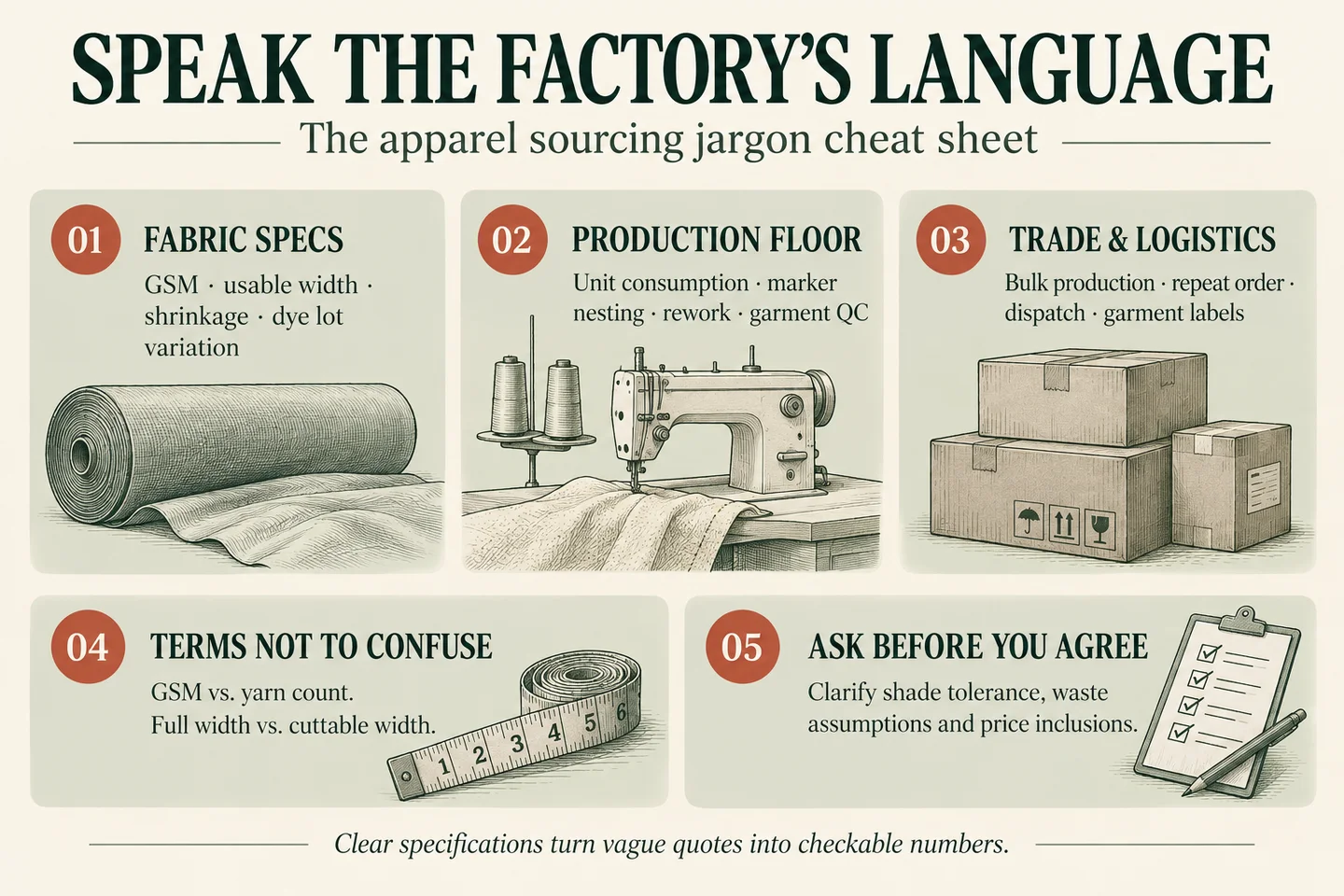
Below is a breakdown of essential manufacturing terms across three operational stages: Fabric, Production, and Trade/Logistics. Use them to clarify what the supplier is measuring, promising and including in the price.
2. Fabric Specs: 4 Terms That Dictate Yield and Color Precision
① GSM (Grams per Square Meter / Fabric Weight)
GSM measures fabric mass per square meter. It helps describe the weight class, but does not alone dictate thickness, softness or quality: yarn, fiber and construction matter too. The manuscript gives 180–220 GSM as a T-shirt example and 80–150 GSM for some lightweight fabrics. These are product examples, not boundaries defining every T-shirt or every heavy knit. Confirm the actual fabric brief and measured weight.
② Cuttable Width (Usable Fabric Width)
This is the width available to the marker after excluding unusable edges. It is different from overall roll width. Loom or knitting-machine configuration sets constraints, but relaxation, processing and finishing can change the delivered width. Record the required finished cuttable width and the measurement conditions rather than assuming it cannot change.
Widths around 140–150 cm are common in apparel; 114 cm and narrower options also exist. Narrow fabric is not exclusively for interlinings or linings. Wider fabric can improve marker yield, but a change from 114 cm to 150 cm does not guarantee a particular percentage saving. Check the real size mix and nesting layout.
③ Dimensional Shrinkage
This is a reduction in dimensions after a specified process, such as laundering or steaming. Agree the method, care conditions and limits in each direction. Cotton, wool and polyester do not have one fixed shrinkage rate: construction, heat setting, relaxation and finishing all affect the result. In particular, 8–15% should not be treated as a normal universal rate for 100% polyester. Test the actual fabric and account for compensation in the pattern before cutting.
④ Dye Lot Variation (Shade Variation)
This means a color difference between batches processed in different dye lots. A split bulk order may require shade grouping to keep garment panels consistent. It is not the same as metamerism, where two samples match under one light source but differ under another. It is also separate from colorfastness, which concerns resistance to color change or transfer under a specified exposure.
| Term | What to ask the factory |
|---|---|
| GSM | What finished GSM, tolerance and conditioning method are specified? |
| Cuttable width | What minimum finished usable width was used for the marker? |
| Shrinkage | What measured length/width changes apply under the agreed wash or steam test? |
| Dye lot variation | Which approved sample, light sources and shade tolerance are being used? |
3. Production Floor: 4 Terms That Define Base Costing
① Unit Consumption (Fabric Used per Garment)
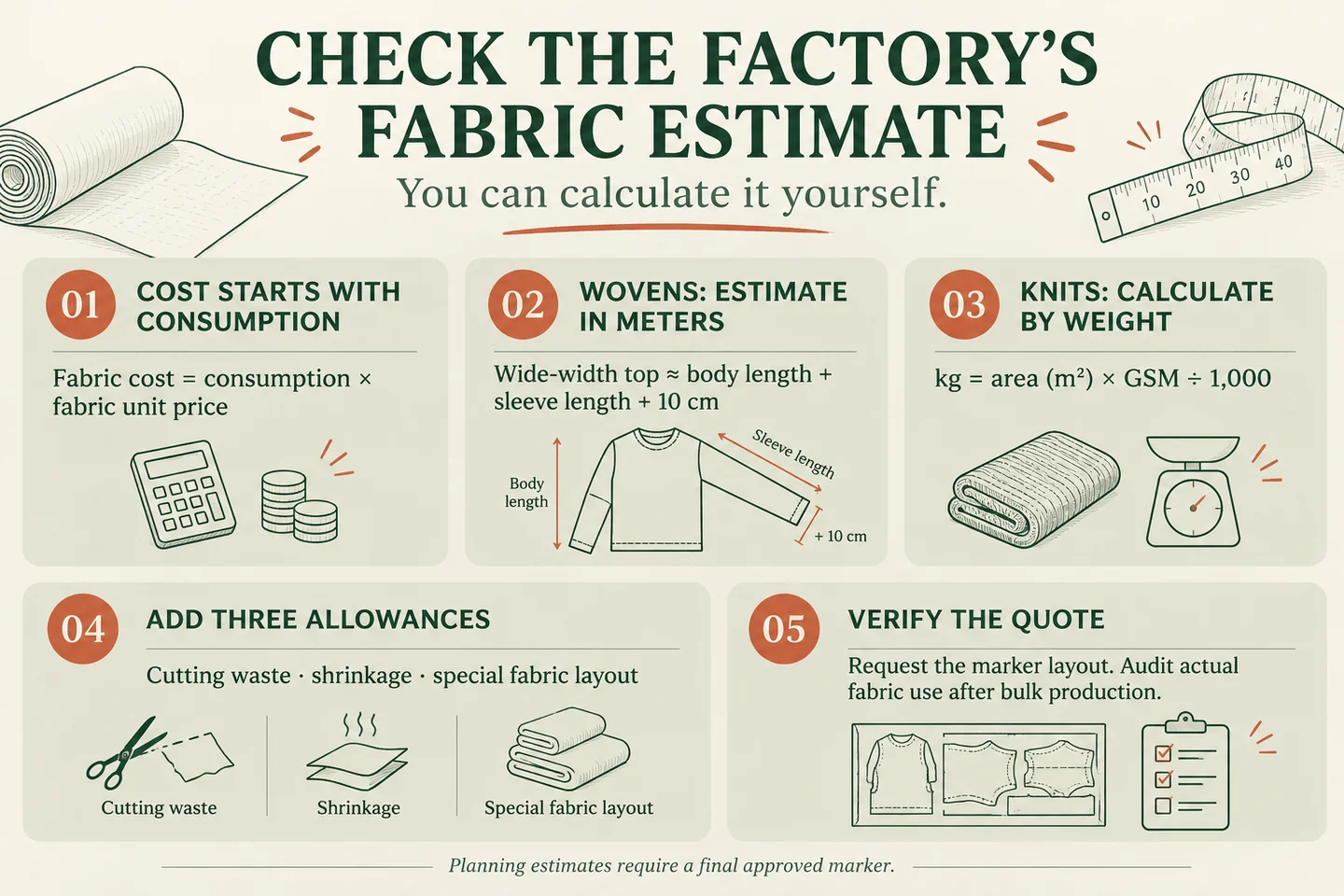
This is the yardage, meterage or weight required for one garment. It forms the baseline for material costing and deserves verification when reviewing a cost sheet. Ask whether the quoted figure is net pattern consumption, marker consumption, or gross consumption after spreading and production allowances. “Yield” can be used differently by suppliers, so state the unit and definition.
② Marker Nesting (Interlocking / Marker Efficiency)
This is the layout of pattern pieces within usable fabric width, including smaller pieces such as collars, pocket flaps and cuffs. Marker efficiency normally expresses pattern-piece area as a share of marker area. It must respect grain, nap, stripe or plaid matching, size ratio and cutting restrictions; rotating a piece to improve the percentage is not always acceptable. A more efficient valid marker can reduce waste.
③ Rework (Factory Defect Repair)
Rework means correcting nonconforming garments or components. Actionable decisions require a tech pack, agreed tolerances, defect definitions and a corrective-action process. A rework rate should state its denominator and whether it counts units or defects. The sampling plan used to accept a shipment is not, by itself, a repair specification for every garment.
④ Garment Inspection (Inline & Final QC)
Typical checkpoints include initial production inspection (IPI), during-production inspection (DUPRO), and final random inspection (FRI). Their timing, coverage and release conditions should be agreed. ISO 2859-1 describes AQL-indexed attribute sampling schemes for lot-by-lot inspection; not every inline check is automatically governed by the same sampling plan. [1]
An AQL number alone is incomplete. Specify the lot size, inspection level, sampling plan, defect classification and applicable acceptance/rejection criteria. AQL is not a promise that every accepted shipment contains no more than that percentage of defective garments.
| Production term | Useful evidence |
|---|---|
| Unit consumption | Approved marker, size ratio and separate allowance breakdown. |
| Marker efficiency | Marker area and panel area for the actual fabric width and layout rules. |
| Rework rate | Defect log, unit/defect denominator and corrective-action record. |
| Final inspection | Agreed sampling plan, defect definitions and inspection report. |
4. Commercial Terms: 4 Concepts Governing Logistics & Documentation
① Bulk Production
Bulk is the manufacturing run produced against approved specifications, usually including an approved pre-production (PP) sample, tech pack and construction requirements. A prototype demonstrates design feasibility; it is not necessarily the final approval standard. Identify the approved sample revision and required approvals before bulk starts.
② Repeat Order (Reorder)
A reorder is a subsequent run of an existing style. It can reuse patterns, grading and established specifications, which may shorten development. However, it does not automatically waive sample or color approval. Confirm revisions, materials, shade, supplier capacity and any required repeat PP approval, especially if fabric batches or manufacturing locations change.
③ Ex-Factory / Shipment Date (Cargo Dispatch)
These expressions must be defined in the order. An ex-factory availability date, collection date, carrier handover, vessel departure and destination arrival are different milestones. Do not assume that a contract’s “ship date” always means factory dispatch.
EXW is an Incoterms® rule when properly incorporated with a named place and version, such as “EXW [named place], Incoterms® 2020.” Under EXW, delivery generally occurs when goods are placed at the buyer’s disposal at that place, not loaded onto the collecting vehicle; the seller is not obliged to arrange export clearance. A colloquial “ex-factory price” does not automatically specify all those terms. [2]
④ Garment Labels and Trim Identification
The main label identifies the brand, the care label communicates the required care and other applicable information, and the size label identifies the size designation. A size label does not necessarily state the garment’s actual measurements. Confirm fiber-content, origin and other mandatory labeling requirements for the selling market.
The Chinese term “唛头” can also mean shipping marks on cartons, depending on context. Ask whether the factory means garment labels or outer-carton marks. Mislabeling may require sorting, relabeling or wider reinspection, but the remedy depends on the error, scope and agreed requirements—not an automatic full-lot repair for every minor label issue.
5. Frequently Confused Term Pairs
Similar words can conceal different measurements or approval stages. Make both sides explicit in the quotation and production documents. The following comparisons help prevent a conversation about one thing from being priced or inspected as another.
| Term pair | The distinction |
|---|---|
| GSM vs. yarn count | GSM measures fabric mass per area. Yarn count describes yarn fineness in a stated system. In indirect systems such as Ne, higher counts mean finer yarn; in direct systems such as tex or denier, higher values mean coarser yarn. Neither alone guarantees softness. |
| Overall width vs. cuttable width | Overall width includes edges; cuttable width is what the marker may use. A 2–4 cm difference is an example, not a universal deduction. Measure the actual cloth. |
| Bulk production vs. prototype samples | Prototypes explore feasibility. Bulk follows approved production specifications, usually with a PP approval stage between them. |
| Reorders vs. new styles | Reorders can reuse approvals and development work, but changes and approval requirements still need confirmation. New styles need development appropriate to the product. |
| Dye lot variation vs. metamerism | Lot variation is a batch-to-batch color difference. Metamerism concerns a match changing under different illuminants. Both can require control. |
6. Three Vendor Statements That Demand Immediate Clarification
“A little shade variation is completely normal.”
Your Follow-Up: “Are we talking about dye-lot-to-dye-lot variation or roll-to-roll variation within the same lot? What approved sample, light sources and specific grey-scale tolerance are we using—for example, a minimum Grade 4 if that is our agreed requirement?”
“Our waste allowance is standard across the board.”
Your Follow-Up: “What is the net consumption per garment, what cuttable width and size ratio were used, and what marker efficiency supports this allowance? Is the percentage an addition to net fabric or a loss share of gross fabric issued?”
“This is our ex-factory price.”
Your Follow-Up: “Is this expressly EXW at a named place under Incoterms® 2020, or just a factory-gate quotation? Please list the tax treatment, packaging, loading, export clearance, inland trucking and terminal charges included or excluded.”
This last question clarifies the cost build-up; it does not mean those extra services are standard EXW seller obligations. If the seller is to perform additional logistics work, agree the responsibilities and appropriate delivery term separately. [2]
Conclusion
Mastering factory jargon provides a more objective yardstick for vendor management. The goal is to translate a familiar-sounding phrase into a specification, approval, measurement or cost item that can actually be checked.
Before committing to a contract, lock down three critical metrics: unit consumption, cuttable width and dye-lot color tolerances. Pair them with approved documents, defined quality controls and clear commercial responsibilities. Written specifications do not eliminate every dispute, but they make unexplained additions easier to question and costs easier to compare.
Adapted from the contributor’s supplied manuscript, excluding the translator’s introductory note. Terminology was clarified where the draft treated variable fabric properties or contract terms as universal. AQL and EXW explanations were checked against ISO and ICC sources. The supplied Chinese image was translated and redesigned into an English article cover.
Practical sourcing terminology, not a substitute for an agreed tech pack, sampling plan, test procedure or legal review of a sales contract. Fabric ranges and shade-grade examples are not universal acceptance standards.
Sources
YOUR NEXT STEP
Put the details to work.
Estimate an order or turn your specifications into a supplier inquiry.