1. Per-Meter vs. Per-Kilogram: Why Fabric Suppliers Quote Differently
When sourcing fabric, you will encounter two distinct pricing models: one supplier quotes “$5.50 per kilogram,” while another quotes “$1.70 per meter.”
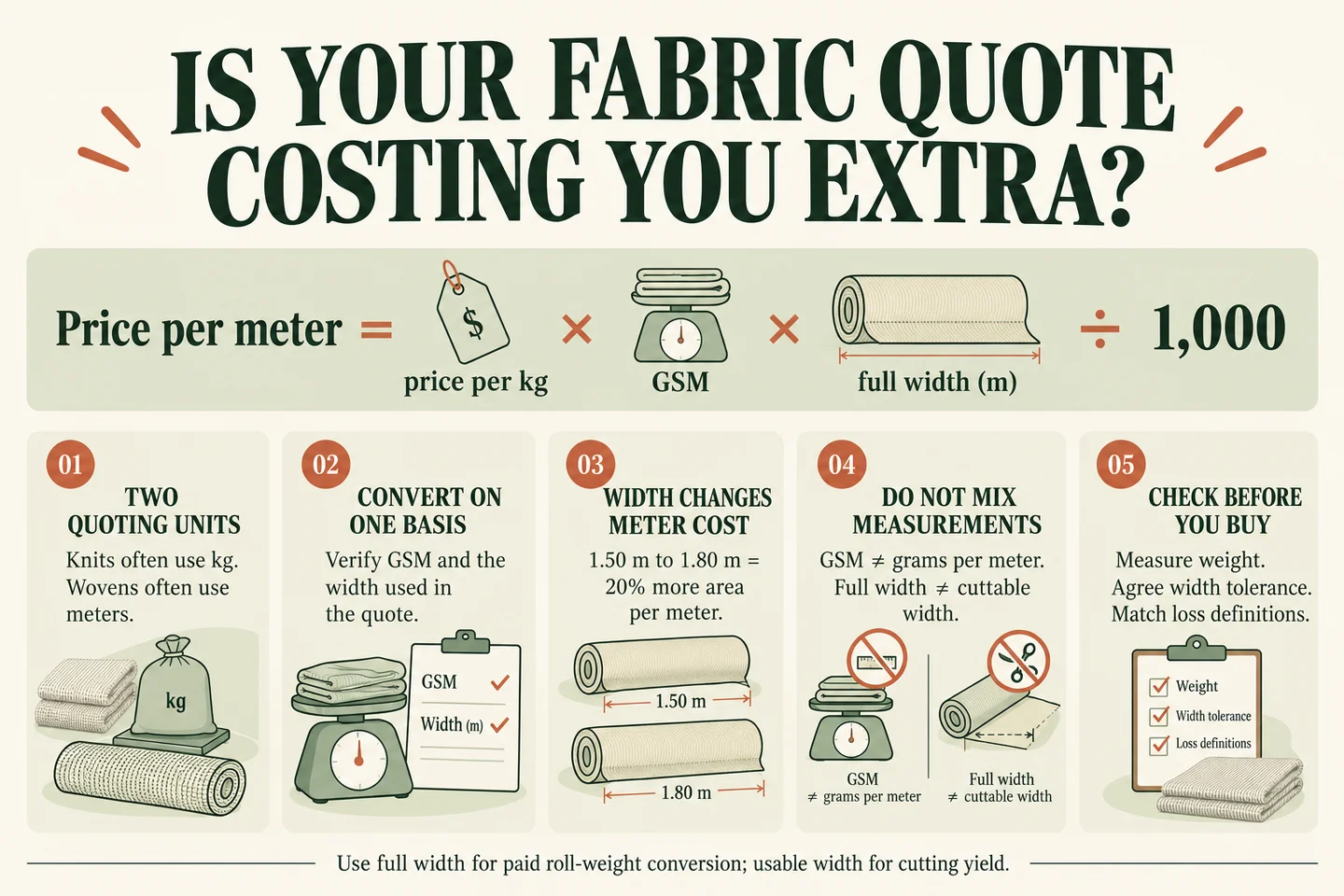
This disparity is not necessarily an attempt to confuse you—it often reflects trading practice. Knit fabrics such as single jersey, fleece and French terry are commonly quoted by weight, whereas woven fabrics such as shirting, twill and denim are commonly quoted by length. These are conventions, not rules: either construction can be sold under a different agreed unit.
The logic is straightforward. Knits can stretch and change dimensions during relaxation, making an unspecified length measurement a source of disputes. Quoting by weight can make billing easier, but does not eliminate uncertainty about GSM, moisture, roll cores or usable yield. Wovens are often more dimensionally stable, making linear measurement convenient, provided the width and measurement conditions are stated.
From a buyer’s perspective, this dual-unit framework poses a challenge: without converting both quotes to a consistent basis, accurate price comparison is impossible. Compare equivalent construction, finish, width, weight and commercial terms, not the quoted number alone.
2. The Conversion Formula: GSM and Fabric Width
Converting a per-kilogram price to a per-meter price requires two parameters: GSM (grams per square meter, g/m²) and the fabric width in meters. Confirm which width is being used.
Weight per meter (kg/m) = GSM × width (m) ÷ 1,000
Price per meter = price per kg × GSM × width (m) ÷ 1,000
For the price of an entire billed linear meter, use the full fabric width represented by the net fabric weight, including selvages if they are part of the paid cloth. Using only cuttable width here would omit the weight of paid unusable edges and understate the price of that shipped meter.
Calculation Example
For a fabric at 200 GSM, 1.5 meters full width and $6.00/kg:
Weight per meter = 200 × 1.5 ÷ 1,000 = 0.30 kg/m
Price per meter = 6.00 × 0.30 = $1.80/m
Conversely, 1 kg of this fabric yields approximately 1 ÷ 0.30 = 3.33 linear meters. This assumes representative GSM, uniform cloth and net fabric weight excluding tubes and packaging. It is a theoretical conversion, not a guarantee of defect-free cutting yield.
3. Width Variances: Why the Meter Price Changes
Width variance is an important source of costing confusion. Consider the same 200 GSM fabric quoted at $6.00/kg. Altering only the full width changes the effective meter price as follows.
From 1.5 m to 1.8 m, the meter price rises from $1.80 to $2.16—exactly 20%. From 1.5 m to 1.2 m, it falls 20%. Across the smallest and largest widths shown, the difference is 50% relative to the 1.2 m example. Always state the baseline for a percentage comparison.
Crucially, the wider meter contains more cloth. All three examples have the same material price of $1.20 per square meter before edge losses. A higher price per linear meter does not, on its own, prove overcharging. The garment marker determines whether the extra width is useful.
Takeaway: A quotation listing only price per kg, without GSM and width, is insufficient for a reliable garment-cost comparison. Request the missing specifications and use a common usable-width or finished-garment basis.
| Full width | Weight per linear meter | Price per linear meter | Price per m² before edge loss |
|---|---|---|---|
| 1.50 m | 0.30 kg | $1.80 | $1.20 |
| 1.80 m | 0.36 kg | $2.16 | $1.20 |
| 1.20 m | 0.24 kg | $1.44 | $1.20 |
4. Two Frequently Confused Metrics: Avoiding Costing Pitfalls
① GSM vs. Linear Weight (Grams per Meter)
GSM (g/m²) is mass per unit area. Linear weight (g/m) is mass per running meter of cloth.
Linear weight (g/m) = GSM × full width (m)
Dye mills may refer to cloth as “300 grams per meter.” That is not automatically 300 GSM. At 1.5 m full width, 300 g/m corresponds to 300 ÷ 1.5 = 200 GSM. Confusing these quantities can materially distort the specification and cost estimate. GSM also does not directly measure thickness; structure and fiber density affect that relationship.
② Full Width vs. Cuttable Width
Full width is the edge-to-edge width of the roll, including selvages. Cuttable or usable width is the part available for production panels. The manuscript’s 2–4 cm difference is a practical example, not a fixed deduction: measure the actual fabric, edges and finish.
Use full width to estimate the mass of a complete linear meter and convert paid net fabric kilograms into theoretical roll length. Use cuttable width to plan markers and garment consumption. Neither measurement includes the mass of a cardboard tube or wrapping.
For example, the 1.5 m full-width cloth above costs $1.80 per shipped meter. If usable width is 1.46 m, its cost per usable square meter is $1.80 ÷ 1.46 ≈ $1.233, before defects and cutting waste—not the $1.20 gross-area figure.
Tubular Fabric Note
For a tubular knit labeled “0.8 m lay-flat width,” the opened circumference is approximately 1.6 m. The double layer must be included when converting GSM into weight per running meter. Using only 0.8 m understates area and weight per meter by 50%, and consequently overstates theoretical meters per kg by 100%. Confirm whether a supplier quotes lay-flat width or opened width, and account for any slitting and edge loss when establishing cuttable yield.
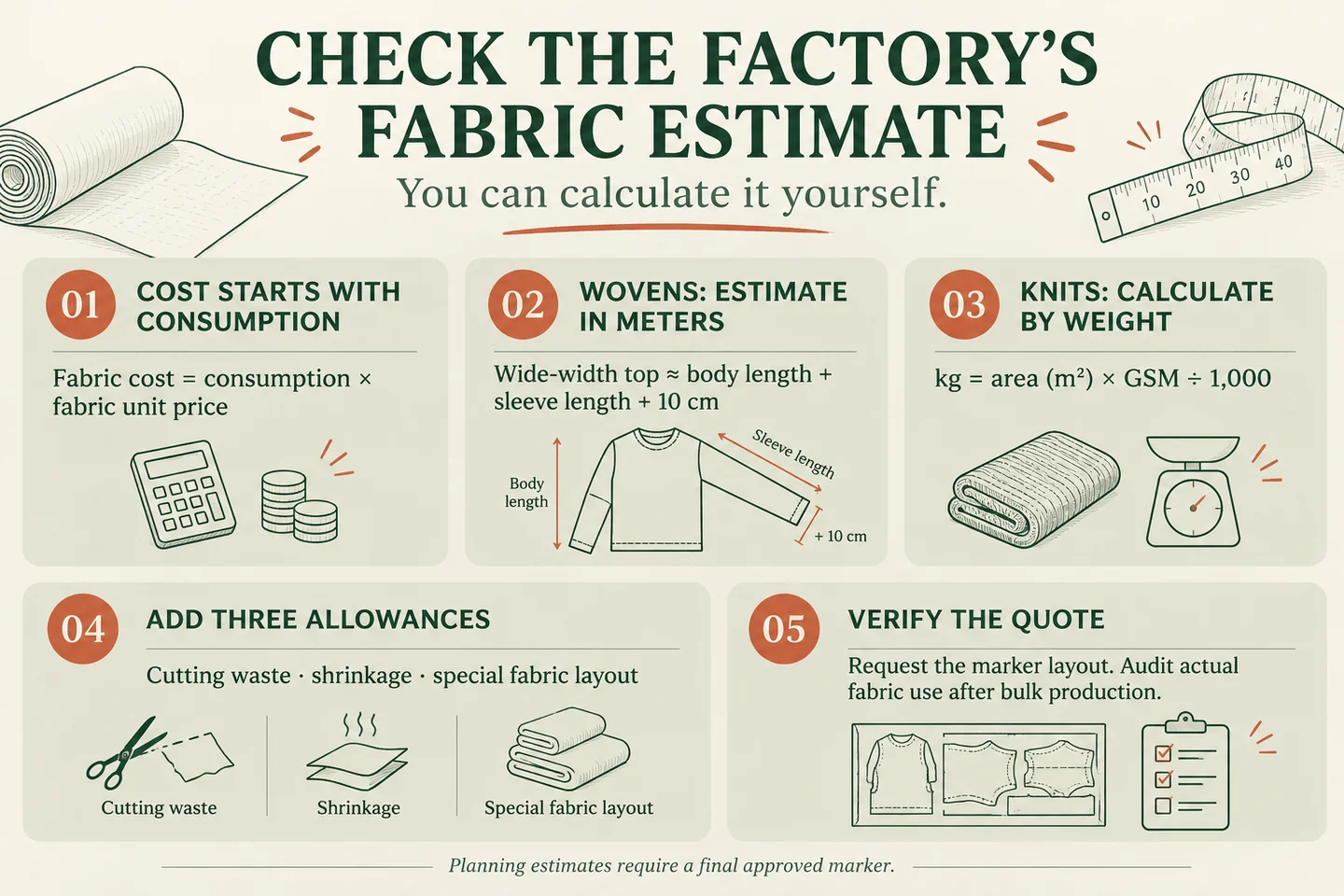
5. Risk Mitigation Checklist for Weight-Based Procurement
1. Verify GSM via Physical Testing
Use a known-area swatch or GSM cutter and a calibrated scale. Take representative measurements from several positions and record how the samples were conditioned. One reading cannot establish a roll’s average or its variability. Agree the sampling and test procedure with the supplier.
2. Establish Contractual Width Tolerances
Record full width, minimum cuttable width, tubular/open-width state, relaxation condition and tolerances on the PO. A nominal overall width is not a promise that the entire width can be used in a garment marker.
3. Clarify Wastage Standards
Specify whether allowances are measured in kg or meters, which stages they cover, and whether a percentage is an addition to net requirement or a loss fraction of gross fabric issued. Weight and length allowances can be equivalent when the same linear mass applies; changing the basis or measurement state is what creates discrepancies. Avoid counting the same loss twice.
4. Enforce Receiving Inspection
Weigh rolls, deduct agreed tube and packaging tare, and measure usable widths on receipt. Reconcile net mass, GSM and measured length before signing off. Record defects and shade grouping separately. If an AQL-based sampling plan is used, define its lot, inspection unit and acceptance criteria; the term “AQL” alone does not specify how roll weight or width should be verified.
Conclusion
To streamline price negotiations and ensure transparency, use this procurement directive when requesting quotes:
“Please state the price per net kilogram, verified GSM, full width, minimum cuttable width and fabric state. Convert the kilogram price into the price of a complete linear meter using the full width, and state the cost per usable square meter so we can compare cutting yield.”
A common linear-meter price is useful only when width and other specifications are comparable. For different widths, also compare usable-area cost and the approved marker’s fabric requirement per garment. That exposes real yield differences without treating a wider meter as an automatic price penalty.
Adapted from the contributor’s manuscript and Chinese reference graphic. Arithmetic and physical units were checked. The width comparison distinguishes equal area pricing from linear-meter price changes; paid full-width weight conversion is separated from cuttable-area yield. The examples are calculations from stated assumptions, not live supplier prices.
Assumes representative GSM and net cloth mass excluding tubes and packaging. Actual quotations depend on conditioning, usable width, fabric state, defects, finishing and agreed trade terms. Verify measurements and approved marker consumption before ordering.
YOUR NEXT STEP
Put the details to work.
Estimate an order or turn your specifications into a supplier inquiry.