Look Beyond the Showroom
When visiting a factory, the tour route curated by the owner is often carefully staged: showroom, sample room and award wall. However, the showroom does not determine your bulk production quality—the shop floor does much of that work.
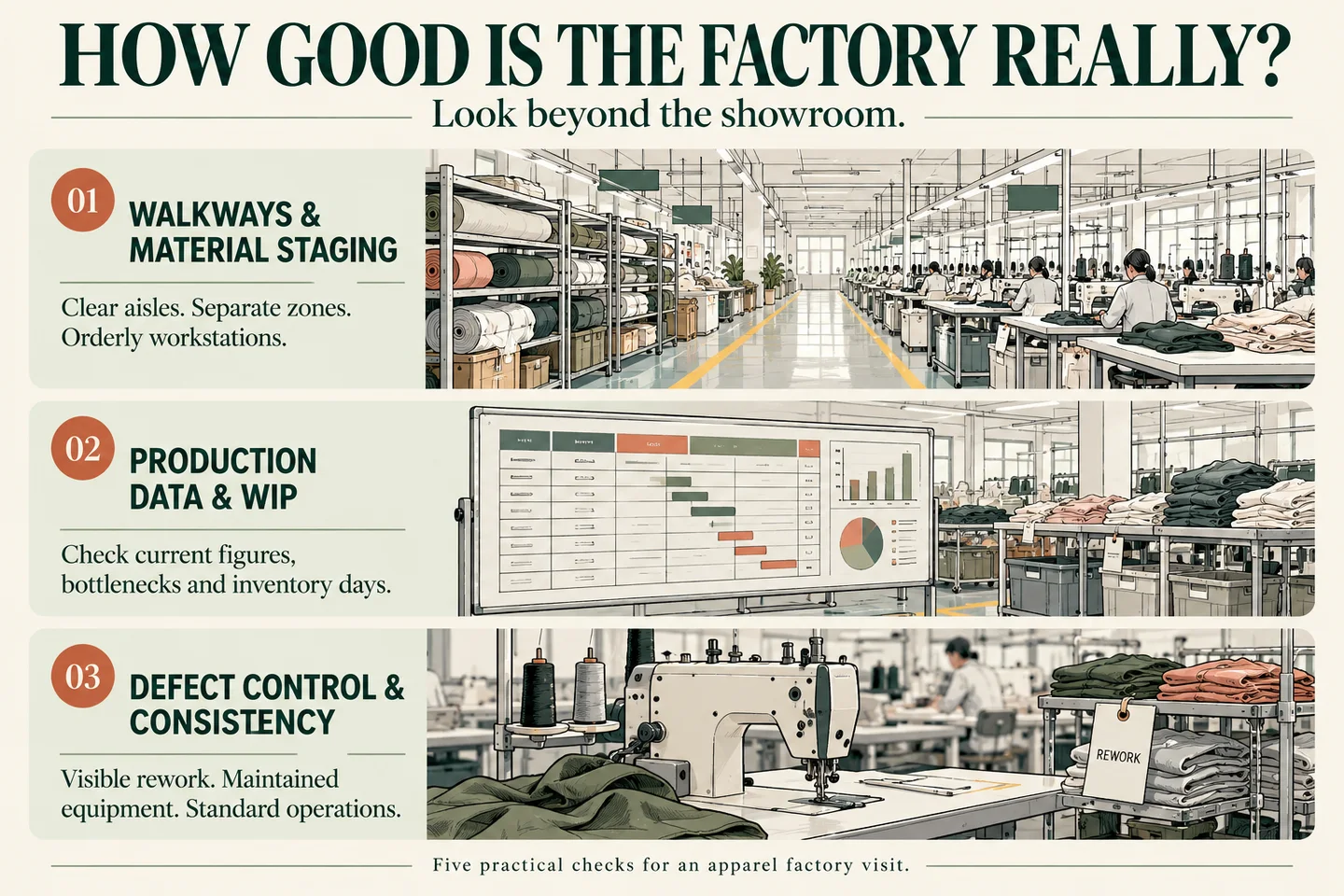
On-site operational management leaves evidence that is harder to stage consistently than a sales presentation. Here are five subtle audit details that help you assess a factory during a single shop-floor walkthrough. Treat them as leads to investigate, rather than proof of future order quality on their own.
1. Inspect Walkways and Material Staging: Housekeeping Never Lies
Upon entering the workshop, set aside the sales pitch and immediately observe three elements: walkways, zone segregation and workstations.
A well-managed facility keeps pedestrian routes and material movement clearly organized. Raw fabrics, cut panels, work-in-progress (WIP) and finished goods are identified and separated, with clean workstations and adequate lighting. Where pedestrian and transport routes share space, check how the facility controls the resulting risk.
Conversely, if aisles are blocked by fabric rolls, cut panels sit directly on the floor, or defective units are mixed with passable WIP without isolation, question the factory’s quality claims regardless of how impressive its presentation sounds.
Poor housekeeping is a warning sign of weak process discipline, though a tidy floor alone does not establish a strong QC system. Ask who owns each zone, how often it is checked and what happens when the standard is missed. The showroom is the facade; the shop floor is where operational capability needs to be demonstrated.
2. Audit Visual Management Boards: Real-Time vs. Pro Forma Data
Factories may use visual management or KPI boards to display daily output, defect rates and rework volumes. Here is a practical vetting tip: check how current the data is. A board is a management tool, not a certification of compliance.
If the KPI board is covered in dust or showing metrics months out of date, ask whether it is still used. Current daily information is a better sign than a presentation refreshed only before customer visits. Some facilities use digital systems instead, so ask to see the live record rather than insisting on a particular board format.
Point to a specific metric and ask: “How did you address this defect spike?” A precise explanation supported by a defect log, action owner and follow-up result is more persuasive than a quick answer alone. Hesitation is a reason to investigate further, not automatic proof of dishonesty.
Check the denominator as well: defects per hundred inspected units, defective garments and reworked units are different measures. A trend is useful only when the calculation and inspection coverage remain comparable.
3. Evaluate Work-in-Progress Inventory: The Honesty Metric
WIP is material or partially completed garments between defined production stages. Be clear about the boundary: uncut fabric waiting in a warehouse is normally raw-material inventory, not sewing-line WIP. The amount and age of WIP can reveal bottlenecks, but a visual impression alone cannot tell you how many production days it represents.
The contributor’s reference ranges contrast a 4–12-day buffer with a much larger 18–24-day buffer. Treat these as discussion examples, not universal industry benchmarks for a high-performing or poorly managed factory. A suitable buffer depends on product complexity, batch size, line configuration, outside processes and the measurement boundary; some lean lines operate with much less WIP.
To check the claim, ask for WIP counted in comparable garment-equivalent units and divide it by the corresponding average daily throughput. For example, 2,000 garment-equivalent units of WIP at 500 completed garments per working day represents approximately four working days of buffer. Do not double-count the same garment represented by separate sleeve and body bundles.
Excessive or aging WIP can have three consequences:
1. Capital is tied up in unfinished inventory.
2. Prolonged panel storage can cause creasing or staining, increasing handling, pressing and rework.
3. Bottlenecks and defect trends can remain hidden until a large batch has accumulated.
Quick Audit Method: Observe queues between sewing workstations. If tables and trolleys are overloaded with pending bundles that restrict movement, ask the supervisor to explain the bottleneck, bundle age and recovery plan. Cross-check that explanation against throughput and aging records.
4. Check Defect Isolation Procedures: Transparency Drives Quality
This factor is frequently overlooked by buyers, yet it is important. Quality-driven factories make defects visible: nonconforming units are clearly identified and moved to controlled hold or rework areas. Red quarantine labels are one possible method; the essential requirement is an unambiguous status and a controlled release process.
Substandard handling mixes rejected units back into normal bundles without a traceable decision. Even a tidy floor can conceal this risk. Follow one rejected unit: who records the defect, who repairs it, who reinspects it, and who authorizes its return to accepted production?
Remember this operational principle: a factory willing to expose problems and demonstrate their resolution gives you stronger evidence of quality control than one claiming never to have defects. Visibility is a useful signal; verify that the correction and reinspection actually happen.
5. Observe Equipment Maintenance and Operator Standardization: Details Don’t Lie
Equipment Maintenance
Machines carrying oil leaks, dust or unresolved faults, combined with blank preventive-maintenance (PM) records, deserve investigation. Check whether maintenance records correspond to the machine, recent dates, observed condition and resolved anomalies. Signed logs are useful evidence, but signatures alone do not establish that the work was done.
Ask how the facility handles broken needles, machine adjustment and sewing-quality problems such as unstable thread tension. Look for a defined response and records that support it, rather than inferring a specific failure rate from appearance alone.
Standard Operating Procedures (SOPs)
Observe operators carrying out the same operation. Consistent work sequence, approved settings, guides and inspection points can support repeatable output. Hand movements may legitimately differ with ergonomics or equipment; the real question is whether the method controls the same product requirements.
For zipper insertion, check alignment, seam allowance, feeding and the completed zipper’s appearance and function. Uncontrolled methods can contribute to waviness, misalignment or functional problems, but component quality, pattern design and fabric behavior also need consideration. Compare the operation with the approved sample and work instructions.
Conclusion
For your next factory visit, arrange access to the cutting and sewing departments rather than spending the whole visit in the showroom. Unexplained refusal to show relevant production areas is a concern, but immediate unrestricted access is not always possible: safety rules, confidential orders and production schedules can justify limits. Ask for the reason and agree an alternative way to verify the capability.
No showroom can substitute for operational evidence. Once you have evaluated walkways, current production data, WIP buffers, defect isolation and process standardization, you will have a firmer basis for deciding whether the factory merits further qualification.
A single walkthrough is a screening exercise, not a guarantee of future production quality. Record the date, observed process, unanswered questions and evidence requested; follow up with the relevant document checks, samples and inspections before committing to an order.
Adapted from the contributor’s supplied manuscript. The reference image was translated and redesigned. WIP-day ranges are retained as contributor examples rather than universal industry benchmarks. The guide distinguishes observation, follow-up evidence and conclusions; it does not claim that the illustrated factory was audited.
A preliminary manufacturing-site screening guide. Factory layout, inventory buffers and inspection methods depend on the product and process. Site access is subject to agreed permission, safety and confidentiality restrictions.
Need someone on the ground?
Commission a documented supplier visit with agreed scope and priorities.
YOUR NEXT STEP
Put the details to work.
Estimate an order or turn your specifications into a supplier inquiry.