Before the First Streetwear Sample
Contributor note: This article was submitted by StitchQuote, which describes itself as a China-based streetwear and casualwear manufacturer. It has been edited for clarity. The contributor has a commercial interest in apparel manufacturing; publication is not a supplier audit, certification or endorsement by ClothingStartups.
A first sample is useful when it answers a defined set of production questions. If the brief leaves fit, fabric and artwork open to interpretation, the sample may show the factory’s assumptions more clearly than the founder’s intended product.
Before requesting a first China cut-and-sew sample, lock enough information to make the result assessable. “Lock” means issuing a dated specification that both sides will use for that round. It does not mean every decision is permanent. Separate confirmed requirements from provisional choices, and state what the sample must prove.
Silhouette References and Product Definition
Silhouette references. Start with a style identifier, garment description and intended fit. “Oversized streetwear hoodie” leaves several decisions unresolved: body width, body length, shoulder drop, sleeve volume, hood shape and hem tension.
Attach front, back and detail references. Annotate what each image controls. One might establish the shoulder line; another might show a pocket construction. Identify unwanted features too. Otherwise, a factory may reproduce details that were only incidental to the reference.
A physical reference garment can help, but record its measurements and explain whether it represents the desired fit, construction or fabric hand. Those are separate approvals.
Size Chart and Measurement Methods
Size chart. Supply a garment measurement chart, identify the sample size and define each point of measurement. State the units, whether widths are measured flat, and the measurement condition—for example, after the specified garment wash.
Distinguish finished garment measurements from body measurements. A chest measurement taken around a person cannot be used directly as the finished chest specification; the garment needs an intentional allowance for fit.
For a first sample, the base size needs a coherent measurement specification. The full size range and grading can remain provisional if clearly marked. Critical dimensions should have agreed tolerances appropriate to the construction, rather than a single blanket tolerance applied everywhere.
Fabric Direction and Substitutions
Fabric direction. Specify composition, knit or weave structure, target weight, surface appearance and desired hand. Add stretch, recovery, opacity or wash requirements where relevant. “Heavy cotton” is insufficient: fabrics with similar weight can differ substantially in stiffness, drape and shrinkage.
If an exact fabric is unavailable, ask the factory to identify the proposed substitute before cutting. Record which properties differ and what those differences prevent you from approving. A substitute may support a construction review while making judgments about drape or finished fit unreliable.
Treat ribbing and other secondary materials separately. Their recovery and tension influence openings, silhouette and comfort.
Decoration Method and Artwork
Decoration method. Provide artwork files, finished dimensions, colour references and placement measurements from defined garment landmarks. Do not rely on a mockup alone: a graphic’s apparent scale changes with the mockup’s garment proportions.
State the intended technique, such as screen printing, embroidery or an applied patch. Include the desired surface effect and backing requirements where relevant. Ask for feasibility feedback if the artwork contains fine lines, dense stitching or placement across seams.
Decoration can change the garment’s hand and shape. A large print or dense embroidery should be evaluated on the intended fabric whenever those effects are central to the design.
Labels, Trims and Packaging
Labels/packaging. List label types, artwork, dimensions and attachment positions. Identify which trims must appear on the first sample and which may use temporary equivalents.
Care instructions and fibre information must reflect the actual product and applicable destination-market requirements. Packaging can remain provisional during a fit round, unless it affects presentation, folding or product protection that the sample must demonstrate.
Quantity Planning: Per Style, Per Colour and Total Order
A factory needs to understand how the intended order divides into production units. “An order of 300 pieces” could describe one garment in one colour or several garments split across colours and sizes. Those plans create different material, cutting and setup requirements.
Use a quantity table that names each style, colour and size allocation. Keep sample quantities separate from intended bulk quantities, and label bulk figures as forecasts if they are not commitments.
These terms should remain distinct:
• Per style: the quantity assigned to one defined garment design.
• Per colour: the quantity assigned to a particular colour within that style.
• Total order: the sum across the listed styles and colours.
For example, two styles with two colours each at 75 pieces per style-colour combination equal 300 pieces overall. That arithmetic does not establish whether any individual combination meets the factory’s requirements.
Ask what the factory means by a minimum. It may apply to a style, a colour, a fabric purchase, a dye lot or a custom trim. A garment quantity that is workable with available fabric may not support a specially developed material.
StitchQuote, the contributor, states on its own website that its MOQ generally starts at 50 pieces per style for most apparel and 100 pieces per style for denim. This is a supplier-specific statement, not an industry minimum or an independently verified production offer. [1] Confirm with the factory whether that applies to the specific style, colour split, materials and decoration.
Also identify variants honestly. Changing fabric, wash or decoration may require separate development even when the base pattern stays the same. Avoid grouping materially different products under one style name simply to present a larger total.
A Sample-First Approval Sequence
Define the first sample’s purpose before discussing its dispatch date. A fit prototype, a decoration trial and a production-representative sample answer different questions. Calling all three “the sample” makes approval ambiguous.
First, resolve feasibility and substitutions. Have the factory review the brief for missing measurements, construction conflicts, material availability and artwork limitations. Record accepted changes in the same revision used for cutting. Decisions scattered across messages are easy to miss.
Next, establish what the first garment will prove. For an early cut-and-sew sample, priorities often include silhouette, balance, mobility, key measurements and construction logic. Review whether the shoulder sits as intended, the sleeve moves comfortably, the neckline behaves correctly and pockets remain usable.
Fit it on a person whose relevant body measurements are recorded. Photograph consistent views and measure the garment using the brief’s stated method. “Too boxy” is less actionable than identifying excess body width, insufficient length or an overly dropped shoulder.
Test high-risk decoration early. Where print, embroidery or washing defines the product, a separate strike-off or trial panel can resolve technique before another complete garment is made. Review appearance, hand, puckering, backing and interaction with the fabric. Check performance after the intended care process where relevant.
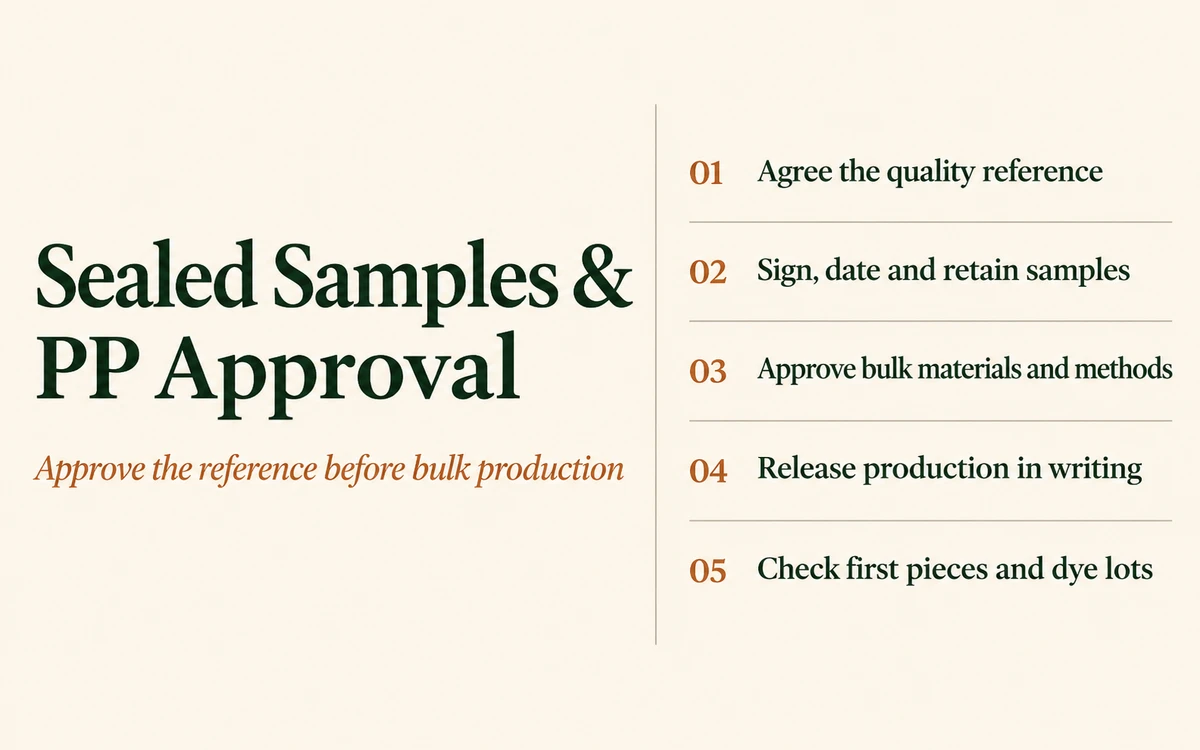
Reserve final approvals for representative materials and processes. A prototype in substitute fabric should not receive unconditional approval for shrinkage, drape or post-wash fit. Likewise, a fit-approved garment does not automatically approve colour, decoration durability, labels or packing.
Later rounds can address revised fit, grading and size-set checks, final trims, packaging and production-representative workmanship. State outstanding approvals explicitly; do not leave the factory to infer them from silence.
StitchQuote states that a sample path of around seven days may be possible for suitable standard styles with confirmed specifications and materials. This is the contributor’s stated offer, not a general lead-time benchmark or a delivery guarantee. [1] Always confirm against the brief, including what starts the timing and whether it covers sample completion or delivery.
Close each round with one consolidated comment sheet. Tie every requested correction to a photograph, measurement or specification, and issue a new revision when requirements change.
First-Sample Brief Checklist
Use the following checklist to confirm the brief before sending it to a factory. Keep it with the current specification revision so every sampling round uses the same reference.
• Each style has an identifier, revision date and clear garment description.
• Reference images explain which silhouette and construction details matter.
• The sample size, garment measurements, units and measurement methods are defined.
• Fabric requirements are documented; substitutions require acknowledgement before cutting.
• Artwork includes technique, dimensions, colour references and measurable placement.
• Labels, trims and packaging are marked as confirmed, provisional or deferred.
• Sample quantities are separate from bulk forecasts.
• Bulk quantities are broken down by style, colour and planned size allocation.
• The factory has clarified which minimums apply to garments, materials and trims.
• The first sample’s approval purpose and limitations are written down.
• Timing is confirmed against the actual brief and material availability.
• One person will consolidate feedback and maintain the current specification.
Submitted English manuscript reviewed for editorial fit and edited for presentation. One contributor-requested external link retained as a branded source link. MOQ and sample timing cross-checked against the contributor website and attributed as supplier claims, not independently audited capability. Original submitted file retained privately.
Independent guest contribution with commercial-interest disclosure. Search checks did not establish originality conclusively; publication does not certify factory ownership, capacity, quality or delivery. No fee or link-attribute promise is asserted.
Sources
YOUR NEXT STEP
Put the details to work.
Estimate an order or turn your specifications into a supplier inquiry.