Modal, Tencel and Lyocell: What Are You Actually Buying?
When shopping for clothes, you’ve almost certainly encountered these three terms: Modal, Tencel and Lyocell. Sales associates often praise them, saying, “This is made of Tencel—it’s unbelievably soft and comfortable.” But if you press further and ask, “What’s the actual difference between Tencel and Lyocell?” many sales reps quickly run out of answers.
Today, let’s break down these three “siblings,” clarify their exact relationships, evaluate their different strengths, and guide you on how to make the right choice.
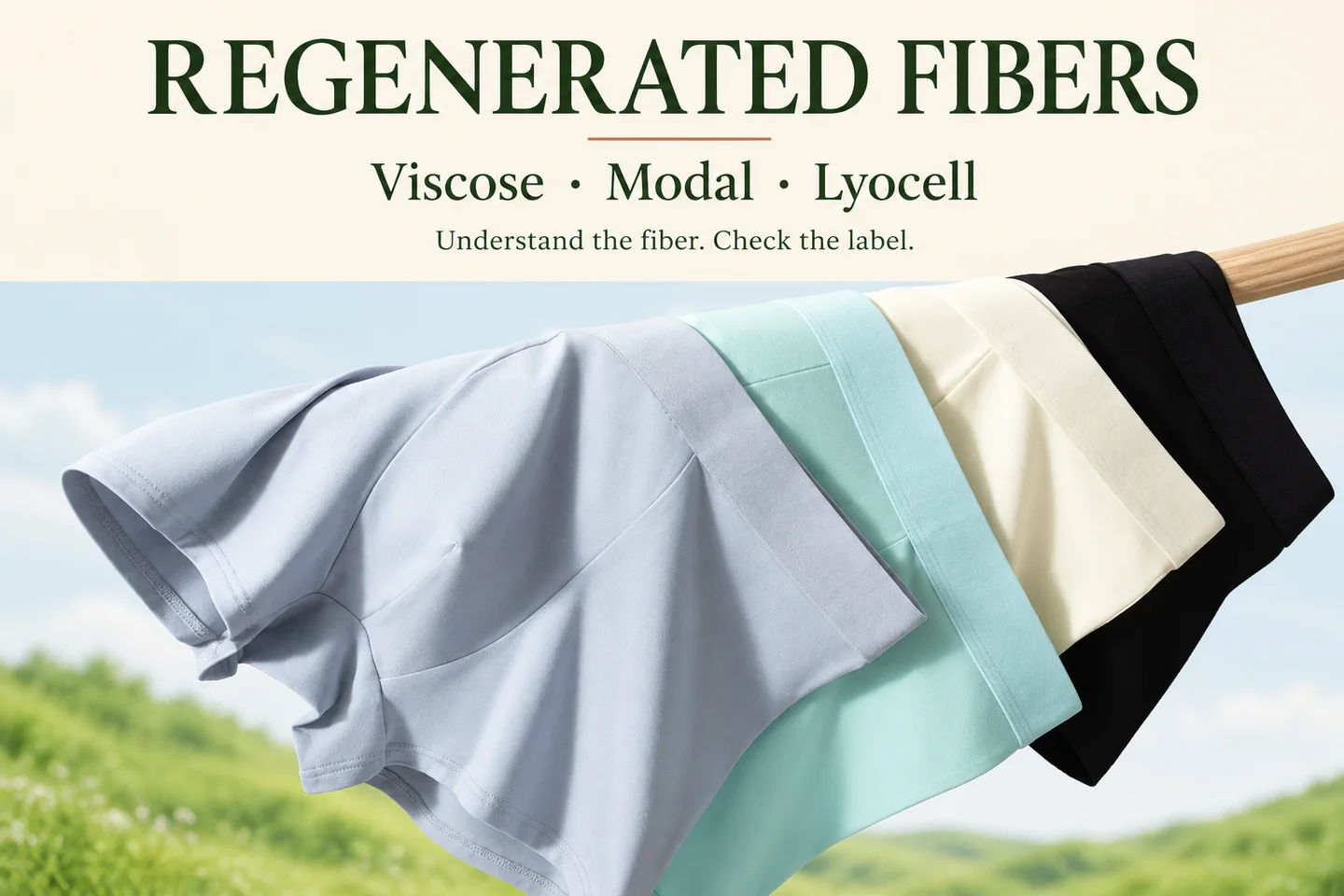
First, Clarify the Core Concept: What Are Regenerated Fibers?
To place the terms on a simple fiber map: cotton and linen are natural plant fibers; wool and silk are natural animal fibers. Polyester and nylon are synthetic fibers made from chemically synthesized polymers. Viscose, modal and lyocell are manufactured fibers made by regenerating cellulose, a naturally occurring polymer. This guide focuses on that regenerated cellulosic family.
Put simply, producers obtain purified cellulose from sources such as wood pulp or cotton linters, dissolve or chemically process it into a spinning solution, and extrude it through tiny spinnerets. The cellulose is regenerated into fiber form; depending on the process and product, the result may be continuous filament or fiber cut into staple lengths. Not every cellulose source is used by every producer. [2]
This process is similar in broad terms to breaking down pulp to remanufacture paper: the raw polymer is natural, but the fiber is manufactured. “Semi-synthetic” is a common explanatory term; “regenerated cellulosic” is the more precise description here. It does not mean half cotton and half polyester.
The True Identities of the Three “Siblings”
Viscose, modal and lyocell are fiber categories. TENCEL™ is a Lenzing brand covering both lyocell and modal fibers, so it should not occupy a fourth place on a generic fiber classification chart. The following table compares conventional viscose, modal and lyocell, while separating general fiber tendencies from properties that require testing. [1]
| Comparison | Viscose (rayon) | Modal | Lyocell |
|---|---|---|---|
| Raw material sources | Dissolving cellulose pulp; commonly wood, with other plant sources possible. | Dissolving pulp; beech is an established source for Lenzing modal. | Dissolving cellulose pulp from various wood species; check traceability. |
| Production chemistry | Viscose route uses carbon disulfide; effective chemical recovery and emission controls matter. | A modified viscose route, not a separate harmless-solvent process. | Direct dissolution, commonly using NMMO; solvent recovery is a key process feature. |
| Strength | Conventional viscose generally loses substantial strength when wet. | Designed for improved wet properties compared with conventional viscose. | Generally high dry and wet tenacity; verify the actual yarn and fabric. |
| Softness and hand feel | Soft, fluid drape; construction and finishing affect body. | Often chosen for a particularly soft, smooth hand. | Can combine smoothness and strength; finishing changes surface and drape. |
| Moisture and breathability | Absorbent cellulosic fiber; fabric structure affects comfort. | Absorbent; construction and blends influence transport and drying. | Absorbent; not automatically the most breathable finished fabric. |
| Shrinkage | Test the actual construction, finish and care process. | Test the actual construction, finish and care process. | Test the actual construction, finish and care process. |
| Environmental assessment | Depends on pulp sourcing, chemical recovery, energy and mill controls. | Depends on the producer and process; avoid a blanket medium-impact ranking. | Closed-loop solvent recovery can reduce losses, but is not zero pollution. |
| Price positioning | Often a lower-cost sourcing option. | Often a step up in price for a softer-hand proposition. | Often premium-positioned; specification and order quantity affect the quote. |
Is Tencel the Same as Lyocell?
After reviewing the table, there is one important distinction to remember: TENCEL™ and lyocell are related, but they are not interchangeable names. TENCEL™ is Lenzing’s fiber brand, and its portfolio includes both TENCEL™ Lyocell and TENCEL™ Modal. [1]
A garment described as “Tencel” could therefore contain branded lyocell, branded modal, or a blend involving one of those fibers. Conversely, lyocell made by another producer does not automatically carry the TENCEL™ brand. The brand name alone is not enough to tell you the generic fiber type or its percentage.
For a purchase order, ask for both pieces of information: the generic fiber composition and, when a branded fiber is specified, supporting supplier documentation. “95% lyocell, 5% elastane” and “made with TENCEL™ fibers” answer different questions. A fiber label describes composition; brand identification describes a particular supply source and its authorized claims.
Why Lyocell Is Often a Premium Choice
The main reason lyocell attracts attention is its production route. Conventional viscose and modal use viscose-based chemistry, while lyocell commonly dissolves cellulose directly using an NMMO solvent system. This changes the chemical-processing route and creates opportunities for efficient solvent recovery. [2]
For its own TENCEL™ Lyocell production, Lenzing reports recovery and reuse of more than 99.8% of the solvent. That is a producer-specific process statement, not a guarantee about every lyocell supplier. [1]
It also does not make production “virtually zero-pollution.” Pulp preparation, energy, water, transport, dyeing and finishing still have impacts. A solvent loop within fiber manufacturing is not the same as a fully closed-loop system from forest cultivation to garment recycling. Responsible pulp sourcing, chemical recovery and textile-to-textile recycling are distinct issues. [3]
Likewise, wood species are not a universal identity test. Lyocell is not limited to birch or eucalyptus, and modal should not be described as a pear-wood fiber. Request pulp-sourcing and traceability information from the actual supplier rather than treating a plant name as proof of sustainability.
In performance terms, lyocell can offer a useful combination of strength, smoothness and moisture absorption. It is often a good candidate for premium intimate apparel, but no fiber name guarantees the strongest, least-shrinking or most breathable finished garment. Yarn, knit density, fabric weight, elastane content and finishing all affect the outcome. Some lyocell constructions also need careful control of fibrillation and surface appearance.
Why the Finished Fabric Still Needs Testing
The supplied comparison chart listed shrinkage ranges of 8–10% for viscose, 5–8% for modal and 3–5% for lyocell. Those figures should not be treated as universal material specifications. A stabilized viscose fabric and an inadequately relaxed lyocell knit can behave quite differently from a simple ranking.
For sourcing, compare samples at the intended fiber blend, GSM and construction. Agree a wash and drying procedure, then check length and width dimensional change, appearance, pilling, seam behavior, stretch recovery and colorfastness. A laboratory report or sample test must relate to the fabric you are buying.
Do not assume that good absorption automatically means fast drying or maximum breathability. Those are different performance questions. For underwear, evaluate the waistband, seams, fit and elastane recovery as well as the body fabric’s hand feel.
How to Choose Intimate Apparel / Underwear
Understanding these distinctions helps you make informed sourcing and purchasing decisions without being misled by marketing claims. Choose against your product brief rather than expecting one fiber to win every category.
For Cost Efficiency: Consider Viscose
Viscose is often an affordable route to a soft hand feel and fluid drape, making it a useful option for budget-friendly daily essentials. Conventional viscose’s weaker wet properties deserve attention; verify wash stability, shrinkage and durability on the actual fabric rather than accepting a low price alone.
For Maximum Emphasis on Softness: Consider Modal
Modal is a strong candidate when softness and a smooth next-to-skin feel drive the brief, particularly in base layers and loungewear. Do not assume every modal is softer than every lyocell construction, or that its environmental footprint must be worse. The producer, yarn, fabric and finish matter.
For a Premium Balance of Properties: Consider Lyocell
Lyocell is worth sampling when strength, softness and moisture handling are priorities and the budget allows. Check the specific producer’s sourcing credentials and process evidence. It is a premium option, not an automatic best choice for every garment or wearer.
Practical Tip: Check the Fiber Percentage, Not Just the Hangtag
Some products advertised with a TENCEL™ or lyocell message are blends rather than 100% lyocell. A garment may contain 30% or less of the highlighted fiber, with the rest made from cotton, polyester or other materials. The particular ratio has to be checked on the product; a marketing headline is not a composition statement.
Always inspect the fiber-content label carefully so you do not pay a pure-lyocell premium while assuming a low-ratio blend is the same product. Blending is not a quality defect in itself: cotton can add body, polyester can change durability or drying behavior, and elastane can supply stretch. Transparency is what lets you judge the price and suitability.
For a brand or sourcing team, write the exact blend, weight, usable width, finish and performance targets into the request for quotation. Confirm any branded-fiber claim separately. The useful question is not simply “Is this Tencel?” but “Which fiber, from which source, at what percentage, in which tested fabric?”
Compiled from the contributor’s three submitted parts. The Chinese comparison was translated into an English table. Brand/fiber distinctions and process statements were checked against Lenzing and TENCEL primary sources. Unsupported universal shrinkage rankings and zero-pollution claims were replaced with specification-based guidance. The supplied product image was edited into an English article cover.
This guide focuses on regenerated cellulosic fibers, not every manufactured fiber type. General tendencies do not substitute for test data on a specific blend, yarn, construction or finished garment. Producer claims are attributed to that producer.
Sources
YOUR NEXT STEP
Put the details to work.
Estimate an order or turn your specifications into a supplier inquiry.