What a Water Strip Test Actually Shows
Whether a quick-dry T-shirt moves moisture effectively when you sweat cannot be decided by how thin the fabric feels or by the words on its hangtag. One useful indicator is wicking height: how far liquid travels upward through a vertically suspended fabric strip in a set time.
The basic comparison is simple. Cut a strip from a spare swatch, suspend it with one end in water, and watch the wet front climb. Measure its position after 30 minutes. This is a practical introduction to vertical wicking, a test approach long used in the textile industry.
Wicking height measures liquid transport. It does not directly measure how much sweat a fabric can hold, how quickly it dries, or how comfortable the finished garment feels during exercise. A useful fabric evaluation keeps those questions separate.
What Is Wicking?
Wicking is capillary action. The small spaces within yarns and between fibers create pathways that can carry water through a fabric. Whether the liquid enters those pathways depends partly on how readily it wets the fiber surface.
For an ideal capillary tube, Jurin's law relates the equilibrium rise to surface tension, contact angle, liquid density and tube radius: h = 2γ cosθ / (ρgr). A more wettable surface and a smaller tube radius can support a greater equilibrium rise. Real textiles contain irregular, connected pores, so the formula explains the mechanism rather than predicting a fabric's exact 30-minute result. Smaller pores can also resist flow; the highest final rise is not automatically the fastest initial movement.
Cotton is naturally hydrophilic and absorbs water readily. Polyester absorbs little water into the fiber itself, but that does not prevent a polyester fabric from moving liquid along its surface. Yarn geometry, construction and a suitable hydrophilic finish can make a considerable difference.
How to Run the Dip-in-Water Comparison
Use the same setup for every sample. The following 25 cm × 3 cm strip and 1 cm immersion procedure provides a straightforward comparative screen. It is not a substitute for following every requirement of a laboratory standard.
For China-market testing, the current Part 1 reference is GB/T 21655.1-2023, not the 2022 edition cited in the supplied manuscript. Formal reports must follow the published method's specimen preparation, conditioning, equipment, readings and calculation rules. [1]
AATCC also distinguishes vertical wicking to specified distances from vertical wicking to specified times. Its TM197 and TM213 methods cover those different approaches for woven, knitted and nonwoven materials. [3]
| Step | What to do | Keep consistent |
|---|---|---|
| 1. Prepare | Cut 25 cm × 3 cm strips from a spare swatch. Mark the fabric direction. | Use the same dimensions; avoid seams, hems and damaged areas. |
| 2. Repeat | Prepare three strips in each direction: warp/weft for wovens, wale/course for knits. | Compare directions separately; do not mix their results. |
| 3. Suspend | Hang each strip vertically without stretching it or letting it touch the container. | Use the same suspension and a level starting position. |
| 4. Immerse | Place the bottom 1 cm in clean distilled water and start the timer. | Use the same water, immersion depth and room conditions. |
| 5. Read | Record the wet-front height at 5, 10 and 30 minutes, measured from the waterline. | Use the same reading rule for an uneven wet front; photograph it if needed. |
| 6. Compare | Record individual readings and calculate a mean for each direction for this informal comparison. | For a formal report, use the standard's specified calculation rather than this screening average. |
Which Performance Test Do You Need?
There is no single wicking-height number that certifies every quick-dry shirt, towel, lining or medical dressing. Acceptance criteria depend on the product, test method, fabric category and buyer's specification. A result of 10 cm can be a useful comparison target, but it does not by itself prove that a finished garment passes every moisture-management requirement.
A buyer may set a higher target, such as 15 cm after a specified interval. Ask for the actual specification and test report rather than assuming all products from a particular athletic brand use the same internal threshold.
For an international sourcing brief, identify the property you need first, then name the method and acceptance criteria together. [1–4]
| Question | Relevant method or reference | What to request |
|---|---|---|
| How far does water climb in a set time? | AATCC TM213: vertical wicking to specified times | Height, interval, fabric direction, specimen preparation and before/after-wash condition. |
| How long does it take to reach a set height? | AATCC TM197: vertical wicking to specified distances | Time to the target distance in each direction. |
| How does liquid spread and transfer through the fabric? | AATCC TM195 or GB/T 21655.2-2019 | The full moisture-management report, including the method's applicable indices. |
| How quickly does the wet fabric dry? | AATCC drying methods or the applicable GB/T 21655.1-2023 procedure | The exact drying method, units, conditions and agreed acceptance requirement. |
Fiber Cross-Section Changes the Capillary Network
Even two fabrics labeled 100% polyester can behave differently. The care label tells you the fiber composition, not the shape of the filaments or the arrangement of the yarns. Circular, hollow and shaped filaments create different spaces between fibers.
The supplied comparison places standard circular polyester at 5.2 cm and trilobal polyester at 10.3 cm after 30 minutes—almost twice the rise in that comparison. Those values are not fixed properties of every fabric made from those fibers. Weight, yarn packing, fabric density, finish and test conditions also affect the result.
When sourcing, use cross-section as a question to ask the supplier. Then compare finished swatches under the same conditions. A shaped-fiber description is useful, but the bulk material still needs to deliver the required performance.
| Fiber type | Cross-section | Supplied 30-minute comparison (cm) | Why it may affect transport |
|---|---|---|---|
| Standard polyester | Circular | 5.2 | Smooth filament geometry and surface wetting influence the available capillary paths. |
| Five-hole hollow polyester | Hollow circular | 8.7 | The structure changes porosity; internal holes contribute only when accessible to liquid. |
| Shaped polyester | Trilobal | 10.3 | Non-circular filaments can create grooves and a different inter-fiber network. |
| Cotton | Kidney-shaped / flattened ribbon | 12.5 | Hydrophilic fibers and natural convolutions affect wetting and yarn structure. |
| Viscose | Serrated / irregular | 14.2 | Hydrophilic surfaces and irregular geometry can assist liquid entry and movement. |
Knits vs. Wovens: Construction Matters
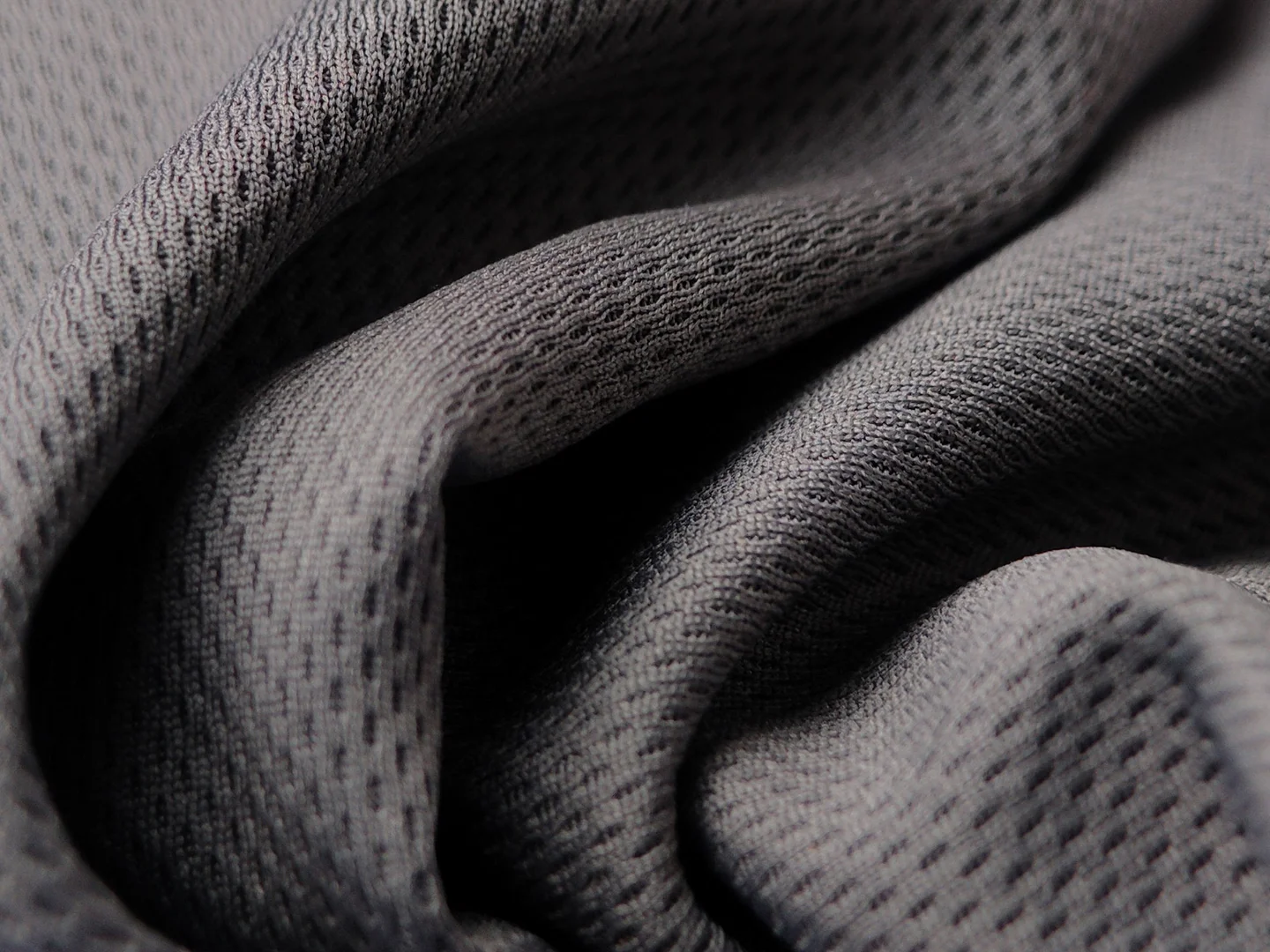
A knitted fabric uses interconnected yarn loops; a woven fabric uses interlaced warp and weft yarns. These structures create different liquid pathways, and wicking can differ in both speed and direction.
The supplied same-yarn comparison reports about 11.5 cm for a knit and 6.8 cm for a woven fabric after 30 minutes. The knit's result is approximately 69% higher in that comparison. This does not establish that every knit outperforms every woven by more than 50%. Density, yarn tension, finishing and pore connections can change the order.
Knits are common in athletic T-shirts for several reasons, including stretch, flexibility and garment comfort. Their suitability should be judged with the finished construction, not inferred from wicking height alone.
| Construction | Supplied 30-minute result | Buying implication |
|---|---|---|
| Knitted fabric | Approximately 11.5 cm | Check both wale and course directions, stretch and the intended finished weight. |
| Woven fabric | Approximately 6.8 cm | Check warp and weft separately; yarn and finish can improve the result. |
How Much Can Chemical Finishing Improve Wicking?
A moisture-wicking finish changes how water wets the fiber surface. Reducing the contact angle can help water enter and travel along the fabric's capillary network. This is one route to effective moisture transport in polyester.
In the supplied comparison, untreated polyester reaches 5.2 cm, while two finishing routes reach 12.8 cm and 15.3 cm. Those increases calculate to roughly 146% and 194%. The result depends on the particular substrate, chemical product, application and test conditions; a silicone-based product is not automatically hydrophilic.
Wash durability is the next question. Some finishes lose performance during laundering, while others are designed to retain it. Claims such as 80% retention after 50 washes or loss of function after 20 washes need a defined wash procedure and before/after measurements. Ask the supplier for those records rather than relying on an unwashed sample.
For sourcing, write the required wash count and post-wash performance into the brief. Test the finished color and production route, because printing, dyeing and other finishes can affect wetting.
| Finishing route | Supplied contact angle | Supplied 30-minute height | Increase from 5.2 cm |
|---|---|---|---|
| Untreated polyester | 85° | 5.2 cm | Baseline |
| Hydrophilic Agent A, 5% o.w.f. | 45° | 12.8 cm | Approximately 146% |
| Agent B, described as silicone-based | 38° | 15.3 cm | Approximately 194% |
Moisture Wicking and Quick Drying Are Different
Moisture wicking describes liquid movement through or across a fabric. Quick drying describes how rapidly water leaves the wet material through evaporation. Good transport can spread liquid over a larger surface and help evaporation, but it does not guarantee a short drying time.
A thick or highly absorbent fabric may show a high wet front and still hold a large amount of water. A light polyester fabric may retain little liquid yet require improved wetting to transport sweat effectively. Airflow, temperature, humidity and the amount of water applied also change the drying result.
GB/T 21655.2-2019 evaluates dynamic moisture transfer. It should not be cited as a 2022 evaporation-rate grading scheme. Keep drying requirements tied to the actual drying method and its units; do not turn the manuscript's proposed rates and times into an unsupported national pass/fail table. [2]
For a performance T-shirt, assess both liquid management and drying under the relevant specification. Neither the words quick-dry nor a strong vertical wicking result covers the whole garment's performance.
| Property | What it tells you | What it does not prove |
|---|---|---|
| Absorbency | How readily and how much liquid a material takes up under the chosen test. | Fast transport or fast drying. |
| Vertical wicking | How liquid travels upward in a strip over time. | One-way transfer away from skin or overall garment comfort. |
| Moisture management | Wetting, spreading and transfer behavior measured by the selected method. | A universal drying time in every environment. |
| Drying performance | How quickly water evaporates under defined conditions. | How well the fabric initially wets or transports liquid. |
How to Read the Result at Home
Use a spare swatch if possible: cutting a strip from a finished shirt damages the garment. Hang the strip, immerse its bottom 1 cm, and record the wet front over 30 minutes. Compare it with another swatch prepared in exactly the same way.
A rise above 10 cm shows more vertical transport than a rise of 3–5 cm in that setup. It is useful evidence for comparing those samples, not a certificate that a shirt meets a product standard or proof that another shirt's marketing is false.
If the water climbs quickly but the cloth remains heavily soaked, investigate drying separately. Apply the same amount of water to matching samples, expose them to the same conditions, and compare how long they stay wet. A laboratory test is the better route when the result will be used for a purchase specification or a performance claim.
Repeat the wicking comparison after a consistent laundering routine to see whether the result changes. Record fabric direction, dimensions, immersion depth, times and wash history so the comparison can be repeated.
| Observation | Practical reading | Next check |
|---|---|---|
| Water climbs readily | The sample transports liquid vertically in this setup. | Compare the other direction and test drying separately. |
| Water stalls near the bottom | Limited wetting or capillary transport in this sample. | Check finish, direction, wash history and repeatability. |
| Good rise, prolonged wetness | Transport and evaporation may not be balanced. | Compare drying under identical water loading and room conditions. |
| Performance drops after washing | The finished sample's transport behavior has changed. | Request post-wash testing and confirm the care and laundering method. |
What to Ask Before Ordering Quick-Dry Fabric
Wicking is applied capillary physics. Fiber shape, yarn arrangement, fabric construction and surface finishing all influence how liquid moves. An appropriate polyester construction and a durable finish can provide effective moisture management, but the approved bulk result matters more than the fiber label.
Ask for the exact test method, both fabric directions where relevant, a complete finished-fabric specification, and results before and after the agreed laundering procedure. Pair the wicking result with moisture-transfer and drying measurements appropriate to the garment.
The simple water-strip comparison is a good first question. The next question is whether the material still meets your requirements after dyeing, printing, finishing and washing. That is how a quick-dry claim becomes a repeatable sourcing decision.
Sources
- SAMR: GB/T 21655.1-2023, Textiles—Evaluation of absorption and quick-drying—Part 1: Method for combination of single-item tests
- SAMR: GB/T 21655.2-2019, Textiles—Evaluation of absorption and quick-drying—Part 2: Method for moisture management tests
- AATCC: Vertical wicking methods TM197 and TM213
- AATCC: Standard test methods for absorbency, moisture management and drying
YOUR NEXT STEP
Put the details to work.
Estimate an order or turn your specifications into a supplier inquiry.