A 180 GSM nylon-spandex knit can give a T-shirt a smooth hand, useful stretch and a lighter everyday feel. The weight is a starting point, not a promise of opacity, quick drying or shape retention. Here is how to evaluate the fabric, its cost and its printing route before placing an order.
The production signal in Keqiao Binhai
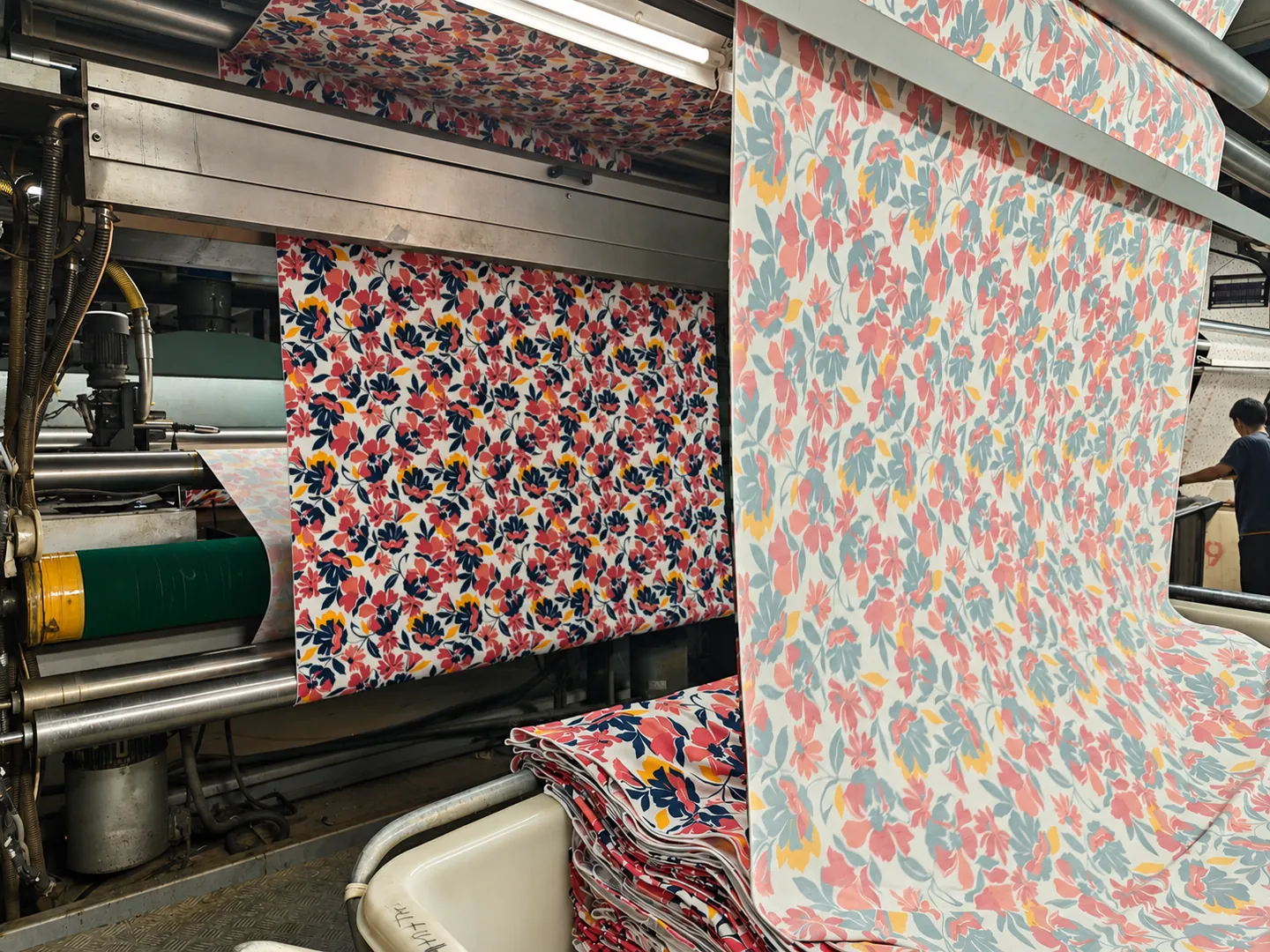
If a fabric looks fashionable in a livestream, that tells you what one seller is promoting. The dyeing and finishing schedule can tell you more about whether the material is practical to repeat. The contributor who supplied this article and the production photograph describes increased attention to nylon-spandex knits in the Shaoxing Keqiao Binhai area. The photograph shows a printed cloth running through production equipment; it does not, by itself, establish fiber composition, weight or market share.
A mill willing to dedicate sampling, dyeing, printing and setting time to a construction is making a more substantial commitment than a trader showing a swatch. Still, a visible production run cannot prove that 180 GSM has become the national standard for T-shirts. Buyers should ask how many repeat colors and bulk lots a supplier has completed, what the approved width and finished weight are, and whether the bulk hand matches the sample. That is a firmer demand signal than a sales slogan.
For this guide, 180 GSM means a proposed finished-fabric weight of 180 grams per square meter. The number is useful because it gives a buyer a common starting point for comparing samples. It says nothing on its own about opacity when stretched, breathability, recovery or the finished garment's feel. Those properties must be specified and checked separately. ASTM D3776 defines the measurement of mass per unit area. [1]
Why designers keep returning to roughly 180 GSM
A functional T-shirt needs enough body to sit cleanly on the wearer while still feeling light enough for warm weather or an active day. A 180 GSM nylon-spandex single jersey can sit in that middle ground. The writer's draft calls it a “golden weight”; a more useful way to treat it is as a sample target. A slightly lighter knit may work for a loose training tee, while a denser or double-knit fabric may be better for close-fitting, pale-colored garments.
The same nominal weight can feel different after changes to yarn fineness, stitch density, elastane placement, brushing or heat setting. A white 180 GSM tee can also look less opaque than a dark one, especially under stretch. An interlock at 180 GSM may behave differently from a single jersey at 180 GSM. Laboratory work on elastic polyamide knits has found differences in air permeability, moisture management and drying across constructions and weights; the construction matters alongside the fiber blend. [4]
When comparing samples, request both the finished GSM and the usable width after setting. Lay the swatches over a contrasting background, stretch them to the amount expected in wear, and evaluate them under the light in which the finished shirt will be used. Then wash and remeasure. A supplier's statement that the fabric is “180 GSM and not see-through” is not a substitute for this product-specific check.
A yarn-cost example, with the arithmetic shown
The supplied draft offers a useful comparison, but its quoted material costs need to be calculated on the same basis. At 180 g/m² and 1.6 meters of usable width, one linear meter contains 0.288 kilograms of fabric: 0.180 × 1.6 = 0.288. That figure is finished fabric mass, not an allowance for knitting waste or processing loss.
Using the draft's illustrative yarn prices—CNY 19/kg for nylon, CNY 50/kg for spandex, CNY 15.5/kg for cotton and CNY 7.3/kg for polyester—an 88% nylon/12% spandex blend works out to about CNY 6.54 of yarn per meter. Cotton works out to CNY 4.46 and polyester to CNY 2.10. The nylon-spandex versus cotton difference is therefore about CNY 2.08 per meter under these assumptions, not less than CNY 2. These are arithmetic examples, not verified October 2026 market quotations.
A finished-fabric quotation also includes knitting loss, dye and auxiliaries, water, steam, setting, inspection, testing, packaging, taxes and the supplier's margin. Digital printing, if requested, adds its own setup, chemistry and fixation costs. A buyer should not take the CNY 6.54 yarn figure as a deliverable fabric price. Ask for two like-for-like finished offers with the same usable width, shade, order size, performance targets and delivery term.
Six selling points that need a real sample
Hand feel is the first reason a brand may try nylon-spandex. A fine yarn and suitable finish can create a smooth, cool touch. But the word “nylon” does not guarantee silkiness; a coarser yarn or different knit can feel firmer. Judge the approved bulk sample after the intended wash, not just a freshly finished sales swatch.
Skin comfort and friction depend on surface texture, seam design, fit and finishing. Stretch can help a T-shirt move without pulling, but the elastane percentage does not tell the whole story. Test extension, growth and recovery in the directions that matter for the garment. ASTM D2594/D2594M describes a method for low-power knit stretch and growth; support or compression garments may need different tests. [3]
Moisture management is often marketed as “quick dry” or “ice silk.” Nylon's fiber properties alone do not prove that sweat will move away from the skin. Yarn structure, knit geometry and finishing affect wetting, spreading and drying. AATCC TM195 measures liquid moisture management on textile fabrics. [2] Set a result and a wash condition if that property matters to the product.
Drape and shape retention also need to be checked on a sewn garment. A clean hanging panel does not guarantee that a collar will stay flat after laundering or that a hem will not curl. Ask for a wear and wash trial. Easy-care claims should likewise be tied to a specified wash procedure, not to an assumed 92–95% recovery figure for every nylon-spandex fabric.
Finally, printing can bring color and range. A design that looks vivid on a flat swatch may open up on stretch or shift after fixation. Evaluate the printed fabric at the expected extension and test shade, rubbing and laundering fastness on the actual approved construction.
Where nylon-spandex fits among T-shirt materials
Cotton remains a familiar choice for classic tees. Its absorbent hand and broad availability make it suitable for everyday styles, from light summer shirts to heavyweight garments. Cellulosic fibers such as modal or lyocell offer another route to soft drape and lounge comfort, though the exact knit and care conditions still govern shape retention. Polyester-spandex is common in performance and value-oriented activewear and can be engineered for quick drying, structure and printability.
Nylon-spandex can occupy a useful space between a soft casual tee and a technical training top. A brand might choose it for an elevated commute tee, a light studio top, a travel layer or a close-fitting sun-protective silhouette. None of these end uses is assured by fiber composition. A sun-protection claim needs a UV test; a training claim needs relevant moisture and stretch performance; a travel claim needs care and wrinkle evaluation.
Thinking in “four generations” can make a marketing story, but the materials are not replacements for one another. A heavyweight cotton white tee solves a different wardrobe problem from a smooth nylon-spandex shirt. A buyer's first question should be: which wearer, fit and use does this fabric serve? The answer determines which comparison and which tests are fair.
Digital printing widens the style range, when the route is right
The supplied factory photograph shows patterned fabric during production, a useful reminder that a nylon-spandex base is not limited to solid colors. Digital printing can make short design runs and frequent pattern changes easier than preparing a separate screen for every new print. It can suit boutique studio collections, event tees or seasonal fashion capsules when the factory's minimum and lead time work for the buyer.
A printed nylon fabric still needs compatible color chemistry, preparation and fixation. Research on polyamide 6.6 digital printing demonstrates that route choice and substrate treatment affect the result. [5] Stretch also makes the quality check more demanding: the buyer should look for exposed ground color when the print is extended, loss of definition, uneven hand, or a change in stretch and recovery after printing. Not every digitally printed design is suitable for every nylon-spandex construction.
The draft cites one-meter minimums, 72-hour turnaround and very high single-pass speeds as if they are universal. They are not reliable promises for a buyer without a named factory, exact process, approved artwork and testing plan. Ask for the actual minimum per design and color, strike-off time, bulk lead time and the method used to test the printed sample. Compare a digital quote with screen or other printing routes at the intended order quantity; the cheaper route can change as volume rises.
How to turn a promising swatch into a repeatable product
Start with a written specification: nylon and elastane percentages; yarn count; knit structure; finished GSM and usable width; shade or print artwork; target hand; and intended garment fit. Specify the stretch direction and acceptable growth after extension. If moisture movement, UV blocking or dimensional stability are central to the sales promise, name the test method and pass level before the mill quotes. Keep the approved physical sample with the purchase order.
Then ask for the complete process and commercial route. Is the offer for greige, dyed fabric or finished printed fabric? Does it include sample making, fixation, heat setting, inspection and testing? What is the minimum per shade or print, and how much usable fabric remains after finishing? A lower quote that excludes several operations is not a like-for-like saving. The same dyehouse may quote a different price for a solid yoga top and a small-run printed T-shirt.
A 180 GSM nylon-spandex knit can be an excellent candidate for a functional T-shirt, but the number 180 is only one line of the specification. The product succeeds when its touch, stretch, drying behavior, appearance and cost all match the use. Keqiao's integrated knitting, dyeing and printing network can make development and replenishment practical; the buyer still needs one approved route and a mill that can reproduce it.
Adapted from a contributor-supplied 2026 manuscript and production photograph. Numerical examples were recalculated from the manuscript's stated input assumptions. Technical references were checked against ASTM, AATCC and peer-reviewed textile studies. The photo was lightly color-treated for the site's palette and optimized as responsive WebP files.
The contributor describes growing interest in nylon-spandex T-shirt fabrics in the Keqiao Binhai production area, but this article does not claim a measured national market share or audited mill capacity. The cost example is illustrative yarn arithmetic, not a current supplier quote. Fabric performance varies with yarn, knit, finish, shade, construction, printing and garment design; verify the exact bulk quality against the buyer's test requirements.
Sources
- ASTM D3776/D3776M, Mass Per Unit Area (Weight) of Fabric
- AATCC TM195, Liquid Moisture Management Properties of Textile Fabrics
- ASTM D2594/D2594M, Stretch Properties of Knitted Fabrics Having Low Power
- Materials (2020), Comparative Analysis of Comfort Properties of Elastic Knitted Fabrics
- Polymers (2021), Digital Sublimation Printing on Knitted Polyamide 6.6 Fabric