Why a Knit Category Name Is Not a Complete Specification
The most frustrating misunderstanding when sourcing or supplying fabric goes like this: a client gives a vague request like “Send me some single jersey.” You quote and ship the order, only for them to open the roll and realize they wanted a 200 GSM jersey for base-layer tees, while you dispatched a 140 GSM lightweight jersey for innerwear. Or the client asks for “something a bit softer,” and after three exhausting rounds of hand-feel adjustments, they are still dissatisfied.
In most cases, the issue stems from specifying the category name without detailing the technical specifications. A knit fabric’s category name is merely a label. Four core parameters help define the product: knit structure, yarn count, GSM (weight), and cuttable width. These should be confirmed alongside fiber composition, finishing, performance requirements and an approved sample; the four parameters alone cannot guarantee execution.
This guide clears up the confusion around common knitted fabric categories and specifications: what each structure looks like, indicative weight ranges, typical garment applications, and what to write on a purchase order. When a client asks for “some single jersey,” use it to identify the missing parameters before quoting or shipping.
I. Establishing Two Dimensions: Weft vs. Warp, Single vs. Double
Weft and warp describe how loops are formed, not a quality ranking. Circular weft knitting is widely used for the apparel fabrics discussed here, while weft knitting also includes flat-machine production. Warp knitting has applications in swimwear, intimate apparel, mesh and many other products; it is not restricted to those uses. [1]
Single jersey is normally produced on one needle bed, with different face and back appearances. The face shows knit loops and the back shows purl arcs; cut edges commonly curl. Rib and interlock use two needle beds. Balanced rib and interlock tend to lie flatter than single jersey, but not every double-knit design looks identical on both sides or has the same stability. [2]
A small swatch laid flat can provide a quick clue: curling suggests an unbalanced structure such as plain single jersey, while rib or interlock often lies flatter. Finishing, elastane, fabric direction and construction can affect the result. Confirm the loop structure and mill specification rather than treating this as a conclusive three-second test.
II. Common Knitted Fabrics: A Sourcing Matrix
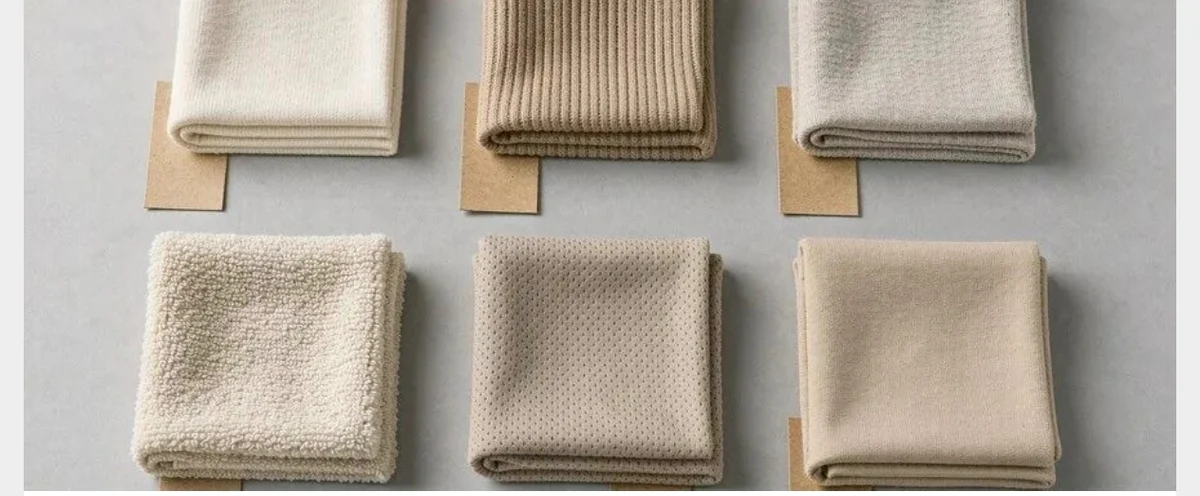
When a client asks for fabric for a garment type, use this matrix to narrow the discussion. The ranges below are indicative examples supplied with this guide, not standardized boundaries. Fabrics outside these bands may be suitable. French terry, brushed sweatshirt fleece and pile terry also need precise naming because suppliers may use “terry” for different constructions.
| Fabric category | Structure | Indicative GSM | Hand-feel and performance considerations | Typical uses |
|---|---|---|---|---|
| Single jersey | Single knit; smooth knit face and purl-loop back | 130–220 g/m² | Often light, soft and breathable; may curl or unravel at cut edges | T-shirts, base layers, underwear, loungewear |
| Rib (1×1, 2×2) | Double knit with alternating knit/purl ribs | 180–320 g/m² | High crosswise extensibility and body-hugging fit; balanced structures tend to lie flat | Neckbands, cuffs, hems, fitted layers, knitted hats |
| Interlock | Double knit with smooth knit appearance on both sides | 160–280 g/m² | Often substantial, smooth and stable; confirm shrinkage after finishing | Childrenswear, loungewear, base-layer leggings, babywear |
| French terry / loopback sweatshirt knit | Smooth face with loops on the back | 240–360 g/m² | Substantial hand; loop construction and fiber affect warmth and moisture behavior | Sweatshirts, casual jackets, tracksuits |
| Brushed / sueded sweatshirt fleece | Sweatshirt base with a raised or mechanically softened surface | 260–400 g/m² | Plush hand and increased loft; assess pilling and shedding | Autumn/winter sweatshirts and lounge sets |
| Piqué (PK) | Textured knit, often a tuck-based single-knit construction | 180–240 g/m² | Textured surface can reduce cling; stability and airflow depend on construction | Polo shirts, sports T-shirts |
| Ponte de Roma | Firm double-knit construction; blend and design vary | 220–320 g/m² | Structured hand with useful recovery in suitable constructions; verify stretch in both directions | Trousers, skirts, tailored knit jackets, dresses |
| Air-layer / spacer-style knit | Two faces linked by connecting yarns; construction varies | 280–420 g/m² | Loft and body can support structured shapes; warmth and surface durability need verification | Jackets, tracksuits, winter tops |
| Pile terry / towel knit | Pile-loop surface; distinguish from loopback sweatshirt fabric | 200–340 g/m² | Absorbency and bulk depend strongly on fiber and pile construction | Bathrobes, loungewear, selected hoodies |
| Jacquard / striped knit | Patterned construction or yarn/color arrangement; single or double knit | Depends on construction | Pattern relief and color effects vary; stripes may be knitted or printed | Fashion garments, striped tees, childrenswear |
The Same Category Can Produce Different Garments
A difference in GSM can change the commercial product substantially. A 140 GSM single jersey may suit lightweight underwear or layering; a 200 GSM version may suit a more substantial T-shirt. Price, opacity, hand-feel and drape can differ—so never specify just the category name.
Neither weight guarantees the end use: fiber, yarn count, stitch density, finish and garment design still matter. Compare representative swatches and a trial garment before assuming the heavier fabric will be more structured.
III. Choosing GSM by Season and Garment Category
When a client asks “What weight should we run?”, use the application matrix as a baseline for sampling. Climate, layering, opacity, garment fit and the selected fiber can shift the appropriate range. These are discussion ranges, not a promise that a fabric will meet every performance requirement.
| Application | Indicative GSM | Common candidates |
|---|---|---|
| Summer T-shirts, underwear and lightweight layers | 130–180 g/m² | Single jersey; piqué where suitable |
| Spring/autumn long-sleeve tees and base layers | 180–240 g/m² | Single jersey, interlock |
| Autumn/winter sweatshirts | 280–360 g/m² | French terry, brushed sweatshirt fleece |
| Autumn/winter jackets and coordinated sets | 300–420 g/m² | Air-layer/spacer-style knit; heavier Ponte where available |
| Trousers and skirts | 220–320 g/m² | Ponte de Roma; interlock where opacity and recovery are suitable |
| Childrenswear and babywear | 160–240 g/m² | Soft interlock or jersey; confirm intended-use requirements |
Higher GSM Does Not Automatically Mean Better Quality
Higher GSM means more mass per unit area, not an automatic quality improvement. It may increase material use and often changes thickness and hand-feel, but it does not by itself determine breathability, warmth or drape. A heavy open construction and a light dense construction can behave differently.
For a “structured, substantial” feel, compare an appropriate higher-GSM option alongside yarn and structure changes. For a lightweight, breathable product, assess a lower-GSM option and verify opacity, strength and comfort. Never default to the heaviest quotation simply because the client asks for better quality.
IV. Width Metrics: Look Beyond a Single Number
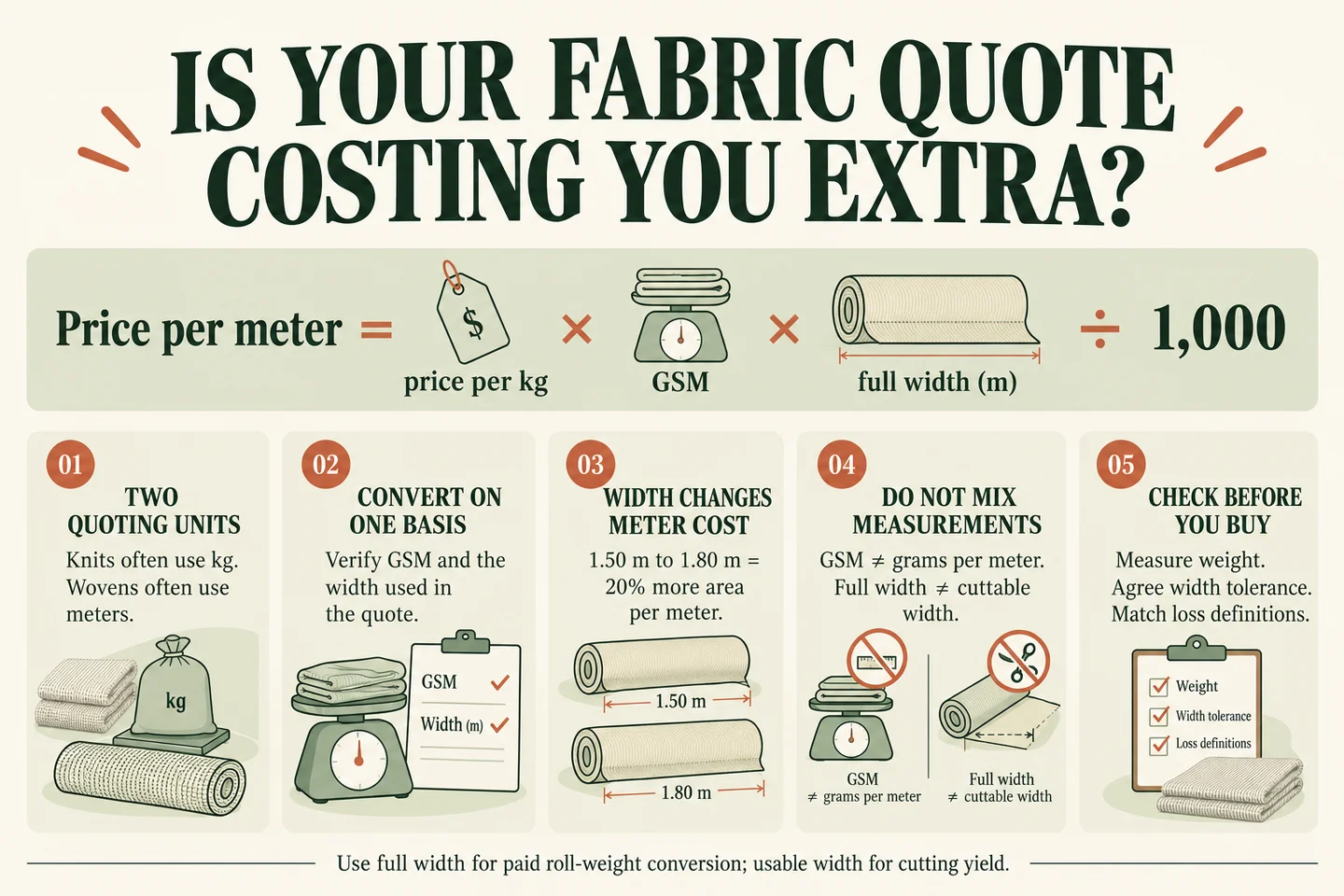
A cuttable width around 150–185 cm is a common sourcing reference for some apparel knits, not a universal standard. Construction, machine diameter, finishing and the application can produce substantially different widths. State whether a quote refers to overall finished width, width including unusable edges, or guaranteed cuttable width.
For tubular fabric, clarify whether the measurement is the laid-flat tube width or the opened circumference. A tube laid flat at 80 cm has a nominal circumference of about 160 cm before any slitting, edge loss or finishing change. For open-width fabric, state the usable width after the agreed exclusion of edges and processing loss; do not deduct the same waste twice.
Confirm width in the agreed relaxed or conditioned state, without stretching the fabric during measurement. A 2 cm reduction can disrupt a tightly fitted marker and cause a significant yield loss, but the impact depends on the pattern layout; it does not automatically remove a row of garments. Verify it with the actual marker.
V. Purchase-Order Specification Checklist: Eight Items to Confirm
Fill in all eight line items before the factory or client approves the order. The examples are illustrative and should be made mutually consistent for the chosen construction. Add the approved swatch reference, quantity by color, delivery terms and test methods to the order documentation.
| Item | What to specify | Illustrative example |
|---|---|---|
| Knit structure | Category, construction and single/double-knit designation | Double-knit interlock |
| Fiber, yarn and count | Composition; yarn type; count system and ply | Combed cotton yarn, Ne 32/1; specify the full fabric composition separately |
| Finished GSM | Target, tolerance and measurement condition | 220 g/m², ±5%, under agreed conditioning |
| Width | Cuttable or tubular/open width, minimum/tolerance and measuring state | Open width: usable 165 cm, tolerance agreed in writing |
| Stretch and recovery | Elastane percentage if used; required direction and performance | 97% cotton / 3% elastane where compatible with the approved construction; agreed recovery test |
| Color and colorfastness | Approved shade reference; tests and acceptance grades | Dark gray to approved lab dip; wash color-change and staining grades specified against an agreed method |
| Finishing | Brushing/sueding, mercerizing, compaction/preshrinking and other treatments | Light sueding plus agreed preshrink/compaction route |
| End application | Garment and expected use/care conditions | Autumn/winter base-layer top |
Make Yarn Count and Finishing Instructions Unambiguous
Do not write “32 count” without identifying the count system and ply. A cotton-style specification such as Ne 32/1 is not interchangeable with Nm, tex or denier. Specify each yarn component where the construction uses different face, binding, loop or elastane yarns. A complete yarn description also needs composition and any agreed spinning or preparation requirements.
Of the eight items, finishing and end application are often overlooked. A 220 GSM interlock with an agreed compaction or preshrink treatment may have a different residual shrinkage result from an untreated version. Specify the process and the required result under an agreed laundering test, rather than assuming the treatment name guarantees a value. Cotton Incorporated’s processing guide explains the relationship between knit geometry, distortion during processing and shrinkage control. [3]
VI. Three Critical Pitfalls to Avoid
Pitfall 1: quoting a category without GSM. The mill may select a construction based on its own assumptions. Confirm the target and tolerance against the approved swatch before bulk manufacture rather than debating the intended product after delivery.
Pitfall 2: overlooking stretch and recovery. “Form-fitting yet comfortable” does not automatically require elastane: rib and other knit structures can provide mechanical stretch. Where elastane is needed, specify the blend, stretch direction and recovery requirement, and obtain a validated processing route for that yarn and fabric.
Pitfall 3: ignoring finishing effects. Brushing, raising and sueding change surface texture and can affect loft, GSM and durability. Raised fibers may increase pilling or shedding risk, but the result is not inevitable. Agree the appearance and the performance requirement, test the finished sample and do not ask the buyer to accept poor pilling simply because a plush finish was requested.
Final Takeaway: Start with the Garment, Then Complete the Specification
Follow this sequence: define the end application, select the fabric category, agree the yarn and composition, lock down finished GSM, and complete usable-width, finishing and performance requirements. Approve a reference sample before bulk production.
When a client supplies only a category name, prompting for the missing parameters demonstrates practical expertise. Convert words such as “softer,” “heavier” and “more structured” into comparable swatches, checkable measurements and agreed acceptance criteria.
The classifications and ranges in this guide are sourcing references compiled from the contributor’s tables and technical background material. Final parameters must follow the actual product, approved lab dips or swatches, and the written order specification.
Compiled from the contributor’s final multipart English manuscript and three Chinese reference tables, translated into accessible HTML tables. The earlier opening paragraph was discarded as requested. Structure claims were checked against CottonWorks references; GSM and width bands remain contributor-supplied sourcing examples, not mandatory industry standards. Unsupported market-share and absolute performance claims were qualified.
Reference ranges are starting points for sample development, not acceptance criteria or guarantees of warmth, opacity, stretch, drape or quality. Actual properties depend on fiber, yarn, stitch geometry and finishing. Approve representative samples and specify test conditions and tolerances before ordering.
Sources
Turn a knit reference into a usable sourcing brief
If you know the look you want but not the construction or specification, start with clear photos or a physical reference and your end use. Our US$99 fabric sample search looks for 2–5 matching or similar swatches within 1–3 days after receiving the complete brief and reference. Courier charges are additional; exact matches and material performance require confirmation. Sample-yardage cutting, bulk purchasing and laboratory testing are not included.
YOUR NEXT STEP
Put the details to work.
Estimate an order or turn your specifications into a supplier inquiry.