Beyond Community: Product Experience Has to Deliver
lululemon is often discussed through its ambassadors, community and retail experience. For a clothing founder, there is another useful question: what must happen inside product development for a promise of comfort to survive contact with an actual workout?
Consumer insight creates a direction. Material development, pattern cutting, sewing and consistent production have to deliver it. A shopper may describe a legging as distracting, restrictive or reassuring; a supplier needs a brief precise enough to change the product. Connecting those two languages is the central idea explored here.
This article examines public information about lululemon’s approach, then translates it into a practical workflow for smaller brands. It does not treat material innovation as the sole explanation for premium pricing or repeat purchases.
What Is lululemon’s Science of Feel?
lululemon describes Science of Feel as a product innovation philosophy connecting function and design. Its public explanation links technical fabrics with construction, fit and features, and says feedback from guests and ambassadors helps identify development opportunities. [1]
For a founder, the practical interpretation is to begin with a desired wearing experience. A yoga user seeking gentle, unobtrusive movement may want a different product from a runner who values secure support. “Soft” alone is too broad to distinguish those briefs.
That interpretation does not mean subjective sensation can be reduced to one universal score. Wearers differ in body shape, movement, sensitivity and preference. Useful research combines what people report with observations and measurements appropriate to the particular problem.
Whitespace: A Historical Example of Multidisciplinary R&D
In a first-person account published in March 2017, Tom Waller said his team began in 2012 and was based in Vancouver. He described capabilities spanning human experience and wear testing, research into movement and thermal comfort, engineering, prototyping and product creation. This supports a multidisciplinary view of the historical Whitespace team. [2]
It does not establish that today’s organization follows a fixed three-department chart. We therefore use concept exploration, material validation and production transfer below as an explanatory development framework, rather than as verified current lululemon department names.
The important organizational question for an emerging brand is straightforward: who owns the handover between a wearer complaint, a fabric decision and a production requirement? Even a small team needs someone responsible for each step.
1. Turn a Wearer Problem into a Development Brief
Start with a specific activity and moment of discomfort. “Make a premium yoga fabric” is difficult to act on. “The waistband presses into the abdomen during seated poses” identifies a location, movement and experience that a development team can investigate.
Separate the likely causes before changing the material. Pressure may come from the waistband geometry, elastic, size grading or fabric resistance to stretch. Chafing may involve seam placement as much as surface handle. A material change that improves one symptom can create another.
Research can suggest candidate fibers, constructions, finishes or assembly methods. The next question is whether each candidate can be sampled, sewn, washed and reproduced at the intended price and order quantity. Novelty becomes useful when it solves the chosen problem under those constraints.
2. Connect Handfeel with Measurable Product Checks
Do not ask a mill to manufacture “buttery softness” without a reference and an evaluation plan. Compare coded samples with the same garment pattern where possible, and record differences in dry handle, wet cling, movement restriction and recovery. Change one major variable at a time so feedback remains interpretable.
Fabric tests and wearer feedback answer different questions. Extension measurements can help describe resistance to movement; a wearer trial can reveal whether the resulting pressure feels comfortable in the intended pose. Neither proves the other on its own.
The table below is an editorial development aid, not a disclosure of lululemon’s internal testing protocol or acceptance limits.
| Desired experience | Candidate checks | What to hold consistent |
|---|---|---|
| Soft against the skin | Reference handle comparison; surface appearance after washing | Sample conditioning and care cycle |
| Easy movement | Extension, recovery and sewn-garment movement trial | Pattern, size and direction of stretch |
| Less wet cling | Relevant moisture tests plus wet-state wear feedback | Activity, exposure and test conditions |
| Reliable coverage | Opacity assessment at agreed garment stretch | Color, lighting, backing and fit |
| Comfort that lasts | Pilling, abrasion, dimensional change and seam checks | Methods, cycles and agreed limits |
Nulu and Align: A Documented Feel-Led Product Story
In its 2025 tenth-anniversary account, lululemon says Align launched in 2015 and that developing Nulu took 18 months. It describes the original need as light, unrestricted movement during yoga, addressed through fabric and garment construction. These are company-reported details, not an independently reconstructed development history. [3]
The same account describes Align as a $1 billion franchise spanning several product categories. That is broader than revenue from one original legging style, and the announcement does not give a reporting period for that figure. It should not be presented as audited annual sales of a single pair-of-pants design. [3]
The useful lesson is the sequence: select the experience, build and compare prototypes, then evaluate the complete garment. The public story does not reveal a reproducible yarn arrangement, chemical formulation, brushing recipe or exact number of sample rounds. A supplier’s “Nulu-like” description therefore remains a comparison claim to investigate, not proof of access to the original material.
Nulu vs. Luon vs. Everlux: Different Briefs, Different Fabrics
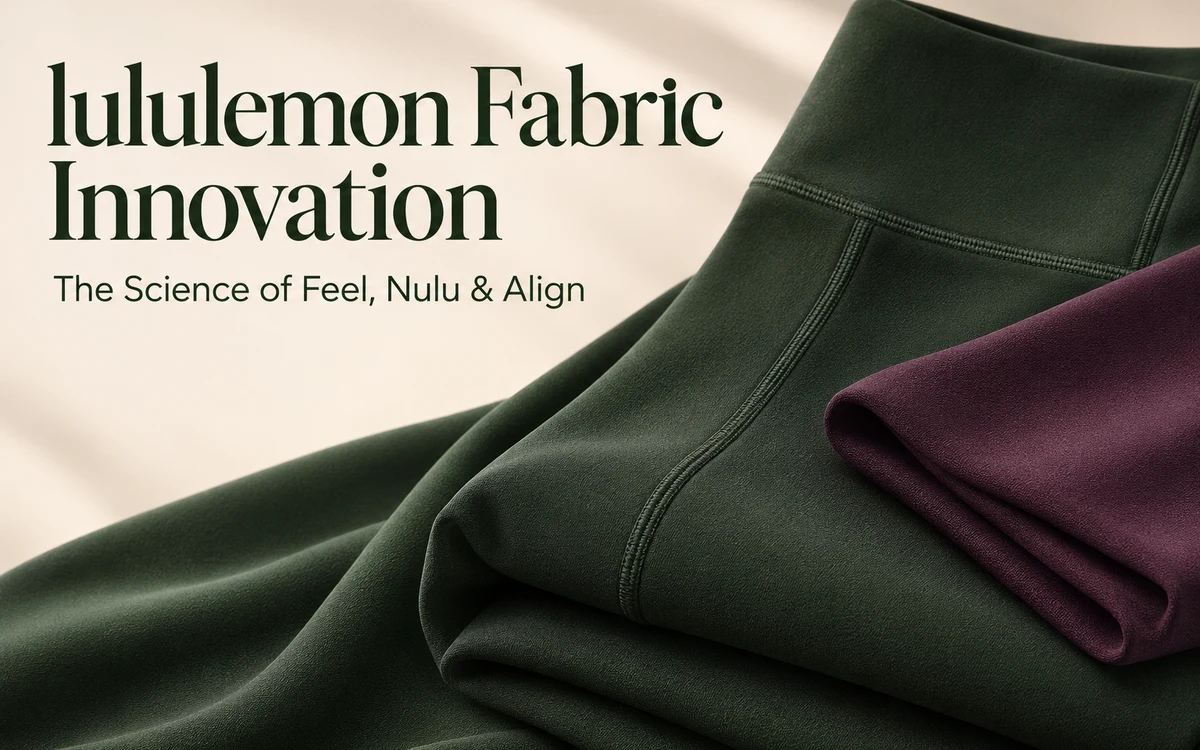
lululemon’s public fabric guide associates Nulu with a light, soft yoga experience, Luon with a cotton-like handle for yoga or lower-impact activity, and Everlux with sweaty studio use. It describes Everlux as a double-knit construction using differentiated yarns on the two sides. These are the brand’s product descriptions, rather than a universal performance ranking. [4]
For sourcing, the implication is that there is no single “best lululemon-type fabric” for every activity. A low-distraction yoga brief and a high-sweat training brief prioritize different compromises. Softness, support, drying, opacity and durability need to be considered together.
Compare the finished garment, not just two swatches that share a nylon–elastane label. Similar fiber percentages do not establish the same yarn, construction, surface finish, fit or wearing experience.
3. Transfer the Approved Experience into Production
In its 2024 annual report, lululemon says it does not own or operate manufacturing facilities. It describes working with fabric and trims suppliers, developing proprietary fabrics, and seeking protection through agreements, trademarks and trade secrets. The report also describes external testing of characteristics such as pilling, shrinkage, abrasion resistance and colorfastness. [5]
Those disclosures support a collaboration model. They do not establish that every supplier arrangement is exclusive, that restrictions always last three to five years, or that one named mill developed every major fabric family. Without product-specific evidence, those details should not be stated as facts.
For an independent brand, a production handover should identify the approved reference, specification tolerances, finishing route, testing plan and process for substitutions. Where custom development is involved, clarify ownership, minimum quantities, permitted sales and any exclusivity in writing.
A one-off development sample is only the beginning. Compare the pilot and bulk material with the approved reference after the same care cycle, then confirm that cutting and sewing preserve the intended fit and handle.
What Small Activewear Brands Can Apply Now
Choose one wearer group and one activity before commissioning a broad fabric range. Collect specific descriptions of where an existing garment distracts, presses, clings or loses shape. Turn those observations into a short list of priorities and compare a manageable number of candidate materials.
Approve a sewn prototype, not just an attractive swatch. Review movement, coverage, seams and laundering, then record what was accepted so the supplier can reproduce it. Keep enough budget and time for revision before bulk production.
You do not need to recreate a large brand’s laboratory to work this way. Begin with a reference, a clear use case, agreed checks and a controlled handover. The central lesson from a feel-led approach is that insight becomes valuable when it changes a product in a way the wearer can actually recognize.
Adapted from contributor-supplied Chinese analysis and checked against public primary sources. Historical Whitespace statements distinguished from present organization. Unsupported three-department chart, journal-reading horizon, sensory-mapping algorithm, neural-signal interpretation, Nulu chemical/process recipe and supplier-specific exclusivity periods omitted. Company-reported development duration and franchise size attributed rather than independently audited.
Independent educational analysis, not an internal laboratory audit or an endorsement by lululemon. Development recommendations are ClothingStartups editorial analysis; no access to confidential formulations, supplier contracts or product-level profitability is claimed.
Sources
- lululemon — Product Design & Development: Science of Feel and guest feedback
- Tom Waller — Is Whitespace your space…? (2017 first-person historical account)
- lululemon — Celebrates 10 Years of Align (2025 company account)
- lululemon — Our Fabric + Technology: Nulu, Luon and Everlux positioning
- lululemon — 2024 Annual Report: product development, proprietary fabrics and manufacturing
Turn a feel reference into a sourcing brief
Send a physical reference or clear photographs with the intended activity, fit, weight and handfeel priorities. Sample search can help compare available options; it does not promise branded proprietary fabric, identical performance or access to exclusive suppliers.
YOUR NEXT STEP
Put the details to work.
Estimate an order or turn your specifications into a supplier inquiry.