What Is JNBY? A Brief Introduction
JNBY Group, known in Chinese as Jiangnan Buyi, is a Hangzhou-based designer-fashion company founded in 1994 and listed in Hong Kong in 2016 under stock code 03306. Its portfolio extends beyond the JNBY womenswear label to brands including CROQUIS menswear, LESS, children’s clothing and JNBYHOME. The group combines distinct design identities with a broader lifestyle proposition. [1]
That multi-brand context matters when considering BOX+, its personalized styling and try-on service. A box can introduce an existing customer to coordinated pieces across a relevant assortment, rather than operate as an unrelated subscription product. For other clothing brands, the useful question is how the service fits the customer relationship and the merchandise already available.
A Membership Business Larger Than the Box
As customer-acquisition costs put pressure on fashion retail, JNBY offers a useful example of a business built around repeat relationships. Coverage of its fiscal year ended June 30, 2026 reports revenue of RMB6.046 billion and net profit of RMB997 million. Members accounted for more than 80% of retail sales, with over 610,000 active member accounts. [2]
Within that base, more than 360,000 accounts spent over RMB5,000 during the year. Their retail purchases totaled RMB5.20 billion and represented more than 60% of offline-channel retail sales. These are retail-sales measures, not interchangeable with consolidated company revenue. [2]
Dividing RMB5.20 billion by a rounded 360,000 gives roughly RMB14,444 per account. Because the disclosed count is “more than” 360,000, that is an illustrative calculation, not an exact reported average. None of these figures tells us how much was purchased through BOX+.
Design, fit, fabrics and brand culture all help explain loyalty. A high membership share does not prove that any one service created it. BOX+ should be examined as one tool within that wider system.
What “Private-Domain” Retail Means Here
In Chinese retail discussion, private-domain operations generally describe ongoing customer relationships managed through membership systems, store staff and channels such as WeChat and mini-programs. For an international reader, customer relationship management and clienteling are useful comparisons, although platform access is still governed by third-party systems.
The aim is to make relevant follow-up possible after a customer’s first purchase. Instead of paying to reacquire attention for every transaction, a brand can offer styling advice, product discovery and services to people whose preferences it already understands. The economics still depend on the cost and value of that service.
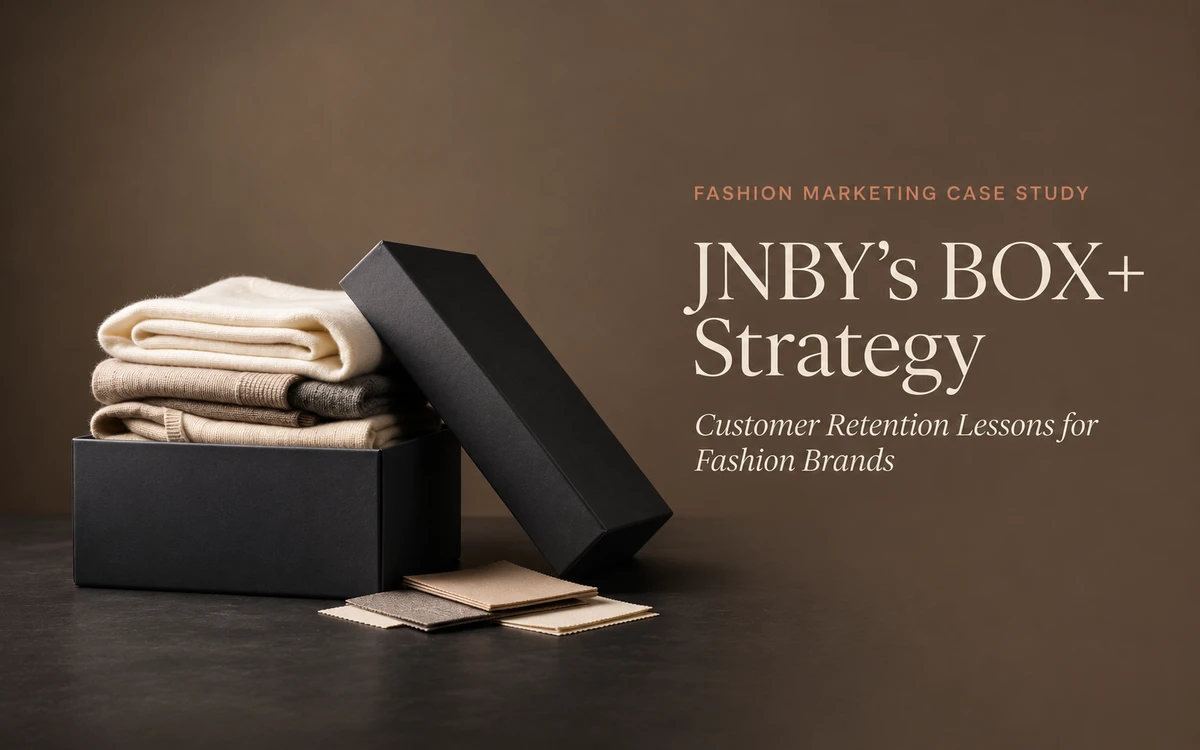
How BOX+ Works: Styling First, Purchase After Trying
Contemporary reporting dates the service’s launch to 2018. Early coverage described an annual RMB199 fee for six personalized styling sessions or boxes, with a stylist helping select garments and a try-before-buy experience. The shopper could keep and pay for selected items and return unwanted pieces under the service terms. [3]
The supplied account describes coordinated selections from group labels such as JNBY, CROQUIS and LESS, informed by shopping history and personal preferences. This turns the transaction from “choose one item” into “try a proposed wardrobe combination.”
Access has not always been limited to a paid subscription. In a 2023 roundtable, a JNBY representative described free access for gold-card members and paid or points-based options for others. That supports a VIP-benefit interpretation, but does not prove that all 360,000 high-value accounts use the service or that paid access is currently closed. [4]
Treat the RMB199 fee, six-use allowance and return-shipping arrangements as historical descriptions. Current eligibility, charges and return conditions must be confirmed with the brand.
Why a Styling Box Is Not Automatically a Profitable Model
JNBY did not invent curated clothing boxes. Stitch Fix is a prominent US predecessor: it was founded in 2011 and went public in 2017. Its fiscal 2025 report records approximately US$1.27 billion in net revenue and a US$28.8 million net loss from continuing operations; its UK business ceased operating in fiscal 2024. These historical results provide context, not a statement about its latest performance. [5]
The model also attracted Chinese entrants, including companies mentioned in the supplied manuscript such as Chuiyi. However, it would be too broad to conclude that all those businesses failed for the same reason.
Inventory exposure, two-way delivery, styling labor, returns and customer acquisition can all pressure a box model. JNBY’s existing assortment, member relationships and retail infrastructure create a different starting point from a standalone startup acquiring customers specifically for a subscription. That difference is commercially relevant, but public group results do not establish BOX+ profitability.
1. A More Considered Route to Inventory Discovery
For a premium brand, repeated clearance messaging can weaken price perception. The manuscript’s first proposition is that styling creates another way to introduce products: a past-season item or an isolated size can be recommended as part of a coherent outfit rather than presented only as discounted stock.
A customer who likes the complete look may judge an item by its usefulness in the outfit, not by its position in the inventory ledger. In principle, this can improve the visibility of pieces that shoppers would not have selected independently.
This is a proposed mechanism, not evidence that JNBY routinely fills boxes with leftover stock or that it clears inventory without discounting. For another brand, recommendations should remain relevant and transparent. Sending unwanted products to valuable members merely relocates an inventory problem into the customer experience.
2. Make the Outfit More Valuable Than the Single Item
A customer browsing alone might buy one top. A stylist can show how it works with trousers, a layer or another color, making additional pieces easier to understand and try. The service can also encourage customers to test silhouettes or palettes outside their normal choices.
This is the potential for higher attachment or basket value: the customer sees relationships between products rather than isolated product pages. It is not a guarantee that every box generates a larger profitable sale.
A brand should measure retained items and contribution after returns, delivery and styling costs. A larger dispatched box or a higher gross order value can be misleading if most items come back. The lasting objective is a useful outfit and a customer willing to repeat the experience.
3. Turn Fit Feedback into Product Learning
Returns can carry valuable information. Comments such as “tight across the chest” or “the silhouette feels unflattering” help a team distinguish fit concerns from color, styling or price objections. If the information is consistently collected and connected to the relevant item, it can inform later design and buying decisions.
The manuscript proposes a feedback loop from the customer to stylists, designers and supply-chain teams. This is a sensible operating model, but the exact internal workflow and its measured effect were not independently verified here.
For other brands, record product and size identifiers, separate subjective preference from repeat fit problems, and look for patterns across returns. Handle customer information with appropriate consent and access controls. A return reason becomes useful only when someone can act on it.
AI Can Assist the Service, but Outcomes Still Need Testing
The supplied account places BOX+ alongside WeChat mini-program commerce within the group’s digital and social-retail operations. Public reporting on FY2026 also describes AI use in recommendations, customer profiles and styling support. This is evidence of reported activity, not confirmation of every proposed step inside the BOX+ selection process. [6]
The manuscript also describes plans for proprietary large-model development. The business implication is prospective: AI-assisted matching might help stylists narrow the assortment, reduce repetitive work or make preferences easier to interpret. It should not be presented as a verified future reduction in labor cost or an already proven increase in matching accuracy.
For a smaller brand, first make the product attributes and customer feedback usable. Then compare assisted recommendations with a baseline using retained purchases, satisfaction, service cost and repeat behavior. More automation is useful only if the experience improves.
What Other Fashion Brands Can Learn
The strongest interpretation is that the box supports a relationship that already exists. In the manuscript’s analysis, it can help discover inventory, sell coordinated looks and collect richer feedback, making member operations more useful. That is different from assuming a new box business will acquire customers cheaply or become profitable by copying a fee.
Start with a small, relevant customer segment and a clearly defined service promise. Decide what the box should improve, which assortment it can draw from, and how returns, logistics and styling time will be funded.
JNBY’s membership figures show the scale of its repeat-customer business; they do not isolate the box’s contribution. The transferable lesson is to connect product appeal, personalized service and operational learning, then measure whether that connection creates value after its costs.
Translated from the supplied Chinese case analysis with an added brand introduction. Company identity checked against JNBY’s official website; FY2026 numerical figures attributed to financial-results reporting because the full-year primary filing was not retrieved. Historical service terms distinguished from present availability. Inventory, basket-size and product-feedback mechanisms labeled as analysis, not verified BOX+ unit economics.
Independent marketing case study, not investment advice, a BOX+ offer or an audit of customer data flows. Group membership sales do not measure BOX+ sales or profits. Media reports and company disclosures do not establish causal impact of the service.
Sources
- JNBY Group — Official company introduction and brand portfolio
- China Securities Journal — FY2026 results briefing and membership figures, September 13, 2026
- Jiemian — Contemporary coverage of the BOX+ launch and original terms, September 12, 2018
- 2023 fashion retail roundtable — JNBY representative describes gold-card access and paid membership options
- Stitch Fix — FY2025 Annual Report, including continuing operations and UK closure
- CNR — JNBY FY2026 results and reported AI applications, September 15, 2026
YOUR NEXT STEP
Put the details to work.
Estimate an order or turn your specifications into a supplier inquiry.