Why Does 65/35 Polyester–Cotton Appear So Often?
Visit a fabric market and T/C 65/35 is a familiar specification for uniforms, workwear, shirts and other easy-care products. In this notation, T/C normally means polyester/cotton: 65% polyester and 35% cotton by mass. Always write out the fiber names, because reversing their order changes the product.
Why not split everything equally? A blend is not a recipe that becomes better simply because the ingredients have equal shares. Buyers are balancing strength, handle, moisture behavior, crease recovery, cost and the ability to reproduce the same result in production.
65/35 is one established commercial answer. A Dickies poly-cotton jacket, for example, lists that composition. This illustrates a real application, not proof that 65/35 dominates every market or outperforms all alternatives. [1]
The important distinction is between a useful starting specification and a universal engineering optimum. The ratio can guide development; the finished fabric and garment still have to meet the brief.
1. The Strength Question: Why Blend Behavior Is Not Always Linear
If polyester and cotton have different strength and extension characteristics, a blended yarn need not behave like a simple weighted average. Fibers do not all share load identically or reach failure at the same extension. Their arrangement, length, fineness, twist and spinning system affect the yarn’s response.
Research on critical mixing ratios documents a strength minimum for particular cotton–polyester yarns and shows why the choice of component fibers matters. It does not establish a universal 50% polyester crossover or a guaranteed strength plateau at 65%. The published experimental yarns are evidence of a specific system, not a formula for every supplier. [3]
This matters even more when moving from yarn to fabric. Woven tensile strength, tear strength and knit bursting strength are different properties. Density, construction, yarn count and finishing can change the result. A stronger yarn does not automatically give the best tear resistance or the most suitable garment.
For a workwear brief, compare candidate fabrics using the required test methods and limits. Do not accept either “65/35 is always strong enough” or “50/50 is necessarily too weak” without evidence for the actual construction.
2. Cotton Content, Comfort and Pilling: A Trade-Off, Not a Fixed Boundary
Cotton contributes moisture absorption and a familiar handle; polyester can contribute resilience, easy care and durability. But moisture regain, liquid wicking, drying and air permeability are different measurements. More cotton does not automatically mean better sweat transport, and less cotton does not automatically make a garment unwearable.
An open, lightweight polyester-rich fabric can feel very different from a dense fabric with the same composition. Fit, ventilation, yarn and finish matter as well. A simple calculation of weighted fiber moisture regain cannot establish how comfortable the garment will feel during work.
Pilling also cannot be reduced to a 65% polyester red line. Strong fibers can help anchor pills, but surface hairiness, yarn structure, fabric construction, finishing and abrasion all influence pill formation and removal. A study of polyester–cotton woven fabrics examines hairiness and its relationship to pilling, reinforcing the need to assess the actual surface and test result. [4]
The table below preserves the supplied range of blend options while replacing fixed performance grades with sourcing questions. It is not a ranking of equal-weight, equal-construction fabrics.
| Polyester / cotton | Strength and body | Moisture / airflow | Pilling check | Handle direction | Development examples |
|---|---|---|---|---|---|
| 80/20 | Polyester-led; verify relevant strength tests | Low cotton absorption; airflow depends on construction | Test the finished surface | Can be crisp or soft depending on yarn/finish | Polyester-rich uniform or utility fabrics |
| 65/35 | Useful easy-care workwear starting point | Check work environment, density and drying | No guaranteed pass at 65% polyester | Often selected for a tidy, structured appearance | Uniforms, workwear, shirts |
| 50/50 | Balanced composition; not a strength grade | Compare absorption, spreading and drying separately | Test yarn and finish, not ratio alone | Varies with construction | T-shirts, fleece, selected shirts and uniforms |
| 40/60 | Cotton-rich; do not assume inadequate strength | More cotton contribution to absorption | Cotton-rich does not mean pill-free | Can emphasize a cotton-like handle | CVC tees, shirts and selected bedding |
| 20/80 | High cotton share; verify wash stability | Absorbency does not guarantee rapid drying | Assess abrasion and surface appearance | Often developed for cotton-focused products | Cotton-rich casualwear and fleece |
3. Is 50/50 Polyester–Cotton Actually a Bad Compromise?
No. Equal shares do not guarantee the best balance, but 50/50 is a legitimate commercial blend rather than a laboratory curiosity. Gildan’s 8000 Adult T-Shirt listing identifies a 50% cotton / 50% polyester composition, with the specific color and product details to be checked before ordering. [2]
It would therefore be misleading to claim that 50/50 has only narrow decorative uses or is inherently unsuitable for uniforms. The question is whether the selected fabric meets the required strength, appearance, laundering and comfort specification for that garment.
Likewise, one moisture-management experiment cannot establish 50/50 as the best ratio across woven shirts, knitted tees and bedding. The relevant construction, yarn, finish, test method and use conditions must accompany the result.
When comparing 65/35 with 50/50, ask the supplier for otherwise comparable options. If GSM, weave, yarn count and finish all change at once, the differences you feel cannot be attributed to the ratio alone.
4. Other Familiar Blends: Read the Fiber Order First
Different end uses lead to different blend choices. CVC commonly describes a cotton-rich cotton–polyester fabric, while T/R is trade shorthand for polyester–rayon, often viscose. These names do not replace a complete composition statement. “Rayon” can cover different regenerated-cellulose fibers, so identify the actual fiber being offered.
Wool–polyester 55/45 is one development option, not a rule that wool must always exceed polyester to retain a wool-like character. Fiber quality, spinning, weave and finish influence handle and appearance. Similarly, 60/40 and 80/20 cotton–polyester options can be useful without fixed thresholds where softness or shrinkage suddenly changes.
Research on cotton-rich blends has demonstrated that polyester fiber characteristics influence strength, abrasion and pilling; a high cotton share alone does not establish poor durability. [5]
Use the following ratios as examples to sample, rather than recipes that guarantee a result.
| Blend / trade shorthand | Example ratio, fiber order explicit | Development objective | What to verify if the ratio changes |
|---|---|---|---|
| T/C: polyester / cotton | 65% polyester / 35% cotton | Combine easy care and body with a cotton contribution | Strength, crease recovery, pilling and wash appearance |
| CVC: cotton-rich cotton / polyester | 60% cotton / 40% polyester | Emphasize cotton handle with polyester contribution | Dimensional stability, drying and surface durability |
| T/R: polyester / viscose | 65/35 or 70/30, polyester first | Balance drape and moisture absorption with stability | Wet and dry performance, pilling and laundering |
| Wool / polyester | 55% wool / 45% polyester | Balance wool character with practical durability | Handle, crease recovery, abrasion and care method |
| Cotton / polyester | 80% cotton / 20% polyester | Develop a cotton-focused product with a synthetic component | Shrinkage, twist, pilling and finish durability |
What About Viscose Wet Strength and Wool Character?
Conventional viscose can lose strength when wet, so wet handling and laundering deserve attention in polyester–viscose development. That does not mean a fabric above 40% viscose will fall apart, or that adding polyester eliminates the need to test it. Modified rayon types and other regenerated-cellulose fibers must not be treated as interchangeable.
For wool blends, avoid judging the entire fabric by which component crosses 50%. Decide what wool character means in the product: surface handle, drape, recovery, warmth or appearance. Then compare swatches and care performance against that target.
Neither viscose-versus-cotton price nor wool-blend quality follows a permanent ranking. Fiber grade, yarn, fabric construction, dyeing, finish, quantity and purchase terms all affect the quotation.
5. How to Choose a Blend Ratio for an Actual Order
For hard-working uniforms or workwear, begin by sampling a suitable 65/35 construction and a comparable alternative. Define required strength, abrasion resistance, pilling, crease recovery, dimensional change and appearance after the intended wash cycle. The label alone does not prove compliance with any workwear specification.
For a cotton-focused casual shirt, tee or bedding product, compare 60/40 and 80/20 cotton–polyester options where appropriate. Evaluate the actual handle, opacity, wash stability and drying behavior rather than assuming the highest cotton share is always best. For draped polyester–viscose or wool–polyester products, add the relevant wet performance, surface and care checks.
Write the full fiber names and percentages into the purchase specification, together with yarn, structure, finished GSM, usable width and agreed performance limits. If the composition is commercially important, arrange representative fiber-content testing using an appropriate method and sampling plan.
A substitution from 65/35 to 50/50 should be disclosed and approved; it is not acceptable simply because the supplier calls it “balanced.” Equally, a genuine 50/50 fabric should not be dismissed as deceptive or inferior without comparing it with the agreed requirements. Approve the actual material and retain the reference.
6. The Hidden Logic Is the Whole Fabric, Not Just the Percentage
Blend percentages are decisions about a complete product system: fiber properties, spinning, fabric construction, finishing, care and the wearer’s priorities. That is why established ratios remain useful starting points, but no percentage can independently guarantee comfort, strength or value.
65/35 is familiar because it can support a practical easy-care brief. 50/50 and cotton-rich blends answer other briefs and can also be engineered for demanding products. The right question is not whether a ratio looks more balanced on paper, but whether the finished material meets the intended use at an acceptable cost.
Understanding that logic makes a sourcing conversation more productive. Instead of asking only for a blend name, ask what will change when the ratio changes, which variables are being held constant, and what evidence will confirm the result.
Translated and edited from the contributor’s Chinese manuscript. Both requested comparison blocks recreated as English HTML tables. Corrected unsupported universal 50% strength crossover, 65% pilling threshold, minimum cotton comfort requirement, blanket 50/50 inferiority and majority-fiber rules for wool blends. Unidentified SciEngine claim and unverified fiber elongation/wet-strength percentages omitted. Supplier ratio examples retained with explicit fiber order and test-based limitations.
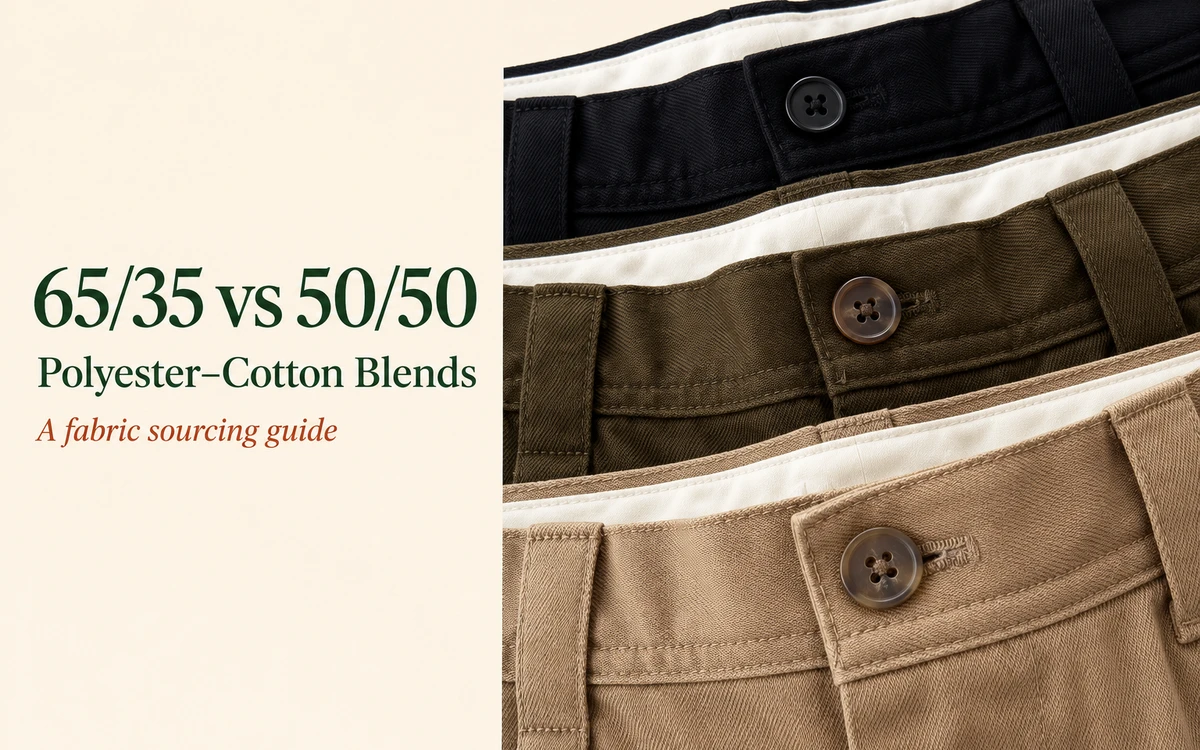
Comparative sourcing guidance, not a laboratory report or a composition certificate for the pictured trousers. Table entries are development prompts, not guaranteed rankings or industry-wide acceptance limits. Product examples demonstrate use, not market share.
Sources
- Dickies — Poly Cotton Jacket, listed composition 65% polyester / 35% cotton
- Gildan — 8000 Adult T-Shirt, listed 50% US cotton / 50% polyester (check color exceptions)
- Kremenakova and Militky — Prediction of Critical Mixing Ratio for Cotton Polyester Blended Yarn Strength, Beltwide Cotton Conferences 2006
- Wang and Xiao — Study on pilling performance of polyester-cotton blended woven fabrics, 2020
- Ruppenicker and Kullman — Properties of Yarns and Fabrics Produced from High-Cotton-Content Blends with Polyester Fibers, 1981
Compare blend options against a real reference
Send your intended garment, a reference sample or photograph, preferred composition, GSM and performance priorities. Candidate swatches can help compare handle and construction before independent testing or bulk approval.
YOUR NEXT STEP
Put the details to work.
Estimate an order or turn your specifications into a supplier inquiry.