Engineered Wear: Where Denim Whiskers Come From
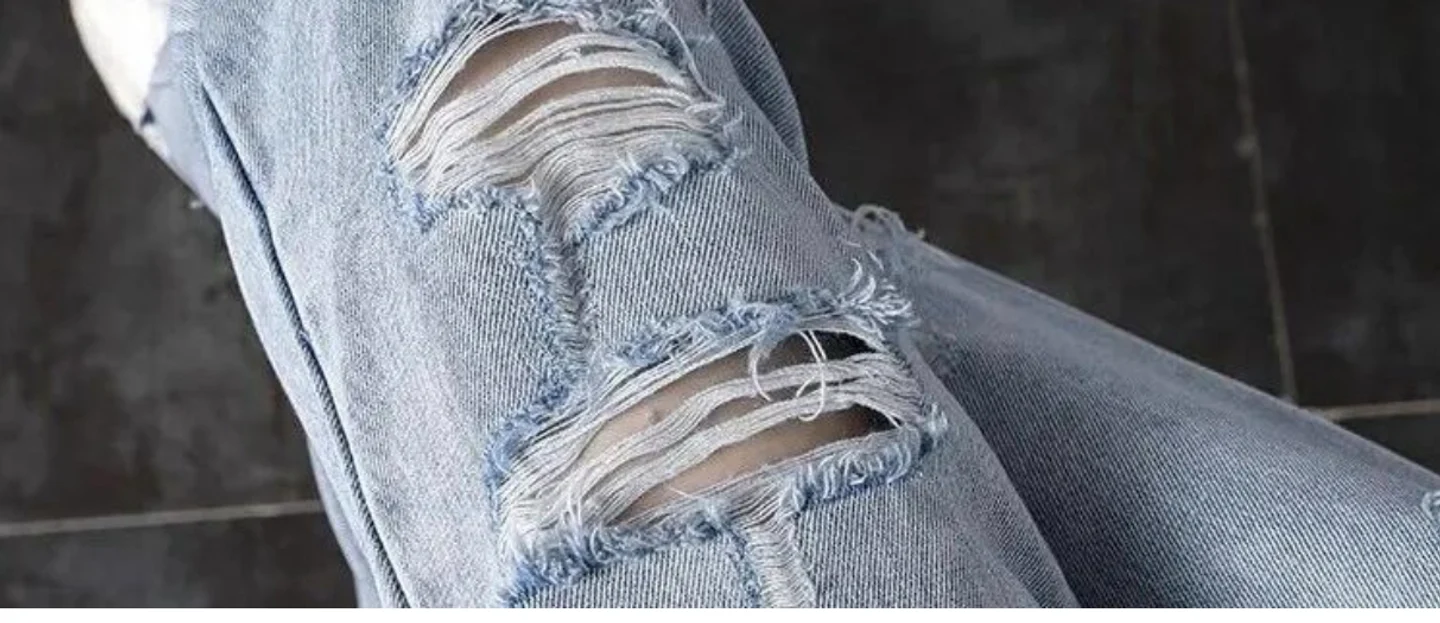
Unfold a pair of distressed jeans and you may see horizontal whiskers around the hip and upper thigh, faded panels and frayed openings. Many of these effects are deliberately produced during manufacturing rather than accumulated through years of wear. Industrial lasers are one route; manual, mechanical and chemical methods remain in use.
Traditional techniques include hand sanding and localized potassium permanganate (KMnO4, often called PP) treatment. Digital laser marking can replace some of those steps by scanning artwork onto the fabric. Processing time depends on design coverage, fabric response, machine configuration, loading and handling—not merely the time the beam is active.
How CO2 Laser Denim Distressing Works
CO2 systems commonly use infrared radiation around 10.6 μm. Absorbed energy heats the denim surface, modifying or removing dye and, at higher exposures, damaging or removing surface fibers. Jeanologia describes its laser marking process in terms of thermal removal of indigo by sublimation. Actual surface changes depend on the substrate and energy delivered. [1]
The workflow can be summarized as: digital artwork → controlled laser exposure → thermal modification of dye and surface fibers → faded pattern → any required cleaning and finishing. Dye removal and fiber ablation are related effects, but excessive carbonization is not a desirable requirement for every finish.
More delivered energy per unit area generally increases treatment severity. Power, scan speed, pulse behavior, focus, overlap and number of passes interact; power alone does not predict the result. Over-processing can cause yellowing, harshness or strength loss, rather than a better fade.
Grayscale artwork allows controlled pattern variation and repeatability. The result still depends on fabric lot, dyeing, garment placement and calibration. A digital file does not guarantee identical color transitions on every substrate. Machine ratings and claimed precision should be checked for the proposed model rather than treated as industry-wide constants.
The Inefficiencies and Hazards of Traditional Distressing
A denim finishing route may combine sanding, localized oxidation, enzymes, mechanical abrasion, rinsing, neutralization and softening. Not every garment uses every step. Resin-set creases and sanding are also distinct operations rather than interchangeable descriptions.
PP treatment oxidizes indigo and requires appropriate downstream processing and effluent management. Abrasive blasting can create serious dust hazards, particularly when silica-containing media are used. These methods need process-specific exposure controls; laser systems in turn require effective extraction, enclosure and fire-safety controls.
A figure for water consumed by an entire laundry recipe cannot be attributed solely to PP spraying. For a meaningful comparison, define whether the boundary is the marking step, all wet finishing, or the full garment supply chain. The same boundary must be used for both routes.
Laser marking itself is a dry operation, but a laser-finished garment may still be washed afterward. Manufacturer descriptions present lasers as part of a broader finishing system rather than proof that every finished pair is water-free. [1] [2]
Laser Processing vs. Traditional Distressing Methods
The comparison below translates and qualifies the supplied table. It separates the laser marking operation from the full garment finishing route. Timing, utility consumption and equipment prices need quotations and trials for the actual style rather than a universal number per pair.
| Comparison | Traditional manual / chemical route | Laser marking route |
|---|---|---|
| Whisker creation | Hand sanding; crease-setting operations may be separate | Digital artwork scanned onto the garment |
| Fading mechanism | Abrasion or localized oxidation, depending on recipe | Thermal modification or removal of dye and surface material |
| Time per garment | Depends on effect, operator and handling | Depends on coverage, machine, passes and handling |
| Water use | Wet treatment and rinsing can consume substantial water | Marking is dry; subsequent washing may still use water |
| Chemicals / materials | May include PP, bleach, enzymes or abrasive media | Can avoid certain marking chemicals; later treatments may still use chemicals |
| Waste and emissions | Effluent and dust depend on the recipe | Fumes and particles require extraction; downstream effluent may remain |
| Consistency | Depends on operator and process control | Digital patterns improve repeatability; fabric and calibration still matter |
| Investment | Manual tools may cost less upfront; full laundry equipment varies | Specialized equipment, extraction, training and maintenance add cost |
Operating Advantages and the Investment Decision
Laser marking can reduce repetitive manual work and improve repeatability for suitable designs. Where it replaces a chemical or abrasive operation, it may also reduce that operation’s associated material use and exposure. It does not automatically outperform every alternative on every style.
Equipment investment depends on work area, power, automation, extraction, installation, local support and financing. The manuscript’s US$40,000–110,000 range is not presented here as a verified current market quotation. Obtain comparable supplier offers that include the complete installed system.
Similarly, annual savings of 3,000 tonnes of water and a two-year payback cannot be assumed for every machine. Measure the baseline and proposed process at realistic utilization, including electricity, labor, maintenance, rejects and downstream washing.
Simple payback = installed investment ÷ annual net operating savings. Use positive, evidenced net savings and disclose assumptions. A full investment appraisal should also consider financing and the useful life of the equipment.
Limitations of Laser Distressing
Surface modification is not the same as a finished tear. Laser treatment can create patterns, perforations and material removal, while a particular frayed-edge look may still require mechanical action or subsequent washing. The required combination depends on the design.
Hand feel and strength need validation. Excessive exposure can leave residues, discoloration, a harsh touch or damaged fibers. Appropriate cleaning and a mild wet finish may improve the result. A hybrid route is common in practice, but its resource use must be counted.
Color response is substrate-specific. Indigo depth, dye penetration, sulfur components, fiber blend and previous finishing all influence the available palette. Neither an ashy tone nor a warm off-white reliably identifies one process. Digital control does not remove the need for a fabric trial.
The skill requirement changes: artwork preparation, garment positioning and parameter validation become important. Operators also need training in extraction, safe operation, maintenance and quality checks. These costs belong in the business case.
Can Buyers Identify Laser-Distressed Denim by Appearance?
Very similar whisker patterns across multiple garments may suggest digital patterning, while edge sharpness and hand feel can provide clues. They are not proof. Laser artwork can intentionally imitate irregular wear, and later washing can soften or change the original mark.
A stiff area may reflect excessive exposure or another treatment. Color hue also depends on dye and finishing chemistry. Do not conclude that a garment was laser-finished—or PP-treated—from touch, symmetry or shade alone.
For procurement verification, ask for the process sequence, machine details and approved production sample. Check the required strength, appearance and laundering performance after the complete finishing route, not immediately after laser marking.
Conclusion: Evaluate the Complete Finishing Route
Laser distressing is a deliberate manufacturing technique capable of creating repeatable whiskers, fading and other effects. For suitable products it can replace some labor-intensive or chemical marking steps.
Its value depends on the complete recipe: fabric selection, artwork, exposure settings, cleaning and subsequent washing. Ask suppliers to demonstrate the required look and performance, then compare cost and environmental results using the same process boundary. Engineered wear can be produced by light, but a photograph alone cannot tell the whole production story.
Adapted from the contributor’s two-part manuscript and translated comparison table. Manufacturer guidance was consulted for process context. Unsupported universal cycle times, water volumes, power specifications, precision and investment-payback figures were removed. Visual identification claims were qualified.
General process guidance, not a machine recipe or a life-cycle assessment. Savings and performance require a defined garment, baseline process, validated production trial and complete resource accounting.
Sources
YOUR NEXT STEP
Put the details to work.
Estimate an order or turn your specifications into a supplier inquiry.