Where Fabric Wastage Starts
A factory quote may include a fabric allowance before the first roll reaches the cutting table. To understand it, follow the fabric from greige stock through finishing, inspection, cutting and garment development.
Finishing can change both length and usable width. The supplied examples allow 1–3% for trimming and roll preparation in some knits and 2–8% for length loss after dyeing and finishing. At 2–8% length loss alone, 100 meters of greige fabric yields 92–98 meters before other deductions. Fiber and construction matter, but the useful figure is the mill’s measured yield for the actual lot. If you buy finished fabric by the meter, ask whether the supplier has already accounted for finishing loss.
Inspection can remove unusable sections because of shade variation, holes or fabric defects. The notes suggest 1–2% in some lots and 3–5% where quality varies. Marked defects can sometimes be cut around, so count the affected length once across inspection and cutting.
At the cutting table, fabric goes into gaps between pattern pieces, short roll ends, defect avoidance and recuts. The original examples assign 5–8% to marker gaps, 2–4% to roll ends, 1–3% to defects and 1–2% to cutting errors. Sampling and pattern revisions may need a separate reserve. Seam allowances and matching requirements should already be included in the approved patterns and marker where applicable.
The notes cite 10–19% as an illustrative total, with some poorly controlled examples reaching 25%. These figures use different possible bases and can overlap. Build the order estimate from the stages that actually apply.
How to Calculate Fabric Allowance for 1,000 Hoodies
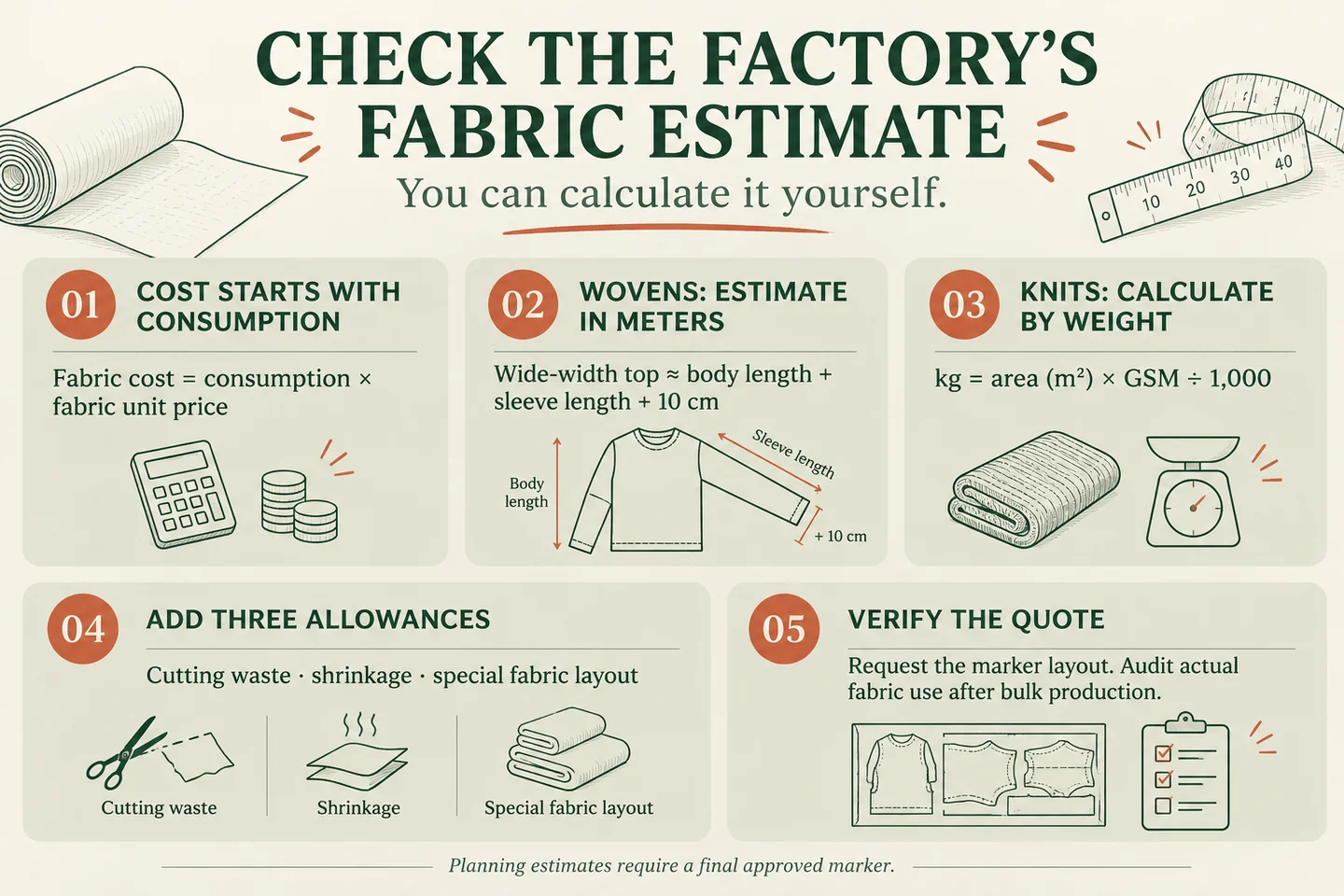
Suppose 1,000 hoodies need 1.5 meters each on the agreed net basis. That gives 1,500 meters. If the quote adds 18% of net consumption, the order is 1,770 meters, or roughly 1,800 meters for planning. The example’s 18 percentage points come from 5 for finishing, 2 for inspection, 8 for cutting and 3 for production reserve.
If those percentages are instead losses from the input to each successive stage, divide 1,500 by 0.95 × 0.98 × 0.92 × 0.97. The result is about 1,806 meters. Ask which method the quote uses and whether the 1.5 meters already includes marker gaps. Adding them twice inflates the order.
Why Cutting Loss Changes With the Garment
A basic T-shirt marker has a different job from a multi-panel dress marker. Narrow usable width can make the same pattern harder to nest. Stripe and check matching, one-way prints and bias cutting limit how freely pieces can be turned or moved. The supplied notes suggest another 2–8% for narrow fabric or 2–5% for stripe and check matching in some cases. Treat these as planning examples and ask the factory to show how the constraints affect your marker.
| Garment | Example cutting loss |
|---|---|
| Basic T-shirt | 5–8% |
| Standard hoodie | 6–10% |
| Fitted leggings | 8–12% |
| Yoga apparel or color-blocked sets | 12–18% |
| Multi-panel dresses or jackets | 15–20% |
Why Factories Include a Fabric Reserve
Actual width, weight, shrinkage and defects may become clear only after the fabric arrives. The factory may also need recuts to meet the agreed visual standard or replace panels after an approved repair. Replacement lots can differ in shade, weight or hand, so substitutions need approval and may require a revised marker.
The original factory example allows a 5–8% buffer. Ask what events it covers, which costs are already in the base consumption and what happens to unused fabric. For buyer-supplied fabric, agree how the mill and factory will record incoming quantities, defects and recuts. Those records help resolve whether an overage came from the material or the process.
What Happens When the Quote Cuts the Allowance but the Marker Stays the Same
Lowering the allowance on paper leaves the marker’s material requirement in place. The shortage may show up as a request for extra fabric, change charges, delayed cutting or fewer finished units. A late attempt to make the fabric stretch further can also compromise matching or approved construction. Ask the factory to show what changed in the marker, specification or order plan when it offers a lower allowance.
Three Checks Before You Accept the Factory Quote
Agree the calculation basis in writing. State whether the percentage is added to net consumption or deducted from input, which stages it covers, who supplies the fabric, who pays for overruns and who owns the balance.
Review the approved marker once. Marker efficiency is the area of the pattern pieces divided by marker length times usable marker width, multiplied by 100. An 85% marker leaves 15% of its area unoccupied by pieces. That is a marker figure. Roll ends and inspection losses need their own accounting. Compare markers at the same width, size mix and matching constraints. [1]
Give the factory a stable order plan. A confirmed size mix and sufficient volume can give the marker planner more combinations to work with. Lock the fabric width, pattern and matching rules before bulk so the factory can quote from a trial marker instead of estimating every variable.
A useful line for the purchase order is “Please state the consumption basis and who covers any overrun, and send the approved marker for review.”
Sources
YOUR NEXT STEP
Put the details to work.
Estimate an order or turn your specifications into a supplier inquiry.