Do Non-Iron Shirts Really Need Ironing?
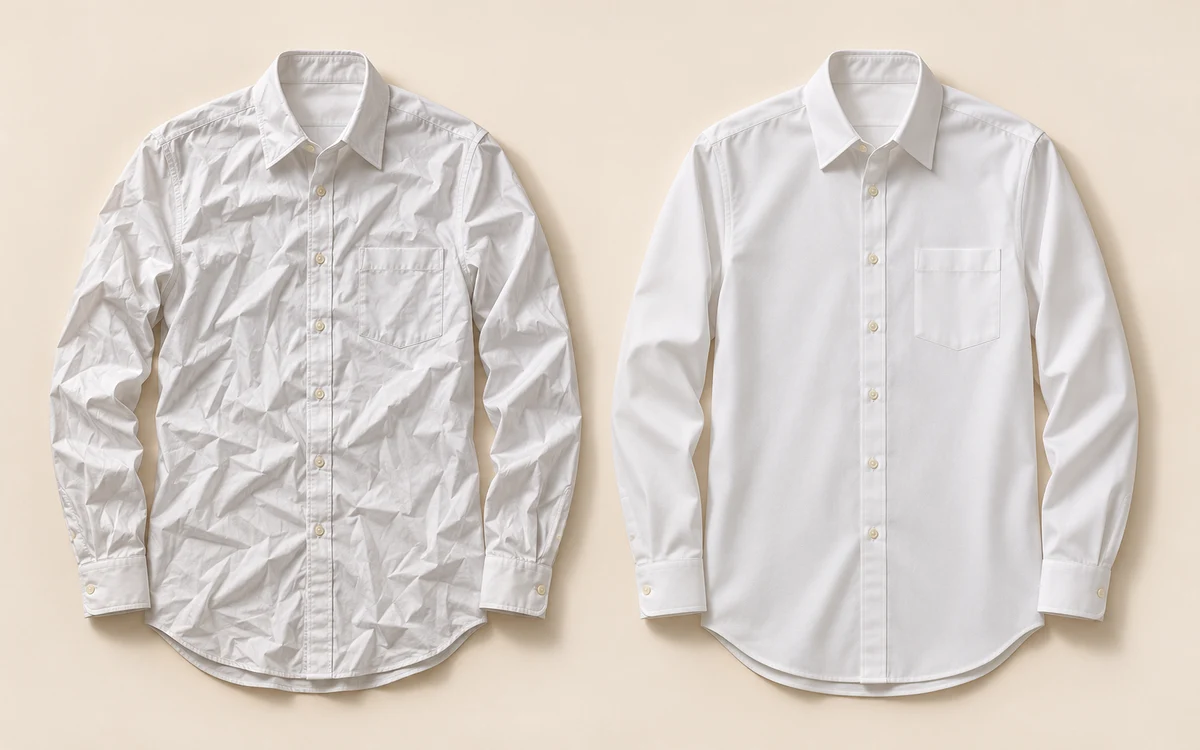
A CNY 99 shirt and a CNY 599 shirt can both say “non-iron.” Whether either can go straight from the hanger to work depends on how smooth the finished shirt stays after washing and drying. Finishing matters alongside the cotton fabric, seam construction and care routine. Ask how the shirt performs after repeated washes, especially at the collar, cuffs and placket.
Resin vs. Liquid Ammonia Finishing for Cotton Shirts
A durable press resin such as DMDHEU forms crosslinks between cellulose chains during curing. These links restrict movement and help the fabric recover from creasing. The finish can also reduce breaking and tear strength, and DMDHEU-based formulations can contribute to measurable formaldehyde in the finished product. Strength retention and formaldehyde depend on the formulation, application and cure.
Liquid ammonia swells cotton and can change fiber shape and cellulose structure, including partial conversion from cellulose I to cellulose III depending on the treatment. The ammonia stage can improve softness and abrasion performance in some constructions. It does not itself apply a durable press crosslinker. Mills may follow it with moist crosslinking to improve wash smoothness while balancing strength and hand. The combined process still uses crosslinking chemistry. [1][2]
The figures below come from the supplied comparison. They illustrate the trade-offs a mill might investigate. The notes do not specify matched fabric constructions, test conditions or comparable lab reports.
| Parameter | Resin durable press | Liquid ammonia + moist crosslinking |
|---|---|---|
| Mechanism | Cellulose crosslinking | Cotton swelling and structural modification followed by crosslinking |
| Smoothness grade | 3.0–3.5 | 3.5–4.0 |
| Breaking strength retained | 60–75% | 80–90% |
| Tear strength retained | 50–70% | 75–90% |
| Formaldehyde examples | ≤75 mg/kg | ≤20 mg/kg |
| Hand | Can feel firmer | Can feel softer and more flexible |
| Air permeability | May decline | Check on matched fabric |
| Appearance after 20 washes | The notes describe a decline | The notes describe better retention |
| Processing cost | Generally simpler processing | Additional equipment and processing stages |
What Can You Learn From a Shirt’s Price?
The supplied examples use CNY 99–199, 200–500 and above 500 to illustrate price differences. A lower-priced shirt may use fabric finished before cutting, while a garment-level finish is applied after sewing. Some higher-priced shirts use liquid ammonia plus moist crosslinking. Any price tier can contain different finishing routes. Fabric, construction, labor and retail markup also affect price. Ask the seller to identify the finish and show the wash results for that shirt.
How to Compare Non-Iron Shirts Before Buying
First, compare smoothness grades at the same wash count and under the same drying procedure. AATCC TM124 evaluates fabric smoothness after home laundering. TM143 covers apparel and other finished textile products. A higher smoothness grade indicates a flatter appearance under that procedure. A grade around 3.5 may suit everyday wear, depending on how crisp you expect the shirt to look. [3][4]
Second, check hand and the sewn garment. Softness alone cannot identify a finish. Inspect the collar, cuffs, placket and seams after laundering. Third, ask for the finished product’s formaldehyde test result. The supplied GB 18401–2010 limits are 20 mg/kg for Category A, 75 for B and 300 for C. These are category limits rather than expected results for either finish. Check the applicable category and rules for the intended market and product. [5]
| Buying cue | Conventional resin example | Liquid ammonia + moist crosslinking example |
|---|---|---|
| Smoothness grade | 3.0–3.5 | 3.5–4.0 |
| Hand | Firmer in some examples | Softer in some examples |
| Formaldehyde | Request finished-shirt result | Request finished-shirt result |
| Price examples in the notes | CNY 100–300 | Above CNY 500 |
| After 10 washes | The notes describe visible creasing | The notes describe a smoother appearance |
| Label wording | Non-iron or wrinkle-resistant | Liquid ammonia or liquid ammonia + moist crosslinking |
When Can You Skip Ironing?
A shirt that dries smooth enough for your use can go straight onto a hanger. One that scores around 3.0 may still need a quick touch-up at the collar or cuffs. If paying more for a non-iron shirt, look for a finished-garment report after the intended number of washes, plus results for strength retention and formaldehyde where relevant. For bulk buying, compare finished samples side by side under the same wash and dry routine.
Sources
YOUR NEXT STEP
Put the details to work.
Estimate an order or turn your specifications into a supplier inquiry.